
Pest Control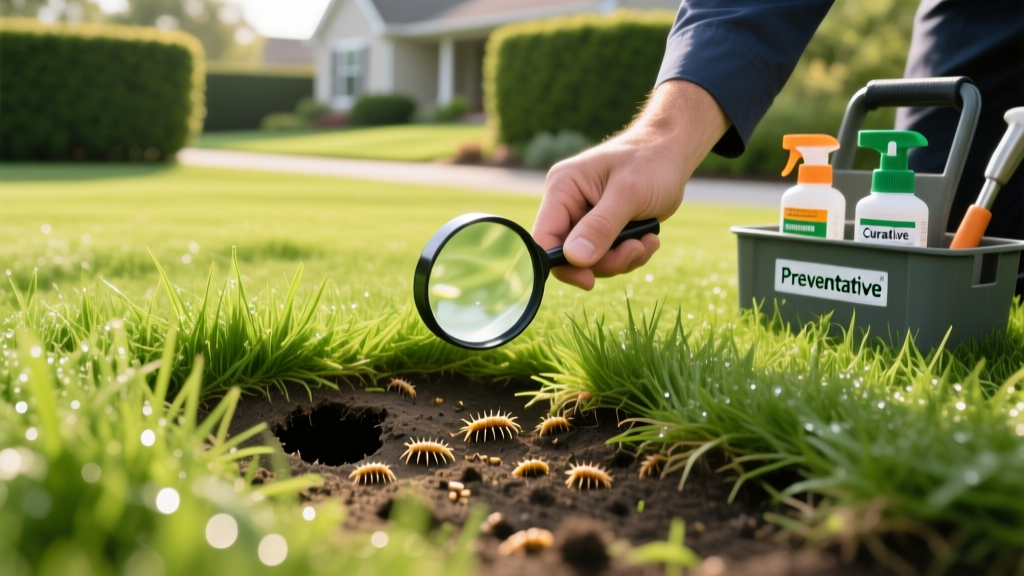
Choosing a Grub Insecticide for Lawns: Preventative vs Curative Guide
The Economic Threshold: When to Treat for White Grubs
Not every white grub sighting warrants a chemical intervention. Turfgrass entomologists universally agree that a healthy, well-fertilized lawn can tolerate a baseline grub population without showing visible damage. The established economic threshold for treatment is 5 to 10 grubs per square foot. Before purchasing any grub insecticide for lawns, you must perform a physical soil count. Using a square-edged spade, cut a 1-foot by 1-foot section of turf, peel it back, and count the C-shaped larvae in the top 3 inches of the soil profile. If you find fewer than 5 grubs per square foot, cultural practices like proper irrigation and nitrogen management will outcompete the damage. If you exceed 8 to 10 grubs per square foot, targeted chemical intervention is required to prevent total root system decimation and secondary damage from foraging raccoons and skunks.
Preventative Grub Insecticide for Lawns: The Long Game
Preventative treatments are the cornerstone of modern integrated pest management (IPM) for turfgrass. These products are applied before grub eggs hatch, targeting the vulnerable first and second instar larvae. Because they rely on systemic uptake or prolonged soil residual, timing is dictated by soil temperature, not the calendar. Preventatives must be applied when the soil temperature at a 2-inch depth consistently reaches 55°F to 60°F, which typically aligns with late May through early July, depending on your USDA hardiness zone.
Active Ingredient Breakdown
According to Penn State Extension, the most effective preventative chemistries belong to the neonicotinoid and anthranilic diamide classes. Here is how the leading active ingredients compare in real-world turf scenarios:
| Active Ingredient | Common Brand | Cost per 1,000 sq ft | Residual Window | Pet & Pollinator Safety |
|---|---|---|---|---|
| Chlorantraniliprole | Acelepryn | $12.00 - $15.00 | 120+ days | High (Safe for bees, low mammalian toxicity) |
| Imidacloprid | Merit 0.5G | $4.00 - $6.00 | 90 - 120 days | Moderate (Toxic to bees if applied to blooming weeds) |
| Clothianidin | Arena 0.25G | $8.00 - $11.00 | 90 - 120 days | Moderate (Requires strict pollinator precautions) |
| Dinotefuran | Zylam | $9.00 - $12.00 | 60 - 90 days | Moderate (Fast uptake, lower soil binding) |
Pro-Tip: Chlorantraniliprole Requires Patience
Unlike older neonicotinoids, Chlorantraniliprole (Acelepryn) is highly lipophilic and moves very slowly through the soil profile. It requires 60 to 90 days to fully translocate into the root zone. Therefore, it must be applied in early spring (April to early May) to be effective against mid-summer hatches. If you apply it in late June, it will not protect your lawn in August.
Curative Grub Insecticide for Lawns: The Emergency Rescue
If you missed the preventative window and your lawn is showing signs of severe stress—spongy turf that rolls back like a carpet due to severed roots—you need a curative grub insecticide for lawns. Curative products are contact insecticides designed to kill large, third-instar grubs rapidly. They have very short soil residuals (often less than 14 days) and degrade quickly.
The Trichlorfon pH Dilemma
Trichlorfon (sold as Dylox 6.2G) is the gold standard for curative grub control, capable of killing mature grubs within 48 to 72 hours. However, it suffers from a severe chemical limitation: rapid alkaline hydrolysis. If your soil pH is above 7.0, Trichlorfon degrades exponentially faster. In soils with a pH of 8.0, the active ingredient can break down completely within 24 hours, rendering the application useless. Before applying Dylox, test your soil pH. If it is highly alkaline, you must switch to Carbaryl (Sevin), which is less effective against large grubs but more stable in high-pH soils, or consider a liquid application of a fast-acting pyrethroid like Bifenthrin, though pyrethroids struggle to penetrate the thatch layer.
Curative Application Protocol
- Remove Thatch: Curative granules must reach the soil surface. If your thatch layer exceeds 0.5 inches, rent a power rake or dethatcher first. Granules trapped in thatch will never reach the grubs.
- Apply at Maximum Label Rate: Third-instar grubs have thick exoskeletons and high fat reserves. Apply Trichlorfon at the absolute maximum curative rate listed on the label (typically 3 to 4 lbs per 1,000 sq ft).
- Immediate Watering: You must irrigate the lawn with at least 0.5 inches of water immediately after application to wash the active ingredient off the grass blades and into the top 2 inches of soil where the grubs are feeding.
- Expect a Second Pass: Curative treatments rarely achieve 100% mortality on large grubs. Plan to apply a preventative (like Imidacloprid) the following spring to break the life cycle.
Environmental Safeguards and Pollinator Protection
The intersection of turf management and environmental stewardship requires strict adherence to pollinator protection protocols. Neonicotinoid preventatives like Imidacloprid and Clothianidin are highly toxic to bees if they contact the chemical directly or forage on treated nectar. Lawns often contain broadleaf weeds like white clover and dandelions that bloom during the early summer application window.
According to research published by Michigan State University Extension, you must mow the lawn immediately before applying a neonicotinoid grub insecticide. Mowing removes the flower heads of blooming weeds, eliminating the food source that would attract bees to the treated area. Alternatively, transitioning to Chlorantraniliprole (Acelepryn) entirely bypasses this issue, as it belongs to a chemical class that is virtually non-toxic to adult bees and beneficial insects, making it the premier choice for eco-conscious turf managers.
Warning: Secondary Poisoning Risks
Applying curative insecticides late in the fall when grubs are migrating deeper into the soil profile often results in surface-level chemical pooling. This not only fails to kill the grubs but leaves toxic residues on the surface that can harm foraging birds and earthworms. Never apply curative treatments after the first hard frost; the grubs are already dormant below the frost line and out of reach.
Post-Treatment Recovery and Root Regeneration
Killing the grubs is only half the battle. Once the insecticide has done its job, the severed root system must be rehabilitated. Apply a fast-release nitrogen fertilizer (such as urea at 0.5 lbs of nitrogen per 1,000 sq ft) to stimulate rapid shoot and root growth. Increase irrigation frequency to keep the top 1 inch of soil consistently moist, compensating for the damaged root system's reduced water uptake capacity. Core aeration and overseeding with a resistant turfgrass cultivar, such as tall fescue or specific endophyte-enhanced perennial ryegrasses, should be scheduled for early fall to restore turf density and naturally deter future insect feeding.

