
Pest Control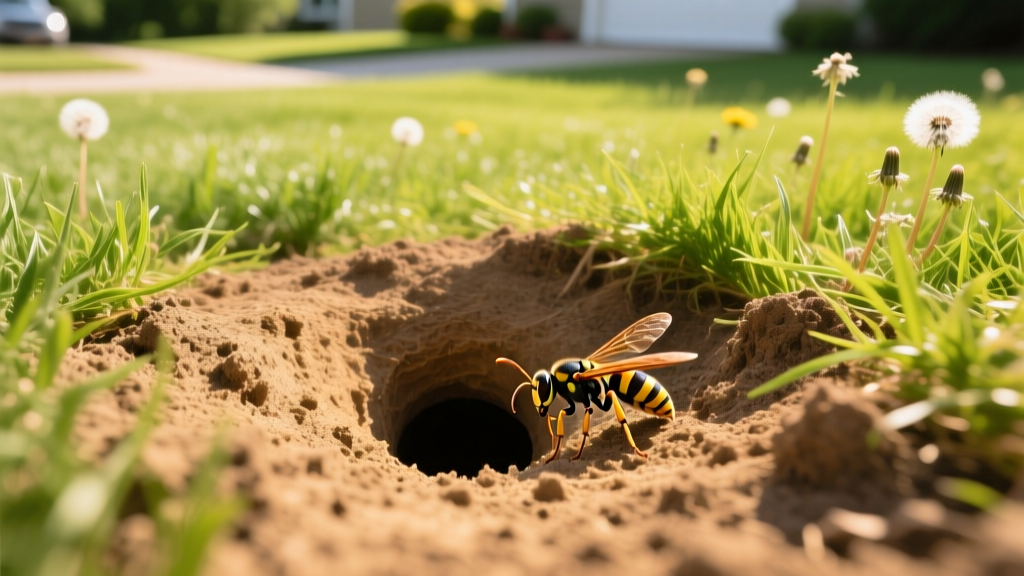
How to Treat and Prevent a Cicada Killer Nest in Ground
The Architecture of a Cicada Killer Nest in Ground
The Eastern cicada killer (Sphecius speciosus) is the largest solitary wasp in North America, frequently measuring between 1.5 and 2 inches in length. Despite their intimidating size and loud, low-frequency flight patterns, their ground-nesting habits are what truly disrupt residential landscapes. Identifying a cicada killer nest in ground requires understanding their specific excavation mechanics.
Unlike social yellowjackets that build massive subterranean hives, cicada killers are solitary. Each female digs her own individual burrow to provision her offspring. The entrance hole is precisely 1/2-inch to 3/4-inch in diameter. As the female excavates, she kicks loose soil out of the tunnel, creating a distinct U-shaped or horseshoe-shaped dirt mound that typically stands 2 to 4 inches high and spans 4 to 6 inches across. The main shaft descends vertically for 6 to 12 inches before branching into three or four lateral cells, where she deposits paralyzed cicadas and a single egg on each.
Threat Assessment: Are They Dangerous?
Male cicada killers are highly territorial and will aggressively dart at humans who walk near their nesting zones. However, males lack stingers and are physically incapable of harming you. Females possess a large stinger but are remarkably docile. According to the University of Florida IFAS, a female will almost never sting unless she is stepped on barefoot or forcibly squeezed in a hand. The primary threat they pose is aesthetic and structural damage to turfgrass, not human envenomation.
Why Liquid Insecticides Fail in Burrows
A common mistake homeowners make when treating a cicada killer nest in ground is spraying liquid aerosol wasp killers directly into the hole. This approach fails almost 90% of the time due to soil mechanics. Cicada killers specifically target well-drained, sandy, or loamy soils with sparse vegetation. When you spray a liquid insecticide into these porous tunnels, the liquid rapidly percolates downward and dissipates into the surrounding soil matrix, leaving the lateral nesting chambers untreated.
Furthermore, the female wasp does not linger at the entrance. She flies in, drops her prey, and exits. To achieve a lethal transfer, you must use a residual insecticidal dust. When the wasp enters the treated tunnel, the microscopic dust particles cling to the setae (hairs) on her legs and abdomen. She inadvertently carries the dust deep into the lateral chambers, grooming it off later and ingesting a lethal dose, while also coating the developing larvae.
Step-by-Step Eradication Protocol
To successfully eliminate an active cicada killer nest in ground, timing and application technique are critical. Follow this precise protocol for maximum efficacy.
Step 1: Time the Application for Dusk
Cicada killers are diurnal. During the day, females are actively hunting cicadas in nearby trees, and males are patrolling the airspace. Wait until 9:00 PM or later, when all wasps have retreated into their burrows for the night and ambient temperatures drop below 70°F.
Step 2: Select the Correct Dust and Tool
As of 2026, the industry standard for burrowing wasps is DeltaDust (0.05% Deltamethrin), which retails for approximately $28 per 1-pound container. It is highly moisture-resistant, making it ideal for subterranean use. For an organic alternative, food-grade Diatomaceous Earth (DE) costs around $15, though it requires reapplication after heavy rain. You will also need a bellows hand duster (such as the JT Eaton model, ~$22) to inject the dust deep into the shaft without clogging.
Step 3: Inject and Retreat
Approach the nest slowly with a red-lens flashlight (wasps cannot see red light well). Insert the duster nozzle about one inch into the entrance hole. Give the bellows two to three firm puffs to coat the interior walls. Do not overfill the hole; a light coating is all that is required.
Step 4: Leave the Hole Open
Do not plug the entrance with dirt or a rock. Plugging the hole forces the wasp to dig a secondary exit, bypassing the treated zone entirely. Leave the entrance open so the wasps track the dust into the nest. The colony will collapse within 48 to 72 hours.
Treatment Matrix: Chemical vs. Organic Dusts
| Product Type | Active Ingredient | Avg. Cost (2026) | Speed of Kill | Pet/Child Safety Post-Settle |
|---|---|---|---|---|
| Synthetic Dust | Deltamethrin (DeltaDust) | $28 / lb | 24 - 48 hours | Safe once dust settles in burrow |
| Carbamate Dust | Carbaryl (Sevin Dust) | $12 / lb | 12 - 24 hours | Moderate toxicity; keep pets away |
| Organic Desiccant | Silica / DE (Food Grade) | $15 / 4 lbs | 3 - 5 days | Completely safe for mammals |
Long-Term Turf Defense Strategy
Eradicating the current nest is only a temporary fix. According to Penn State Extension, cicada killers are opportunistic site selectors. They specifically seek out lawns with three characteristics: sparse turf canopy, well-drained sandy soil, and full sun exposure. To permanently prevent a cicada killer nest in ground from reappearing next July, you must alter the micro-environment of your lawn.
1. Achieve 85% Turf Density
Female cicada killers will not excavate through a thick mat of grass roots and dense blades. If your lawn has bare patches or thinning areas, core aerate in the early fall and overseed with aggressive, rhizomatous grass species. For cool-season zones, use a blend heavy in Kentucky Bluegrass (Poa pratensis). For warm-season zones, Zoysia or dense Bermuda grass cultivars create an impenetrable root mat that deters burrowing.
2. Implement Deep Root Irrigation
Cicada killers prefer dry, easily excavated soil. Shallow, frequent watering keeps the top two inches of soil moist but leaves the deeper layers dry and diggable. Transition to a deep, infrequent watering schedule. Apply 1 to 1.5 inches of water per week in a single session. This forces grass roots deeper and keeps the 6-to-12-inch soil profile too wet and heavy for the wasps to excavate without tunnel collapse.
3. Top-Dress with Organic Matter
If your soil is heavily compacted sand, top-dress the lawn with a 1/4-inch layer of compost in the spring. This increases the soil's water-retention capacity and alters the texture, making it less appealing for nesting. Over time, this builds a loamy topsoil layer that supports thick grass but frustrates burrowing insects.
Frequently Asked Questions
Will filling the hole with water drown the nest?
No. The lateral chambers are elevated slightly above the main shaft in many instances, and the sandy soil absorbs water rapidly. Flooding the hole usually just results in muddy grass and an angry, displaced wasp digging a new exit nearby.
Do cicada killers reuse the same nest year after year?
The original female dies in late autumn. Her offspring overwinter in the lateral cells as prepupae and emerge the following summer. While the offspring may emerge from the exact same hole, they typically dig their own fresh lateral chambers. However, a highly favorable nesting site will attract multiple generations and neighboring females, leading to massive aggregations of 50+ nests in a single yard.
Is professional extermination necessary?
For minor infestations (under 10 nests), DIY dusting is highly effective and costs under $50. If your property borders a wooded area and you are dealing with 50 or more active mounds, professional pest control remediation is recommended. In 2026, professional subterranean wasp treatments typically range from $175 to $350, depending on property size and accessibility.

