
Pest Control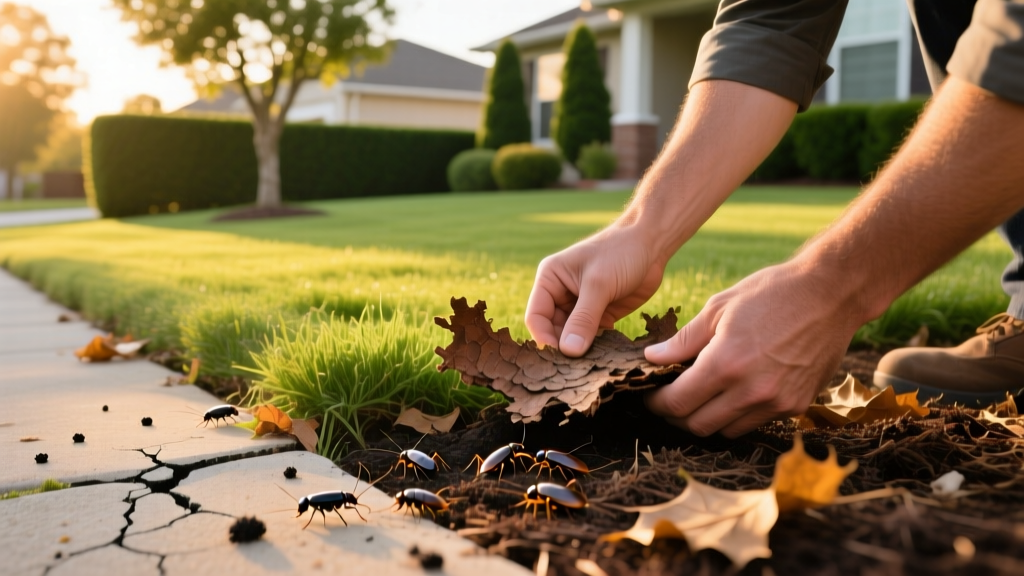
How to Combat Roaches: Yard Perimeter Defense Strategy
Most homeowners make a critical error when dealing with cockroach infestations: they focus entirely on the kitchen and bathrooms. While German cockroaches thrive indoors, the largest and most aggressive species—American, Smokybrown, and Oriental cockroaches—breed in your yard, mulch beds, and sewer lines. If you want to know how to combat roaches effectively, you must establish an exterior perimeter defense before they migrate inside. Treating the interior without securing the yard is a temporary fix that guarantees recurring infestations.
According to Texas A&M AgriLife Extension, outdoor cockroach populations explode in late summer and early autumn as they seek shelter from dropping temperatures. A proactive, multi-tiered yard defense strategy disrupts their breeding cycle and eliminates colonies at the source.
Identifying Your Outdoor Adversary
Different species require slightly different habitat modifications. Correct identification dictates your moisture management and bait placement strategy.
| Species | Average Length | Primary Yard Habitat | Key Identifier |
|---|---|---|---|
| American (*Periplaneta americana*) | 1.5 - 2.0 inches | Sewer lines, damp mulch, woodpiles | Yellowish figure-8 pattern on pronotum |
| Smokybrown (*Periplaneta fuliginosa*) | 1.25 - 1.5 inches | Tree holes, roof shingles, dense ivy | Uniform dark mahogany color, strong fliers |
| Oriental (*Blatta orientalis*) | 1.0 - 1.25 inches | Crawlspaces, leaf litter, stone walls | Glossy black/dark brown, cannot fly |
The 3-Tier Perimeter Defense Strategy
Eradicating outdoor colonies requires combining environmental modification with targeted chemical applications. Broadcast spraying repellent pesticides is an outdated practice that merely pushes roaches deeper into your yard or forces them inside through weep holes.
Tier 1: Habitat and Moisture Modification
Cockroaches require high humidity to survive. The University of Florida IFAS notes that American cockroaches will die within days without access to a water source. Altering your yard's microclimate is your first line of defense.
- Mulch Depth: Cap organic mulch at 2 inches thick. Pull mulch back at least 6 inches from your home's foundation to create a dry, exposed soil barrier.
- Irrigation Timing: Switch sprinkler systems to run at dawn rather than dusk. Evening watering creates the damp, dark conditions roaches need to forage safely at night.
- Woodpile Elevation: Store firewood on metal racks at least 18 inches off the ground and 20 feet away from the house. Never stack wood directly on soil.
- Gutter Maintenance: Clear decaying leaves from gutters. Smokybrown roaches frequently breed in the damp detritus of clogged gutter systems before migrating to the attic.
Warning: Avoid Pyrethroid Broadcast Sprays
Using cheap, big-box store bifenthrin or permethrin sprays across your entire lawn creates a repellent barrier. Roaches will detect the chemical, avoid the treated grass, and funnel directly toward the untreated gaps around your doors and utility penetrations. Always use non-repellent transfer chemicals for perimeter defense.
Tier 2: Non-Repellent Liquid Barriers
Instead of repelling roaches, non-repellent insecticides allow them to walk over the treated surface, pick up a lethal dose, and return to the colony, spreading the active ingredient through feces and physical contact (the transfer effect).
Tier 3: Insect Growth Regulators (IGRs)
IGRs do not kill adult roaches; they mimic juvenile hormones, causing nymphs to develop twisted wings and preventing them from reaching reproductive maturity. This breaks the breeding cycle within 30 to 60 days.
2026 Professional Product Loadout
To execute this strategy, skip the consumer-grade aerosols. The following professional formulations are the current industry standard for outdoor perimeter defense.
- Alpine WSG (Dinotefuran 40%): A water-soluble granule non-repellent. Highly effective against outdoor peridomestic species. Cost: ~$45 for a box of ten 10g packets.
- Gentrol IGR Concentrate (Hydroprene 9%): Mixes directly with Alpine WSG to provide both immediate colony transfer-kill and long-term reproductive disruption. Cost: ~$30 per 8 oz bottle.
- Advion Insect Granule Bait (Indoxacarb 0.22%): A highly palatable granular bait designed specifically for outdoor broadcast and mulch-bed placement. Resists mold and moisture degradation better than gel baits. Cost: ~$35 per 25 lb bag.
Step-by-Step Application Protocol
Execute this protocol in early spring and repeat in late summer. Ensure no rain is forecast for at least 24 hours post-application.
- Mix the Liquid Barrier: In a 1-gallon pump sprayer, combine 1 packet (10g) of Alpine WSG and 1 ounce of Gentrol IGR with 1 gallon of water. Agitate thoroughly until the WSG is fully dissolved.
- Apply the Foundation Band: Spray a continuous band 3 feet up the foundation wall and 3 feet out onto the soil/mulch. Focus heavily on weep holes, utility penetrations, and door thresholds. Apply at roughly 40 PSI using a fan-nozzle tip.
- Broadcast the Granular Bait: Once the liquid barrier is dry (approx. 2 hours), broadcast Advion Insect Granules into mulch beds, leaf litter zones, and around tree bases at a rate of 1.15 lbs per 1,000 square feet.
- Treat Sewer and Drain Vents: American cockroaches use municipal sewer lines as highways. Remove the grate from exterior cleanouts and sidewalk drains, and apply a light dusting of granular bait or a targeted spray of the Alpine/Gentrol mixture inside the upper rim.
Troubleshooting: Why Your Perimeter Defense Might Fail
If you are still seeing large outdoor roaches migrating indoors after 14 days, consult this diagnostic matrix to identify the failure point.
| Symptom | Probable Cause | Corrective Action |
|---|---|---|
| Roaches found dead right at the doorway thresholds. | Using a repellent pesticide (like Bifenthrin) instead of a non-repellent. | Wash the threshold with soap and water to remove repellent residue. Reapply Alpine WSG. |
| Live roaches still active in deep mulch beds after 3 weeks. | Granular bait degraded due to heavy irrigation or UV exposure. | Rake back the top layer of mulch, apply fresh Advion Granules, and lightly cover them to protect from direct sunlight and sprinklers. |
| High Smokybrown activity near rooflines and gutters. | Perimeter foundation spray does not reach aerial nesting sites. | Extend the liquid spray to the eaves, fascia boards, and directly into tree hollows where Smokybrowns harbor. |
| Nymphs (babies) are present, but no dead adults. | IGR is working, but initial adult population was not knocked down. | Ensure your liquid non-repellent mix rate was correct. Add a localized flush-out using a botanical contact spray (like Essentria IC3) strictly in non-perimeter hiding spots. |
Frequently Asked Questions
Will outdoor roach treatments harm my lawn or pollinators?
When applied correctly as a targeted foundation band and subsurface mulch bait, the risk to pollinators is negligible. Avoid spraying Alpine WSG directly onto blooming flowers or pollinator-attractive weeds. Granular baits placed beneath mulch are entirely inaccessible to foraging bees.
How do outdoor roaches impact indoor health?
Peridomestic roaches are significant mechanical vectors. The Centers for Disease Control and Prevention (CDC) highlights that cockroaches carry pathogens like Salmonella and E. coli on their bodies from sewers and decaying matter into your home. Furthermore, their shed skins and feces contain potent allergens that can trigger severe asthma attacks, particularly in children.
Can I use gel bait outdoors instead of granules?
Gel baits (like Advion Cockroach Gel) are highly effective indoors but perform poorly outdoors. UV radiation, rain, and high humidity cause gel baits to dry out, mold, or wash away within 48 to 72 hours. Always use moisture-resistant granular baits for exterior yard defense.

