
Pest Control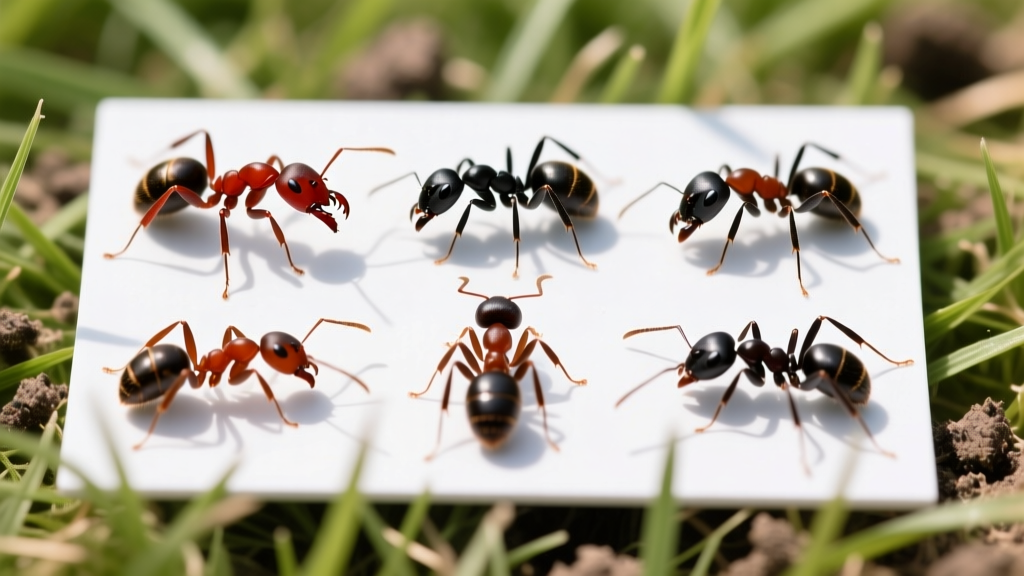
Identifying 7 Common Types of Ants Destroying Your Lawn
The Hidden Cost of Ant Mounds in Turfgrass
While ants provide minor ecological benefits like soil aeration and predation on other insects, unchecked colonies devastate residential lawns. Large mounds smother turfgrass, alter soil hydrology, and dull mower blades, leading to uneven cuts and mechanical damage. More critically, certain species inject formic acid into the root zone or strip vegetation entirely to expand their nesting territory. Effective eradication requires precise species identification; applying a generic contact insecticide to a multi-queen colony will trigger 'budding,' splitting the colony into several satellite nests and multiplying your problem.
Visual Identification Matrix: 7 Common Lawn Ant Species
Use the following matrix to cross-reference the physical characteristics and lawn damage patterns of the most prevalent turf-invading ants in North America.
| Species | Mound Profile | Worker Size | Primary Lawn Threat |
|---|---|---|---|
| Red Imported Fire Ant (Solenopsis invicta) | Fluffy, unstructured soil; up to 18" high | 1/8" to 1/4" | Aggressive stinging; massive mound volume smothering grass |
| Allegheny Mound Ant (Formica exsectoides) | Firm, cratered mounds up to 3 feet high | 1/4" to 1/2" | Injects formic acid, killing grass in a wide radius |
| Harvester Ant (Pogonomyrmex spp.) | Flat, gravel-covered craters; cleared perimeter | 1/4" to 1/2" | Strips all vegetation within a 3-foot radius of the nest |
| Argentine Ant (Linepithema humile) | No distinct mounds; shallow subterranean networks | 1/16" to 1/8" | Supercolonies displace native species; protect aphids on ornamentals |
| Carpenter Ant (Camponotus pennsylvanicus) | No soil mounds; sawdust-like frass near wood | 1/4" to 1/2" | Nests in dead tree roots and landscape timbers under the lawn |
| Pavement Ant (Tetramorium caespitum) | Small soil craters along hardscape edges | 1/10" to 1/8" | Undermines patio pavers, walkways, and driveway edges |
| Field Ant (Formica spp.) | Low, broad mounds often thatched with grass clippings | 1/8" to 3/8" | Mounds interfere with mowing; farms root-feeding mealybugs |
Deep Dive: The Big Three Turf Destroyers
1. Red Imported Fire Ants (RIFA)
According to the University of Florida IFAS Extension, RIFA is the most destructive lawn pest in the southern United States. Unlike field ants, fire ants do not create a central entrance hole on their mounds. If you poke the mound with a stick and thousands of reddish-brown ants immediately swarm the stick, you have RIFA. Their mounds are notoriously difficult to mow over; the hardened clay interior can dent mower decks and snap blades.
2. Allegheny Mound Ants
Prevalent in the Northeast and Midwest, these ants construct some of the largest mounds in North America. The Penn State Extension notes that while they are often confused with carpenter ants due to size, Allegheny mound ants are strictly soil-nesting. Their most devastating lawn impact is chemical: they spray formic acid into the soil to deter predators and clear competing vegetation, which rapidly drops the local soil pH and burns turfgrass roots, leaving large, irregular brown patches.
3. Harvester Ants
Common in arid and semi-arid western lawns, harvester ants are the only species that actively clear-cut the lawn. They will clip grass blades at the soil line and drag them away to expose the soil to the sun, which bakes the earth and creates an ideal microclimate for their brood. The resulting bare dirt circles can measure up to 6 feet in diameter and are highly resistant to reseeding as long as the colony remains active.
Species-Specific Eradication Protocols
Successful ant management relies on exploiting the colony's trophallaxis (food-sharing) behavior. Broadcasting fast-acting contact insecticides like Bifenthrin or Cypermethrin only kills the foraging workers (about 5% of the colony). The queen responds to this chemical stress by initiating reproductive swarms or colony budding. Instead, utilize slow-acting, non-repellent active ingredients.
⚠️ Warning: The Budding Effect
Never use liquid spray repellents (e.g., Ortho Home Defense containing Bifenthrin) on Argentine ants, Pharaoh ants, or multi-queen Fire Ant colonies. The chemical barrier stresses the colony, causing the queens to split the population into multiple new satellite nests, effectively turning one infestation into five.
Protocol A: Individual Mound Treatment (IMT) for Fire & Mound Ants
For large, distinct mounds, use a bait matrix containing Indoxacarb (0.04%). Indoxacarb is a pro-insecticide; it is biologically inactive until the ant's digestive enzymes metabolize it into the active DCJW compound. This delay ensures the foragers carry the bait deep into the mound and feed it to the queen before dying.
- Product Recommendation: Syngenta Advion Fire Ant Bait.
- Application Rate: 2 to 4 tablespoons evenly distributed in a 4-foot circle around the mound perimeter. Do not dump it directly on the apex of the mound, as this triggers a defensive sealing response.
- Cost Expectation: Approximately $45 for a box of 20 individual application packets (2026 retail pricing).
Protocol B: Broadcast Treatment for Supercolonies (Argentine & Pavement)
Because Argentine and Pavement ants do not build centralized mounds, IMT is useless. You must use a non-repellent liquid termiticide/insecticide that creates an invisible, toxic transfer zone.
- Active Ingredient: Fipronil (9.1%) or Dinotefuran (40%).
- Product Recommendation: BASF Termidor SC (Fipronil) or Alpine WSG (Dinotefuran).
- Application Rate: Mix 0.8 fl oz of Termidor SC per gallon of water. Apply as a coarse spray to the entire lawn surface or heavily infested zones, delivering 1 gallon per 1,000 square feet.
- Cost Expectation: A 20 oz bottle of Termidor SC retails for roughly $85 and treats up to 20,000 square feet.
The Sweet vs. Protein Baiting Decision Tree
Ant colonies cycle their nutritional requirements based on the brood development stage. If your bait is being ignored, you are likely offering the wrong macronutrient.
💡 Field Testing Trick
Before purchasing expensive commercial baits, place a drop of honey (carbohydrate) and a smear of peanut butter (protein/fat) on a piece of cardboard near an active foraging trail. Wait 20 minutes. The bait that attracts the most workers dictates the matrix you need to buy.
- Spring/Early Summer (Protein Demand): Colonies are producing brood (larvae). Larvae require protein to develop. Use granular baits with soybean oil or abamectin-infused protein pellets (e.g., Maxforce Complete Granular Bait).
- Mid-Summer/Fall (Carbohydrate Demand): Workers are foraging for energy to sustain the queen's egg-laying and to store winter reserves. Switch to sweet gel baits or sugar-based granular matrices (e.g., Optigard Ant Gel).
Why Your DIY Ant Treatments Failed
According to the Environmental Protection Agency (EPA), improper application timing is the leading cause of pest control failure among homeowners. Avoid these critical edge-case mistakes:
- Applying Bait to Wet Grass: Granular baits rely on the ant's olfactory receptors. If applied during morning dew or immediately after irrigation, the moisture degrades the pheromone trail and ruins the bait matrix within hours. Always apply to dry turf in the late afternoon.
- Disturbing the Mound: Sticking a shovel or rod into the mound before baiting triggers an alarm pheromone release. The colony will immediately relocate the queen deeper into the soil or to a secondary site, rendering surface-applied baits useless.
- Ignoring the Root Zone: For Field Ants and Harvester Ants that farm root-mealybugs, surface baiting may not reach the subterranean honeydew source. In these cases, a soil drench using a systemic insecticide like Imidacloprid (applied at 0.15 lbs per 1,000 sq ft) eliminates the ants' food source, forcing them to forage above ground where your toxic baits are waiting.
Preventative Lawn Care to Deter Nesting
Ants select nesting sites based on soil compaction, moisture, and thermal regulation. You can make your lawn inhospitable through specific cultural practices:
- Core Aeration: Ants prefer slightly compacted soil that holds the structural integrity of their tunnels. Annual core aeration disrupts the soil matrix, causing shallow tunnels to collapse during freeze-thaw cycles or heavy rains.
- Thatch Management: Keep the thatch layer under 0.5 inches. Thick thatch provides a dry, insulated environment that is highly attractive to Carpenter Ants looking to establish satellite colonies near the soil surface.
- Irrigation Calibration: Overwatered lawns with poor drainage create the exact moist, loamy soil profile that Argentine ants prefer. Adjust your smart controller to deliver 1 to 1.5 inches of water per week, split into deep, infrequent soakings to force grass roots deeper while drying out the top 2 inches of soil where ant larvae are typically housed.

