
Pest Control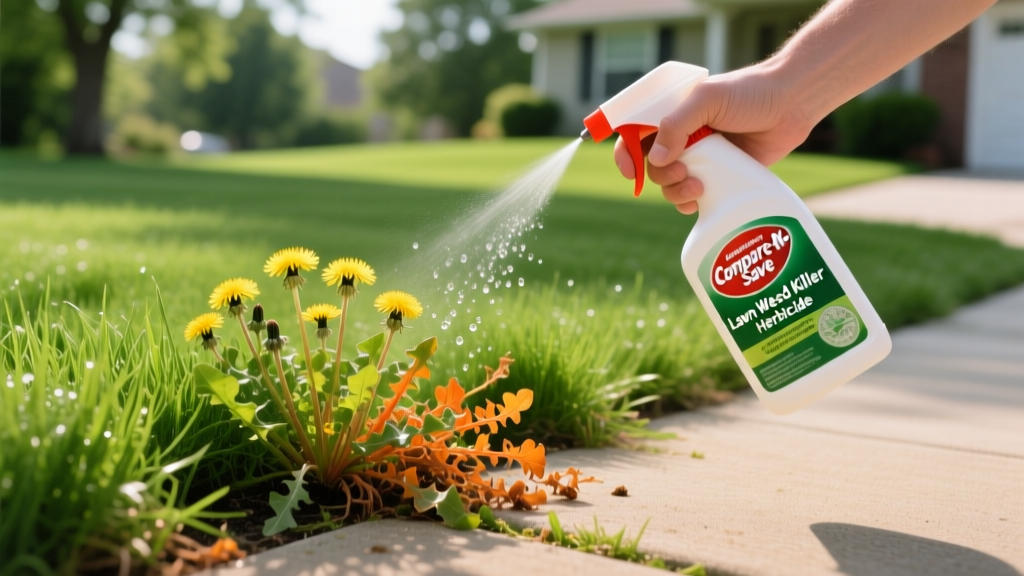
Spot-Treating Weeds With Compare-N-Save Lawn Weed Killer Herbicide
CRITICAL PRODUCT DISTINCTION: Compare-N-Save manufactures both non-selective (Glyphosate) and selective (2,4-D Amine) herbicides. For lawn spot-treatment, you MUST use the Compare-N-Save 2,4-D Amine or their specific 3-Way Broadleaf formula. Using their standard "Grass and Weed Killer" (Glyphosate) will permanently kill your turfgrass. Always verify the active ingredient on the label before mixing.
The Chemistry of Compare-N-Save 2,4-D Amine
Compare-N-Save lawn weed killer herbicide formulations designed for turf safety primarily rely on synthetic auxins, most notably 2,4-D (2,4-Dichlorophenoxyacetic acid). Unlike contact herbicides that burn foliage on impact, 2,4-D is a systemic herbicide. It mimics natural plant growth hormones, causing broadleaf weeds to undergo uncontrolled, unsustainable cellular division. This leads to vascular tissue collapse, nutrient starvation, and eventual plant death within 7 to 14 days.
According to the Environmental Protection Agency (EPA), 2,4-D is highly effective against dicotyledonous (broadleaf) plants but is largely metabolized and ignored by monocotyledonous plants (turfgrasses). However, achieving this selectivity requires precise calibration, correct dilution ratios, and the addition of a non-ionic surfactant (NIS) to breach the waxy cuticle of mature weeds.
Weed Species Susceptibility & Treatment Matrix
Not all broadleaf weeds respond identically to 2,4-D amine. While simple perennials like dandelions succumb quickly, complex perennials with rhizomatous root systems or thick cuticles require adjusted application strategies. The following matrix outlines expected control timelines and specific spot-treatment adjustments for common lawn weeds.
| Weed Species | Scientific Name | 2,4-D Susceptibility | Surfactant Requirement | Visible Control Time |
|---|---|---|---|---|
| Dandelion | Taraxacum officinale | High | Standard (0.25% v/v) | 7–10 Days |
| White Clover | Trifolium repens | Moderate | Standard (0.25% v/v) | 10–14 Days |
| Broadleaf Plantain | Plantago major | Moderate | High (0.5% v/v) | 14–21 Days |
| Wild Violet | Viola spp. | Low (Resistant) | Requires 3-Way Mix (Dicamba) | 21–28 Days |
| Common Chickweed | Stellaria media | High | Standard (0.25% v/v) | 5–7 Days |
For highly resistant species like Wild Violet or Ground Ivy, a straight 2,4-D Amine application will only cause temporary leaf cupping. You must upgrade to a 3-way herbicide containing Dicamba and MCPP, or tank-mix your Compare-N-Save 2,4-D with a separate Dicamba concentrate to achieve total root kill. For comprehensive identification and lifecycle data, refer to the NC State University TurfFiles weed database.
Precision Spot-Treatment Calibration Protocol
Broadcast spraying wastes chemical and increases the risk of turf phytotoxicity. Spot-treating with a 1-gallon or 2-gallon handheld pump sprayer delivers the active ingredient directly to the weed rosette. Follow this exact mixing and calibration sequence to prevent chemical lock-up and ensure optimal foliage penetration.
Step 1: Calculate the Mix Rate
For general broadleaf spot-treatment in established cool-season lawns (Fescue, Kentucky Bluegrass, Ryegrass), the standard dilution rate for 41% 2,4-D Amine is 2.5 fluid ounces per 1 gallon of water. This mixture will cover approximately 400 to 500 square feet when applied as a fine mist.
- Cool-Season Grasses: 2.5 fl oz per gallon.
- Warm-Season Grasses (Bermuda, Zoysia): Reduce to 1.5 fl oz per gallon to prevent temporary turf stunting.
Step 2: The W-A-L-E-S Mixing Order
Never dump all chemicals into an empty tank. Use the W-A-L-E-S protocol to prevent the amine from precipitating out of the solution:
- Water: Fill the sprayer tank halfway with clean water.
- Agitate: Swirl the tank gently.
- Liquid: Pour the measured 2.5 fl oz of Compare-N-Save 2,4-D Amine into the tank.
- Emulsifiable Concentrates: (Skip if using only amine).
- Surfactant: Add 0.5 teaspoons (approx. 2.5 ml) of a Non-Ionic Surfactant (NIS) per gallon. Do not use dish soap; the sodium in dish soap can bind with the amine and reduce efficacy.
Top off the tank with the remaining water, secure the lid, and pressurize to 40-45 PSI.
Pro-Tip: Nozzle Selection. Swap the standard cone nozzle on your pump sprayer for a flat fan tip (e.g., 8002 or 11002). A fan tip produces uniform droplets that coat the broadleaf weed's rosette without excessive runoff into the soil, where 2,4-D is rapidly degraded by microbes.
Turfgrass Tolerance & Phytotoxicity Risks
While 2,4-D is classified as selective, "selective" does not mean "immune." Certain warm-season turfgrasses lack the metabolic pathways to rapidly detoxify synthetic auxins, leading to severe phytotoxicity.
High-Risk Turfgrasses
Do not apply Compare-N-Save 2,4-D Amine to St. Augustinegrass or Centipedegrass. Exposure will cause severe leaf curling, chlorosis (yellowing), and prolonged stunting that can last up to 6 weeks. For these specific turf types, you must use an alternative active ingredient such as Atrazine or a specialized Quinclorac-based product labeled specifically for St. Augustine safety.
Environmental Variables & Drift Mitigation
Synthetic auxins are highly susceptible to volatilization (turning into a gas) and physical drift. To protect neighboring ornamental beds, vegetable gardens, and sensitive trees (like tomatoes, grapes, and redbuds), adhere to these strict environmental thresholds:
- Temperature Ceiling: Never apply when ambient temperatures exceed 85°F (29°C). Above this threshold, 2,4-D volatilizes and drifts invisibly, causing "epinasty" (twisted, deformed growth) on sensitive plants hundreds of feet away.
- Wind Speed: Apply only when winds are between 3 and 10 mph. Dead calm conditions often indicate a temperature inversion, which traps herbicide droplets near the ground and allows them to drift laterally as the inversion breaks.
- Rainfast Window: Compare-N-Save 2,4-D Amine requires a minimum of 2 hours to penetrate the leaf cuticle before rainfall. For maximum translocation to the root zone, a 6-hour dry window is optimal.
Troubleshooting Application Failures
If treated weeds exhibit leaf cupping but fail to die after 21 days, diagnose the failure using these common edge cases:
Failure Mode 1: Hard Water Lock-Up.
If your local water supply is high in calcium or magnesium (hard water), these positively charged ions will bind to the negatively charged 2,4-D amine molecules, rendering them inactive before they even reach the weed. Fix: Add 1 tablespoon of Ammonium Sulfate (AMS) per gallon of water to the tank before adding the herbicide to condition the water.
Failure Mode 2: Drought-Stressed Weeds.
Weeds shut down their vascular systems during severe drought to conserve water. Because 2,4-D relies on the phloem to translocate from the leaves down to the taproot, it will stall in the foliage of a drought-stressed plant. Fix: Irrigate the lawn deeply 24 hours before application to ensure the weeds are actively growing and translocating nutrients.
By strictly adhering to these mixing ratios, surfactant requirements, and environmental limits, Compare-N-Save lawn weed killer herbicide provides a highly economical, professional-grade solution for eradicating broadleaf weeds without damaging your established turf.

