
Pest Control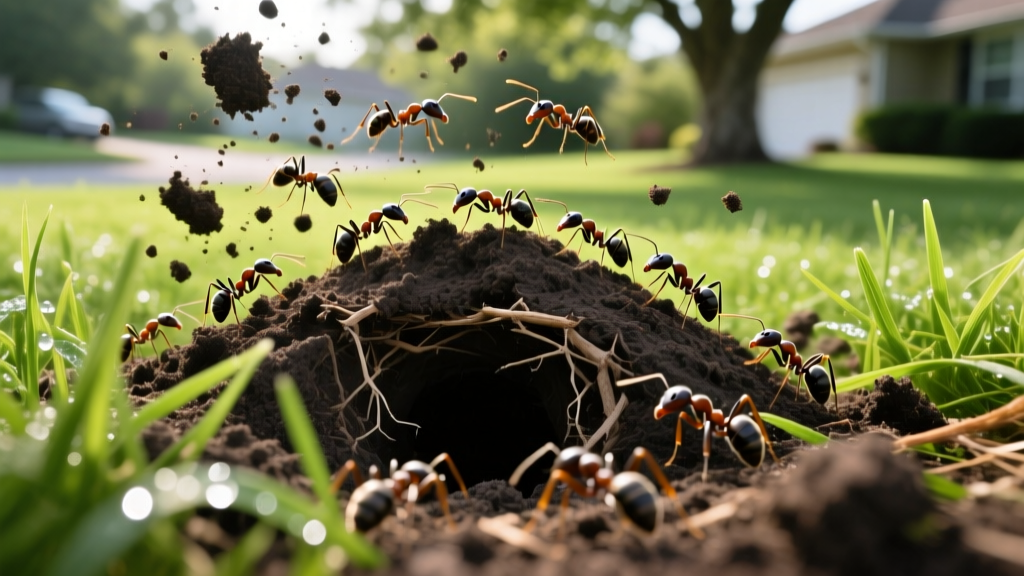
What Happens When You Destroy an Ant Hill? (The Splinter Effect)
The Immediate Aftermath: Chaos and the "Splinter" Effect
When you physically destroy an ant hill—whether by kicking it, mowing over it, or pouring boiling water into the central crater—you trigger an immediate, highly coordinated survival response. Contrary to popular belief, flattening a mound rarely kills the colony. Instead, it initiates a biological protocol known as colony budding or splintering.
Within minutes of structural disruption, worker ants shift from foraging to emergency brood rescue. They will rapidly transport the queen(s), larvae, and pupae deeper into the soil or outward into satellite chambers. For species with multiple queens (polygyne colonies), this physical stress signals that the primary nest is compromised. The colony will intentionally fracture into two or more distinct sub-colonies, each taking a queen and a portion of the workforce to establish a new mound up to 50 feet away.
Monogyne vs. Polygyne: How Different Species React to Mound Destruction
Understanding the queen structure of the ant species on your lawn dictates whether physical destruction will solve or multiply your problem. Below is a breakdown of how common lawn-inhabiting ants respond to mechanical mound disruption.
| Ant Species | Queen Structure | Reaction to Mound Destruction | Recovery Timeline |
|---|---|---|---|
| Red Imported Fire Ant (Solenopsis invicta) | Monogyne (Single Queen) or Polygyne | Single-queen colonies rebuild the mound in place. Multi-queen colonies splinter into 2-4 satellite mounds. | Mound rebuilt in 3-7 days; splintering complete in 48 hours. |
| Argentine Ant (Linepithema humile) | Polygyne (Multiple Queens) | Massive fragmentation. Workers scatter brood into wall voids, mulch beds, and neighboring lawns. | New foraging trails established in 24-48 hours. |
| Pavement Ant (Tetramorium caespitum) | Monogyne | Relocate deep beneath concrete slabs. Surface mound disappears, but subsurface tunneling expands. | Surface activity resumes in 5-10 days. |
| Field Ant (Formica spp.) | Monogyne / Oligogyne | Aggressive defense. Workers will swarm and bite. Mound is rebuilt using surrounding thatch and soil. | Mound rebuilt in 2-4 days. |
According to Texas A&M AgriLife Extension, attempting to shovel or rake fire ant mounds often results in the colony simply relocating a few yards away, making targeted baiting the only reliable long-term solution for large properties.
The Hidden Consequences: Soil Disruption and Turf Damage
Beyond the biological reaction of the insects, destroying an ant hill has physical consequences for your lawn's ecosystem and topography.
- Subsurface Voids and Turf Sinking: Large ant colonies excavate extensive gallery networks up to 3 feet deep. When you cave in the surface mound, the underlying tunnels remain. Over time, heavy rainfall or foot traffic will cause the soil to collapse into these voids, resulting in uneven turf, sunken depressions, and potential tripping hazards.
- Loss of Soil Aeration: Ants are vital ecosystem engineers. Their tunneling aerates compacted soil, improves water infiltration, and cycles nutrients. UC Agriculture and Natural Resources notes that while ant mounds are unsightly, the insects themselves provide critical soil health benefits. Eradicating them entirely can lead to increased soil compaction in heavily clay-based lawns.
- Moisture Trapping: Flattening a mound often packs the excavated clay-heavy subsoil tightly over the grass blades beneath it. This blocks sunlight and traps moisture against the turf crown, creating an ideal microclimate for fungal pathogens like Pythium blight or brown patch.
Why Physical Destruction Fails (And What to Do Instead)
Pouring boiling water, gasoline, or club soda into an ant hill are outdated, environmentally hazardous methods that fail to reach the queen, who resides deep within the protective thermal mass of the colony. To achieve actual eradication, you must exploit the colony's social feeding behavior—a process called trophallaxis.
The Trophallaxis Exploit: Slow-Acting Baits
Worker ants forage for food and regurgitate it to share with the queen, larvae, and other workers. By using a slow-acting, non-repellent active ingredient, you turn the foraging workers into Trojan horses. The U.S. Environmental Protection Agency recommends targeted baiting over broadcast sprays to minimize environmental impact while maximizing colony elimination.
The 14-Day Eradication Protocol
- Days 1-3 (Identification & Placement): Identify the species. Place granular baits containing Indoxacarb (e.g., Advion Fire Ant Bait) or Spinosad (organic option) 2 feet away from the mound perimeter. Do not disturb the mound. Let foragers find the bait naturally.
- Days 4-10 (Trophallaxis Transfer): Foragers carry the toxicant into the deep galleries. You will see a decrease in surface activity. Do not apply liquid contact sprays during this window, or you will kill the foragers before they can poison the queen.
- Days 11-14 (Queen Elimination): The active ingredient reaches the queen and brood. The colony collapses from the inside out.
- Day 15 (Mound Leveling): Once the colony is confirmed dead (no movement when probed with a stick), use a garden rake to disperse the remaining soil mound, integrating it back into the lawn canopy.
When to Use Liquid Drenches
If an ant hill poses an immediate threat to pets or children (such as a massive Red Imported Fire Ant mound near a playset), and you cannot wait 14 days for a bait to work, a liquid mound drench is the only acceptable physical intervention. Mix a liquid concentrate containing Fipronil (0.01% to 0.06% active ingredient) or Cyfluthrin at a rate of 2 gallons per mound. Pour it slowly over the center and edges of the undisturbed mound to flood the central shaft, forcing the chemical down to the queen's chamber before the workers can seal it off.
Frequently Asked Questions
Will mowing over an ant hill kill the colony?
No. Mowing simply decapitates the above-soil crater. The colony will rebuild the mound around the grass blades within 48 to 72 hours. Furthermore, mowing over active fire ant mounds risks damaging your mower deck and allows winged alates (reproductive ants) to hitch a ride to new areas of your yard.
What happens to the grass underneath a destroyed ant hill?
The grass beneath a large, established mound is usually smothered and dead due to the sheer volume of excavated soil blocking sunlight. When you destroy and rake out the mound, you will likely find bare dirt. You will need to core aerate the exposed soil, apply a thin layer of topsoil, and overseed with a grass species matching your existing lawn to prevent weeds from colonizing the bare patch.
Can I just shovel the ant hill into a bucket of soapy water?
While soapy water (using a high-surfactant dish soap) breaks down the waxy exoskeleton of ants and kills them on contact, shoveling a mound guarantees you will miss the queen, who is located 12 to 24 inches below the surface. The surviving workers will immediately initiate budding, creating multiple smaller, harder-to-treat satellite colonies in your landscaping beds.

