
Pest Control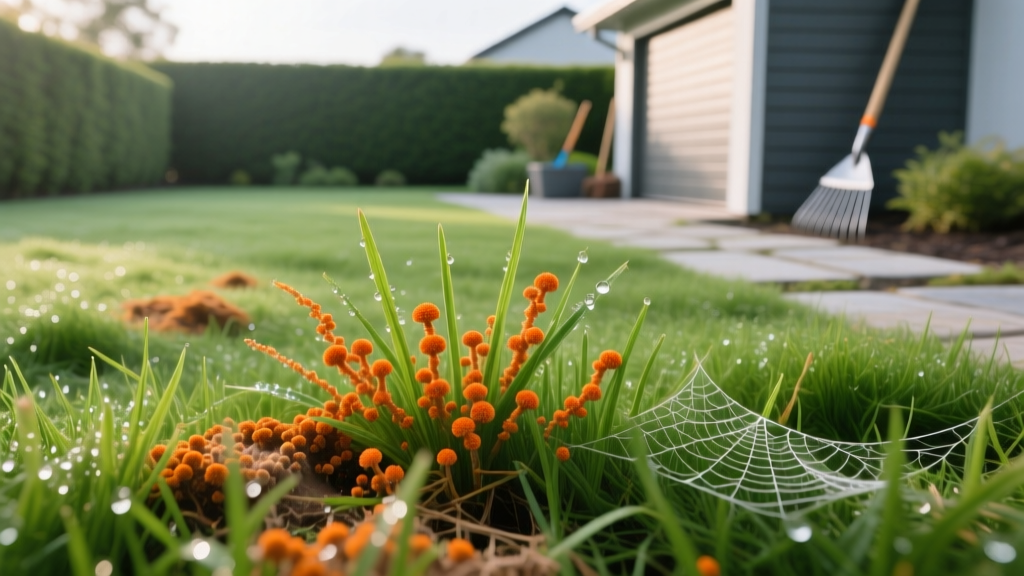
Orange Fungus on Grass: Diagnosis and Rescue Fixes for Lawn Rust
The 60-Second Symptom Check: Is It Lawn Rust?
When you notice an orange, yellow, or rust-colored dust coating your turfgrass blades or your shoes after mowing, you are likely dealing with lawn rust. Caused primarily by fungi in the Puccinia genus (such as Puccinia coronata for crown rust and Puccinia graminis for stem rust), this disease rarely kills mature turf outright but severely weakens it, making the grass highly susceptible to winter kill, drought stress, and secondary pathogens.
The White Tissue Test: To confirm lawn rust within 60 seconds, take a white paper towel or tissue and firmly wipe it across the discolored grass blades. If the tissue comes away coated in a distinct orange or yellowish-brown powdery residue, you have confirmed the presence of rust urediniospores. If the tissue remains clean and the grass is simply yellowing, you are likely looking at nitrogen deficiency or a different foliar disease like dollar spot.
Why Orange Fungus on Grass Appears (The Root Causes)
Rust fungi are opportunistic. They do not typically attack vigorously growing turf. Instead, they exploit lawns experiencing slow vertical growth, usually triggered by environmental stress or nutrient deprivation. According to turf pathology research from the University of Minnesota Extension, rust spores require extended periods of leaf wetness (often 6 to 8 hours) and moderate temperatures (68°F to 77°F) to germinate and infect plant tissue.
The Environmental Trigger Matrix
| Environmental Factor | High-Rust-Risk Condition | Low-Risk Condition |
|---|---|---|
| Soil Nitrogen | Deficient (slow growth) | Adequate (vigorous growth) |
| Leaf Wetness | Evening watering, heavy dew | Early AM watering, good airflow |
| Canopy Density | Thick thatch, shaded areas | Dethatched, full sun exposure |
| Mowing Height | Scalped (under 2 inches) | Maintained at 2.5 to 3.5 inches |
Immediate Rescue Fixes: Stop the Spread in 48 Hours
Once you have confirmed the presence of orange fungus on grass, immediate intervention is required to halt spore production and restore turf vigor. Relying solely on fungicides without correcting the underlying cultural deficit will result in a recurring infection cycle.
Cultural Triage (Do This First)
- Apply Fast-Release Nitrogen: Rust thrives on starving grass. Apply 0.5 lbs of actual nitrogen per 1,000 square feet using a fast-release source like urea (46-0-0) or ammonium sulfate (21-0-0). This forces a flush of vertical growth, allowing you to mow off the infected leaf tips. Expect to spend roughly $12 to $15 on a 50lb bag of urea, which will cover over 20,000 square feet at this rate.
- Adjust Irrigation Timing: Shift your sprinkler schedule to run between 4:00 AM and 6:00 AM. This ensures the grass blades dry rapidly once the sun rises, depriving the Puccinia spores of the 6-hour continuous leaf wetness window they need to germinate.
- Bag Clippings Temporarily: For the next two mowing sessions, attach a bagger to your mower. This physically removes millions of spore-laden leaf tips from the property. Return to mulching only after the orange dusting has ceased.
- Raise the Mower Deck: Set your mower deck to a minimum of 3 inches. Cutting too low reduces the plant's photosynthetic capacity, further stressing the turf and slowing the recovery rate.
Chemical Rescue: Fungicide Selection & Application
If cultural practices do not visibly reduce the orange fungus on grass within 10 to 14 days, or if the infection is severe enough to cause noticeable turf thinning, a targeted fungicide application is necessary. According to NC State University Turf Pathology, rotating fungicide modes of action is critical to prevent pathogen resistance.
FRAC Code Warning: Always check the Fungicide Resistance Action Committee (FRAC) code on the label. Never apply two consecutive treatments of the same FRAC code for rust control.
| Active Ingredient | FRAC Code | Consumer Product Example | Approx. Cost & Coverage |
|---|---|---|---|
| Azoxystrobin | 11 (QoI) | Scotts DiseaseEx | $28 / 10lb bag (5,000 sq ft) |
| Propiconazole | 3 (DMI) | BioAdvanced Fungus Control | $42 / 16oz liquid (8,000 sq ft) |
| Myclobutanil | 3 (DMI) | Spectracide Immunox | $15 / 16oz liquid (5,000 sq ft) |
Application Specifics: For liquid concentrates like Propiconazole, use a pump sprayer calibrated to deliver 1.5 to 2 gallons of water per 1,000 square feet. This volume ensures the chemical reaches the lower canopy and crown where the fungus initiates. Do not water in contact fungicides (like Azoxystrobin granular) immediately; allow the product to sit on the foliage for at least 24 hours.
Long-Term Prevention Framework
Recurring rust infections indicate a fundamental mismatch between your grass cultivar and your site conditions. If orange fungus on grass returns every late summer or early autumn, transition your lawn to resistant varieties during your next overseeding project.
Resistant Cultivar Selection
When purchasing seed, avoid generic 'Contractor's Mix' bags. Instead, look for specific cultivars bred for rust resistance. For cool-season lawns, Kentucky Bluegrass varieties such as 'Midnight', 'NuGlade', and 'Awards' exhibit strong genetic resistance to Puccinia coronata. For perennial ryegrass, seek out 'Manhattan 4' or 'Pinnacle II', which are endophyte-enhanced. Endophytes are beneficial fungi that live within the grass plant, producing alkaloids that naturally deter both fungal pathogens and surface-feeding insects.
Frequently Asked Questions
Will orange lawn rust kill my grass completely?
Rarely. Lawn rust primarily attacks the leaves, not the crown or root system. However, the severe loss of photosynthetic tissue weakens the plant, making it highly vulnerable to winter desiccation, drought, and opportunistic weeds like Poa annua. The real danger is secondary stress, not the rust itself.
Can I mow over rust-infected grass without spreading it?
Yes, mowing is actually a mechanical control method because it removes the spore-bearing leaf tips. However, you must thoroughly wash your mower deck, wheels, and undercarriage with a 10% bleach solution or a commercial quaternary ammonium disinfectant after mowing. Failing to clean your equipment will physically transport millions of spores to uninfected zones of your yard.
Does lime or baking soda cure lawn rust?
No. Internet forums frequently recommend baking soda sprays to alter the leaf surface pH. While sodium bicarbonate has mild fungicidal properties against powdery mildew, it is entirely ineffective against Puccinia rust species and can cause severe phytotoxicity (leaf burn) if applied at the high concentrations required to impact turf fungi. Stick to proven nitrogen applications and labeled FRAC-coded fungicides.

