
Pest Control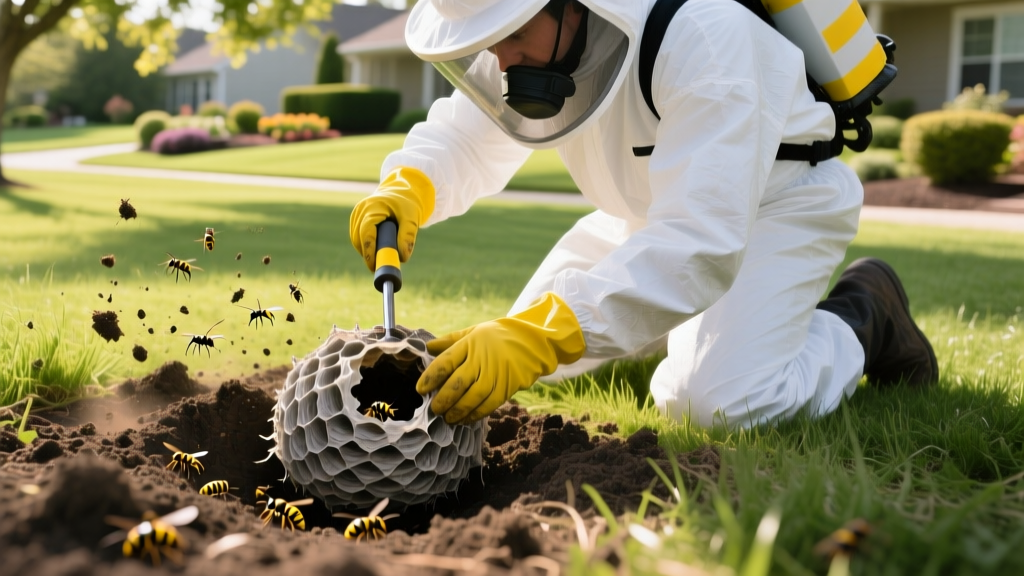
How to Eliminate a Yellow Jacket Bees Nest in Ground Safely
Symptom Diagnosis: Identifying the Subterranean Threat
While many homeowners urgently search for a yellow jacket bees nest in ground soil, it is critical to first clarify a biological misnomer: yellow jackets are not bees. They are aggressive, ground-nesting wasps belonging to the Vespidae family. Misidentifying them can lead to disastrous treatment choices, as ground-nesting wasps behave entirely differently from docile, ground-dwelling miner bees.
A subterranean yellow jacket colony can house between 1,000 and 5,000 workers by late summer. Unlike paper wasps that build visible aerial combs, ground-nesting yellow jackets excavate complex, multi-chambered cavities in abandoned rodent burrows or hollow root systems. The primary symptom is a 1-to-2-inch wide entrance hole surrounded by a small, fan-shaped mound of loose, granular soil.
Differential Diagnosis: Wasp vs. Beneficial Insect
Before initiating any rescue fix, confirm the insect identity using this diagnostic matrix. Applying lethal wasp treatments to beneficial pollinators is both ecologically damaging and unnecessary.
| Trait | Yellow Jackets (Vespidae) | Ground Miner Bees (Andrenidae) | Cicada Killers (Sphecius) |
|---|---|---|---|
| Entrance Hole | 1-2 inches, single main hub | 1/4 inch, hundreds of scattered holes | 1 inch, large dirt mound (volcano shape) |
| Flight Pattern | Rapid, erratic, heavy traffic | Low, slow, solitary hovering | Large, loud, solitary zig-zagging |
| Aggression Level | Extreme; swarm defense triggered by vibration | Docile; females rarely sting | Low; males lack stingers, females avoid humans |
Source references: University of Minnesota Extension and Penn State Extension.
⚠️ CRITICAL WARNING: Never run a lawnmower or use a string trimmer near a suspected ground nest. The low-frequency vibrations travel through the soil and trigger an immediate, mass swarm defense response. Always turn off equipment and walk away if you notice sudden, aggressive wasp activity.
The Architecture of a Ground Nest (And Why Aerosols Fail)
The most common failure mode in DIY yellow jacket elimination is the use of over-the-counter aerosol sprays (e.g., Raid Wasp & Hornet). These products shoot a liquid foam up to 15 feet, which is highly effective for aerial nests but catastrophic for ground nests.
When liquid foam is blasted into a soil entrance, it rapidly expands and hardens, effectively sealing the primary exit. However, the colony chamber is often located 12 to 18 inches below the surface and spans several feet laterally. Blocked from their main exit, the surviving workers will frantically dig secondary emergency exits. These new tunnels frequently breach the surface in the surrounding lawn root zone, creating multiple hidden hazards across your yard.
Rescue Fix 1: Insecticidal Dust (The Gold Standard)
To eliminate a subterranean colony without sealing the entrance, you must use a hydrophobic insecticidal dust. Dust particles cling to the wasps' bodies as they enter and exit, and they track the poison deep into the nest chambers, initiating a colony-wide transfer effect.
Recommended Products & Pricing (2026 Market)
- Delta Dust Insecticide (0.06% Deltamethrin): ~$28 per 1 lb bottle. Highly hydrophobic; will not clump or degrade in damp soil environments. (NPIC Deltamethrin Fact Sheet)
- Drione Dust (Silica Aerogel + Pyrethrin): ~$32 per 1 lb bottle. Desiccates the insects' exoskeletons while delivering a rapid nervous system knockdown.
- JT Eaton Bellows Hand Duster: ~$18. Essential for delivering dust deep into the void without standing directly over the hole.
Step-by-Step Dust Application Protocol
- Timing is Everything: Treat the nest between 9:00 PM and 11:00 PM. By this time, all daytime foragers have returned to the nest, and the cooler temperatures slow their metabolism and flight speed.
- PPE Requirements: Wear a long-sleeved shirt, pants tucked into socks, 6-mil nitrile gloves, and a protective face veil. Carry a flashlight with a red cellophane filter (yellow jackets cannot see red light well).
- Load the Duster: Fill the JT Eaton bellows duster no more than 1/3 full with Delta Dust. This allows adequate air space to create a fine, billowing cloud rather than a dense clump.
- Application: Approach the nest slowly from the side, never casting a shadow over the entrance. Insert the duster tip 1 inch into the hole and give 3 to 4 firm puffs. The goal is to coat the interior tunnel walls, not to pack the hole with powder.
- Retreat and Wait: Leave the area immediately. Do not cover the hole with dirt or a rock. The wasps must freely enter and exit to track the dust into the queen's chamber. Expect total colony collapse within 24 to 48 hours.
Rescue Fix 2: Microencapsulated Liquid Drench
If the nest is located in an area with heavy foot traffic (e.g., near a playground or patio) and requires immediate surface knockdown, a microencapsulated liquid suspension is the secondary rescue option.
Pro-Tip: Standard liquid concentrates wash away in soil moisture. Microencapsulated products (like Cyzmic CS or Onslaught FastCap, priced around $45-$60 per 8oz bottle) trap the active ingredient in microscopic polymer shells. These shells resist soil absorption and remain lethal on the surface and tunnel walls for up to 90 days.
Mixing and Application: Mix 0.4 fluid ounces of Cyzmic CS per gallon of water. Using a 1-gallon pump sprayer with the nozzle adjusted to a narrow stream, inject 1.5 gallons of the solution directly into the entrance hole at dusk. The high volume floods the upper galleries, while the microcapsules provide a residual barrier for returning foragers.
Rescue Fix 3: Organic Soil Flood (Low-Toxicity Alternative)
For homeowners strictly avoiding synthetic pyrethroids, an organic soil flood can physically collapse the nest and suffocate the colony, though it carries a higher risk of provoking a swarm due to the prolonged application time.
- The Mixture: Combine 1/4 cup of heavy-duty liquid dish soap (e.g., Dawn Ultra) with 2 gallons of boiling water. The soap breaks the surface tension of the water, preventing it from beading up on the wasps' waxy exoskeletons and ensuring rapid suffocation.
- Execution: Pour the boiling soapy water directly into the hole using a long-spout watering can. Follow immediately by dumping 2 cups of Food-Grade Diatomaceous Earth (DE) over the saturated entrance. As the soil dries, the DE acts as a mechanical desiccant for any survivors attempting to dig out.
- Failure Mode: If the colony is exceptionally deep (over 18 inches) or the soil is heavily compacted clay, the water may pool on the surface and fail to reach the queen's chamber.
Post-Elimination Lawn Recovery
Once 72 hours have passed and no activity is observed at the entrance, the nest is dead. Do not simply leave the hole open, as it will become a new habitat for spiders or rodents.
- Use a hand trowel to break up the edges of the entrance hole to a depth of 3 inches.
- Fill the void with a 50/50 mix of screened topsoil and compost.
- Overseed the patch with a grass variety matching your existing lawn. For warm-season lawns, use Cynodon dactylon (Bermuda) sprigs; for cool-season lawns, apply Tall Fescue seed at a rate of 6 lbs per 1,000 sq ft.
- Tamp the soil down gently and water deeply to initiate germination and prevent future soil subsidence.
Frequently Asked Questions
Can I just flood the nest with a garden hose?
No. Ground yellow jackets can survive underwater for several hours by trapping air bubbles in their nest chambers. Flooding with plain water will only anger the colony and cause them to relocate their entrance a few feet away.
When is the best time of year to treat ground nests?
Late August through October is the most dangerous time, as colonies are at peak population and highly defensive. Treat them as soon as you spot the entrance hole in early summer (May/June) when the colony is still small (under 100 workers) and easier to eradicate.

