
Pest Control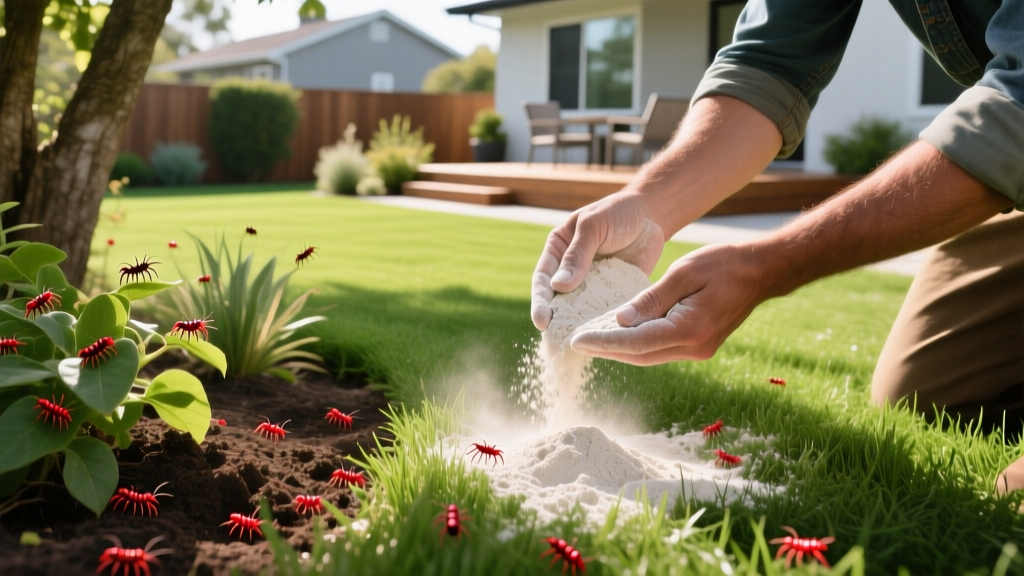
Using Diatomaceous Earth for Chiggers: A Yard Defense Guide
The Mechanics of Desiccation: How DE Targets Chiggers
Chiggers are not insects; they are the larval stage of trombiculid mites. Unlike adult mites that burrow, chiggers attach to the skin surface, inject digestive enzymes, and feed on liquefied tissue, causing intense pruritus (itching). In the yard, they congregate in moist, shaded, and overgrown microclimates. Diatomaceous earth (DE) offers a mechanical, non-toxic defense against these pests, but its efficacy relies entirely on proper environmental conditions and application techniques.
DE consists of fossilized remains of diatoms, a type of hard-shelled algae. Under a microscope, DE particles (typically 10 to 200 microns in size) feature razor-sharp, jagged edges. When a chigger crawls across a treated surface, these microscopic edges abrade the mite's waxy epicuticle. Once this protective lipid layer is compromised, the chigger rapidly loses moisture and dies from desiccation. Because this is a physical mode of action rather than a chemical one, chiggers cannot develop biological resistance to DE.
CRITICAL SAFETY WARNING: Never use pool-grade or filter-grade diatomaceous earth in your yard. Filter-grade DE undergoes high-heat calcination, which converts the naturally occurring amorphous silica into crystalline silica—a known human carcinogen that causes severe respiratory damage when inhaled. Always purchase OMRI-listed, Food-Grade DE, which contains less than 1% crystalline silica.
Selecting the Correct Grade and Formulation
Not all diatomaceous earth products are created equal. For yard defense, you must choose between standard dry food-grade DE and wettable DE formulations, depending on your local climate and irrigation schedule.
| Feature | Standard Food-Grade DE (Dry) | Wettable DE Formulation |
|---|---|---|
| Example Products | Safer Brand, Harris, Diatomaceous Earth Food Grade | Bonide DE, Perma-Guard Wettable |
| Average Cost (4 lbs) | $20 - $28 | $35 - $45 |
| Moisture Tolerance | Zero (clumps and loses efficacy when wet) | High (suspends in water, dries into an active film) |
| Application Method | Bellows hand duster or motorized dust blower | Pump sprayer or hose-end sprayer |
| Best Use Case | Dry, arid climates; under eaves; indoor-outdoor borders | Humid climates; shaded yards; areas with regular irrigation |
Strategic Application Rates and Equipment
Applying DE by sprinkling it from the bag is highly inefficient and creates dangerous airborne dust clouds. For effective chigger control, the dust must be applied as a barely visible, uniform film directly to the soil surface and the lower third of grass blades where chiggers quest for hosts.
Calibration and Coverage
The target application rate for dry food-grade DE is 2 to 4 pounds per 1,000 square feet. A standard 4-pound bag will cover roughly 1,000 to 2,000 square feet, costing approximately $0.01 to $0.02 per square foot. Focus your application on high-traffic transition zones: the perimeter of your property, the edges of wooded areas, and the borders of tall grass or brush piles.
Required Equipment
- Bellows Hand Duster: For areas under 2,000 sq ft, a tool like the Harris Red Hand Duster ($15) or the JT Eaton Duster ($25) is mandatory. These tools use a pneumatic bellows to shoot a fine, electrostatically charged mist of dust that clings to foliage.
- Motorized Duster: For properties exceeding half an acre, rent or purchase a backpack motorized duster (e.g., Solo 421 or Chapin 8601B, $150-$300) to ensure rapid, even coverage before wind disperses the product.
- PPE: Even food-grade DE is a severe respiratory irritant. Always wear an N95 or P100 particulate respirator, safety goggles, and long sleeves during application.
The Moisture Conflict: Overcoming DE’s Biggest Weakness
The primary challenge of using diatomaceous earth for chiggers is an environmental paradox: chiggers thrive in damp, humid, shaded environments, while DE requires bone-dry conditions to function. When DE absorbs ambient moisture or gets hit by rain, the particles clump together, losing their electrostatic charge and their ability to abrade the chigger's exoskeleton.
To overcome this failure mode, implement the following yard defense strategies:
- Target Dry Microclimates: Apply dry DE heavily under roof eaves, beneath raised decks, and along dry stone retaining walls where rain cannot reach, but chiggers may still harbor.
- Modify the Habitat: Chiggers require high humidity to survive. Prune lower tree limbs to increase sunlight penetration, dethatch your lawn to improve soil drainage, and remove leaf litter. By artificially drying out the environment, you make the yard hostile to chiggers and hospitable to DE.
- Use Wettable DE for Humid Zones: If you live in the Southeastern US or an area with high summer humidity, abandon dry dust. Mix a wettable DE powder with water according to the label (usually 1/2 cup per gallon) and spray it using a pump sprayer. The water acts as a carrier, and once it evaporates, it leaves a micro-thin, rain-resistant film of DE on the grass blades.
Integrated Chigger Defense: DE vs. Chemical Alternatives
While DE is an excellent organic option, severe infestations often require an integrated pest management (IPM) approach. According to entomologists at the University of Florida IFAS, combining habitat modification with targeted chemical or biological controls yields the highest success rates. Below is a decision matrix to help you choose the right active ingredient based on your yard's specific conditions.
| Active Ingredient | Residual Control | Moisture Tolerance | Pet & Wildlife Safety |
|---|---|---|---|
| Diatomaceous Earth | Indefinite (if kept dry) | Very Low | High (Non-toxic if ingested; respiratory risk during application) |
| Bifenthrin (0.1% Granular) | 4 to 8 weeks | High (Binds to soil organics) | Moderate (Highly toxic to aquatic life and bees; safe for pets once watered in and dry) |
| Permethrin (Liquid Spray) | 2 to 4 weeks | Moderate | Low for felines (Highly toxic to cats until fully dry); safe for dogs. |
| Beneficial Nematodes (Steinernema) | 1 to 2 months (living organism) | Requires moist soil to survive | Extremely High (100% safe for all mammals, birds, and plants) |
For comprehensive yard defense, apply Bifenthrin granules to the broad lawn area for long-lasting residual control, and use DE as a targeted, organic barrier treatment around dry patio perimeters, outdoor seating areas, and pet enclosures. As noted by the National Pesticide Information Center, DE's lack of chemical toxicity makes it an ideal supplementary treatment in areas where children and pets play frequently, provided the dust has settled.
Frequently Asked Questions
Will applying DE to my lawn kill beneficial earthworms?
No. Earthworms live deep within the soil profile and secrete a protective mucus layer. DE applied to the surface at standard rates does not penetrate deeply enough or affect annelids in the same way it affects arthropods with waxy exoskeletons.
How quickly does DE kill chiggers after contact?
Desiccation is not instantaneous. Depending on ambient humidity and the thickness of the dust layer, it typically takes 24 to 48 hours for a chigger to succumb to moisture loss after crossing a treated barrier.
Can I mix DE with water and spray it from a standard hose-end sprayer?
Standard dry food-grade DE will immediately clog the siphon tube and nozzle of a hose-end sprayer. You must purchase a specifically formulated 'wettable' DE product that includes suspension agents to keep the particles dispersed in the water column.

