
Pest Control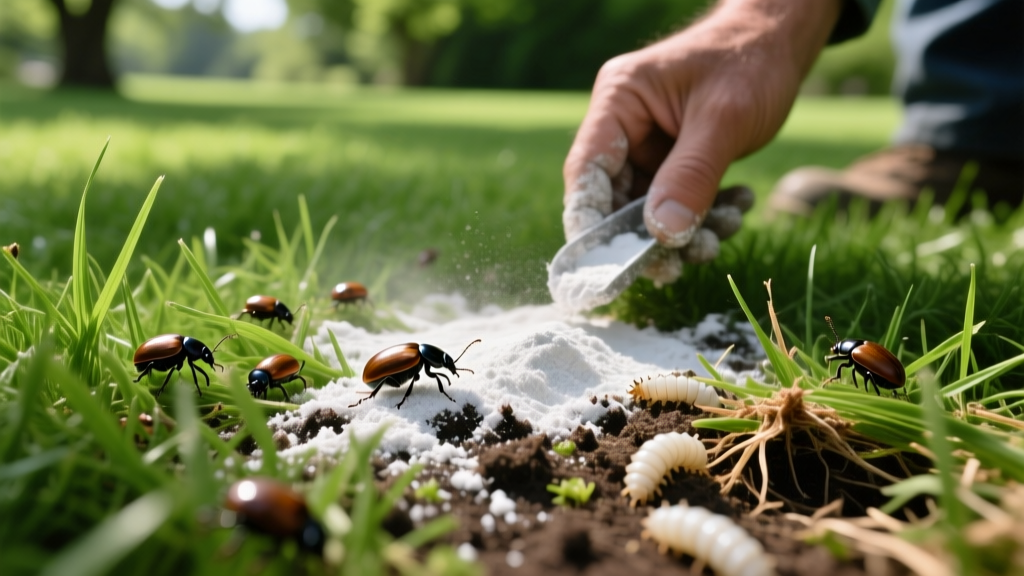
Diatomaceous Earth Insecticide: Lawn Pest Diagnosis and Solutions
Diagnosing the Culprit: Which Lawn Pests Succumb to DE?
Before deploying any treatment, accurate pest identification is critical. Diatomaceous earth (DE) is a mechanical insecticide composed of fossilized aquatic organisms called diatoms. Under a microscope, these particles resemble shards of glass with sharp, abrasive edges. When crawling insects cross a barrier of DE, the microscopic shards lacerate their waxy exoskeletons, leading to fatal dehydration. However, this mechanism only works on specific arthropods. It is entirely ineffective against nematodes, fungal pathogens, or mollusks like slugs and snails, whose thick mucus layers protect them from the abrasive silica.
To determine if a diatomaceous earth insecticide is the right solution for your yard, cross-reference the damage you are seeing with the pest profiles below.
| Pest | Primary Damage Signs | DE Efficacy | Application Strategy |
|---|---|---|---|
| Fire Ants | Mounds in sunny turf, aggressive swarming when disturbed | High | Dust directly into mound crevices and along foraging trails at dusk. |
| Fleas & Ticks | Pet scratching, small dark specks (flea dirt) in grass | Moderate | Broadcast lightly over dry lawn; requires repeated applications. |
| Earwigs & Millipedes | Chewed leaf edges, nocturnal hiding under mulch/stones | High | Create a 2-inch perimeter barrier around garden beds and foundations. |
| Grubs (White Grubs) | Brown turf patches, sod rolls back like carpet, bird/crow digging | None | DE cannot penetrate soil to reach subterranean grubs. Use beneficial nematodes instead. |
| Slugs & Snails | Irregular holes in leaves, silvery slime trails on hardscapes | None | Mucus neutralizes DE. Use iron phosphate baits for mollusks. |
The Science of Desiccation: Why DE Works (And When It Fails)
The efficacy of DE relies entirely on its ability to absorb lipids. According to the National Pesticide Information Center (NPIC), the amorphous silicon dioxide in food-grade DE is highly porous. When an insect brushes against it, the powder absorbs the protective waxy cuticle of the exoskeleton. Without this lipid layer, the insect rapidly loses water to the surrounding air and dies of desiccation within 24 to 48 hours.
Expert Insight: DE does not poison insects chemically. Because it acts mechanically, pests cannot develop genetic resistance to it, making it a cornerstone of long-term integrated pest management (IPM) strategies where chemical pesticides have failed.
The Moisture Failure Mode
The single most common reason homeowners report that DE 'doesn't work' is environmental moisture. Water fills the microscopic pores of the diatoms, rendering them incapable of absorbing the insect's lipids. Furthermore, wet DE clumps together, eliminating the dry, dusty barrier insects must crawl through.
Warning: Morning dew, irrigation overspray, and light rain will instantly deactivate surface-applied DE. If you live in a high-humidity climate or coastal region, you must apply DE in the late afternoon after the sun has baked the moisture out of the turf, and reapply immediately after any precipitation event.
Selecting the Right Grade: Amorphous vs. Crystalline Silica
Not all diatomaceous earth is safe for residential use. The CDC National Institute for Occupational Safety and Health (NIOSH) strictly differentiates between amorphous silica and crystalline silica. Using the wrong grade poses severe respiratory risks to humans and pets.
| Grade | Composition | Primary Use | Lawn & Garden Safety |
|---|---|---|---|
| Food / Pest Grade | <1% Crystalline Silica (Amorphous) | Grain storage, livestock feed, home pest control | Safe when applied with proper respiratory PPE. |
| Filter Grade | >30% Crystalline Silica (Cristobalite) | Pool filters, industrial filtration, brewing | Toxic. Causes silicosis. Never use in yards or gardens. |
Always purchase products explicitly labeled as 'Food Grade' or registered as an EPA minimum-risk pesticide, such as Harris Food Grade Diatomaceous Earth or Safer Brand Ant & Crawling Insect Killer. Expect to pay between $15 and $25 for a 4 lb bag, which is sufficient to treat approximately 2,000 to 4,000 square feet of targeted perimeter and bed space.
Step-by-Step Application Protocol for Turf and Garden Beds
To maximize lethality while minimizing airborne dust, follow this precise application sequence:
- Prep the Zone: Mow the lawn to a height of 2 inches and clear away heavy thatch or wet mulch. DE must reach the soil surface and the base of plant stems where crawling insects travel.
- Don PPE: Put on safety goggles, long sleeves, and a NIOSH-approved N95 respirator. While food-grade DE is non-toxic if ingested, inhaling the fine 10-20 micron particulate matter causes mechanical irritation to the lungs.
- Targeted Crevice Treatment: Load a brass bulb duster (like the Harris Bulb Duster) with DE. Fill the duster only halfway to allow air space for a fine cloud. Puff a light, barely visible dusting directly into ant mound entrances, cracks in retaining walls, and beneath deck stairs.
- Perimeter Barrier: For garden beds, use a shaker can or a handheld broadcast spreader on its lowest setting. Apply a continuous band 2 to 3 inches wide along the foundation of your home and the borders of your mulch beds. Aim for a rate of 1 to 1.5 lbs per 1,000 square feet of treated border area.
- Settle the Dust: Wait 30 minutes for airborne particles to settle before allowing children or pets back into the treated zone. Once settled, DE is harmless to mammals.
Protecting Non-Target Organisms and Pollinators
While DE is a broad-spectrum mechanical insecticide, its impact on beneficial organisms can be mitigated through strategic placement.
- Earthworms: DE does not harm earthworms. Their protective mucus coating and subterranean lifestyle keep them safe from surface applications.
- Bees and Butterflies: Avoid applying DE directly to the blossoms or foliage of flowering plants. Pollinators do not crawl along the soil surface, so keeping DE restricted to the soil line and hardscape borders prevents accidental exposure.
- Aquatic Life: Keep DE away from koi ponds, streams, and storm drains. The fine silica powder is highly toxic to fish and aquatic invertebrates if it washes into waterways.
Troubleshooting Matrix: DE Application Failures
If your pest population persists after treatment, consult this diagnostic matrix to identify the operational failure.
| Symptom | Root Cause | Corrective Action |
|---|---|---|
| Ants are walking directly over the DE barrier without dying. | The DE has absorbed ambient humidity or morning dew, deactivating its lipid-absorbing pores. | Sweep away the wet DE. Wait for the surface to dry completely, then reapply a fresh, dry layer in the late afternoon. |
| Heavy dust clouds are blowing into the neighbor's yard during application. | Applying too thick of a layer. Insects will instinctively walk around thick piles of white powder rather than through them. | DE must be applied as a microscopically thin, barely visible film. Use less product and focus on a finer dusting technique. |
| Pests return within 48 hours of a successful kill. | Rain or sprinkler irrigation washed the DE into the soil profile where it is useless against surface crawlers. | Install physical moisture shields (like small plastic awnings) over critical crevices, or switch to a weather-resistant granular bait for that specific zone. |

