Fruit flies can turn a thriving home garden or compost bin into a frustrating battleground almost overnight. These tiny, persistent pests — most commonly Drosophila melanogaster — are attracted to the sweet scent of fermenting fruit, decaying organic matter, and the warm, moist environments found in compost piles. While a few fruit flies hovering around your kitchen counter might seem like a minor annoyance, a full-blown infestation in your garden or compost bin can disrupt decomposition, damage ripening produce, and make outdoor spaces thoroughly unpleasant.
The good news? You don't need expensive chemical pesticides to regain control. Some of the most effective fruit fly traps can be assembled at home using simple, inexpensive materials you probably already have. In this comprehensive guide, we'll walk you through everything you need to know about identifying fruit flies, preventing infestations in your garden and compost, and building several highly effective DIY traps that are safe for your family, pets, and beneficial insects. For broader strategies on keeping your outdoor spaces healthy, our lawn care guides cover a wide range of maintenance tips that contribute to a pest-resistant yard.
Identifying Fruit Flies in Your Garden and Compost Bin
Before you can effectively combat fruit flies, you need to make sure you're dealing with the right pest. Several small flying insects commonly appear around gardens and compost bins, and misidentification can lead to ineffective treatment strategies.
What Fruit Flies Look Like
Adult fruit flies are small — typically about 1/8 inch (3 to 4 millimeters) long — with tan or light brown bodies and distinctive red or dark eyes. They have translucent wings and tend to hover in lazy, erratic patterns near fermenting or decaying organic material. You'll most often notice them clustering around overripe fruit on the vine, the surface layer of compost bins, or near any fallen produce that hasn't been cleaned up.
Fruit Flies vs. Fungus Gnats vs. Drain Flies
It's easy to confuse fruit flies with other small flying insects commonly found in garden environments:
- Fungus gnats are darker, more mosquito-like in appearance, and tend to hover around damp soil and potted plants rather than fruit. They're more of a root-feeding problem for seedlings and young plants. If you're noticing tiny dark flies around your garden beds, you may also want to read our guide on common garden pests and how to control them.
- Drain flies (also called moth flies) have fuzzy, moth-like wings and are typically found near standing water or drains rather than compost or fruit.
- Vinegar flies are essentially the same species as fruit flies (Drosophila melanogaster) and respond to the same traps and baits described in this guide.
Signs of a Fruit Fly Infestation
Watch for these telltale signs that fruit flies have colonized your garden or compost area:
- Clouds of tiny flies rising when you disturb compost or approach ripening fruit
- Small, white, thread-like larvae visible on the surface of overripe or damaged produce
- A noticeable increase in fly activity around your compost bin, especially on warm days
- Fruit on vines or trees that seems to spoil or ferment faster than expected
- Tiny eggs or larvae visible in the top layer of your compost pile
If you're also dealing with broader lawn health issues that might be attracting pests, our lawn maintenance tips can help you create a healthier, more resilient landscape that's naturally less inviting to a wide range of pests.
Prevention Strategies: Keeping Fruit Flies Out of Your Garden and Compost
The most effective pest control strategy always starts with prevention. By making your garden and compost bin less attractive to fruit flies in the first place, you dramatically reduce the likelihood of an infestation taking hold. These preventive measures work hand-in-hand with the DIY traps we'll cover in the next section.
Compost Bin Best Practices
Your compost bin is essentially a fruit fly paradise if not managed properly. Here's how to keep it less inviting:
- Bury food scraps deep: Always cover fresh kitchen scraps with at least 4 to 6 inches of brown material (dry leaves, shredded cardboard, straw, or wood chips). Fruit flies are attracted to exposed, fermenting food — burying it removes the scent signal.
- Maintain the right carbon-to-nitrogen ratio: A well-balanced compost pile with plenty of brown (carbon-rich) material generates more heat, which accelerates decomposition and creates conditions that are less hospitable to fruit flies.
- Turn your compost regularly: Frequent turning disrupts breeding cycles, distributes moisture evenly, and helps the pile heat up. Fruit fly larvae cannot survive the higher temperatures found in the interior of an actively composting pile.
- Use a tight-fitting lid: If you're using a bin-style composter, ensure the lid closes securely. For open piles, consider covering the top with a layer of hardware cloth or a breathable compost cover.
- Avoid adding certain materials: While composting is an excellent way to recycle kitchen waste, avoid adding large quantities of very sweet or very ripe fruit at once. If you do add fruit scraps, always bury them thoroughly.
Garden Hygiene and Harvest Management
Keeping your garden tidy is one of the simplest and most powerful ways to prevent fruit fly problems:
- Harvest promptly: Pick fruits and vegetables as soon as they're ripe. Overripe produce left on the vine or tree is an open invitation to fruit flies.
- Clean up fallen fruit: Regularly collect any fruit that has fallen to the ground beneath trees and bushes. Even small amounts of decaying fruit can support a large population of flies.
- Remove damaged produce: Fruit with splits, bruises, or insect damage ferments quickly and attracts flies. Remove and compost (bury deeply) or dispose of damaged items promptly.
- Keep garden beds weeded: Dense weeds trap moisture and create sheltered microclimates where fruit flies thrive. Regular weeding improves air circulation and reduces habitat. Our weed control strategies can help you manage this across your entire landscape.
Environmental Controls
A few environmental adjustments can further reduce fruit fly pressure:
- Improve drainage: Standing water and chronically soggy soil contribute to the moist conditions fruit flies prefer. Address drainage issues in your garden beds and around your compost area. Proper lawn drainage helps keep the entire yard drier and less pest-friendly.
- Increase airflow: Prune dense vegetation around your compost bin and garden beds to improve air circulation. Fruit flies prefer still, humid air.
- Position compost bins wisely: Place your compost bin in a location that receives partial sun. The warmth helps the composting process while making the immediate area less comfortable for flies that prefer shaded, cool spots.
DIY Fruit Fly Traps: Step-by-Step Recipes for Home Gardens and Compost Bins
When prevention alone isn't enough, DIY traps offer a safe, affordable, and surprisingly effective way to reduce fruit fly populations. These traps use attractants to lure adult flies in, then prevent them from escaping. Below are five proven designs you can build in minutes using common household items.
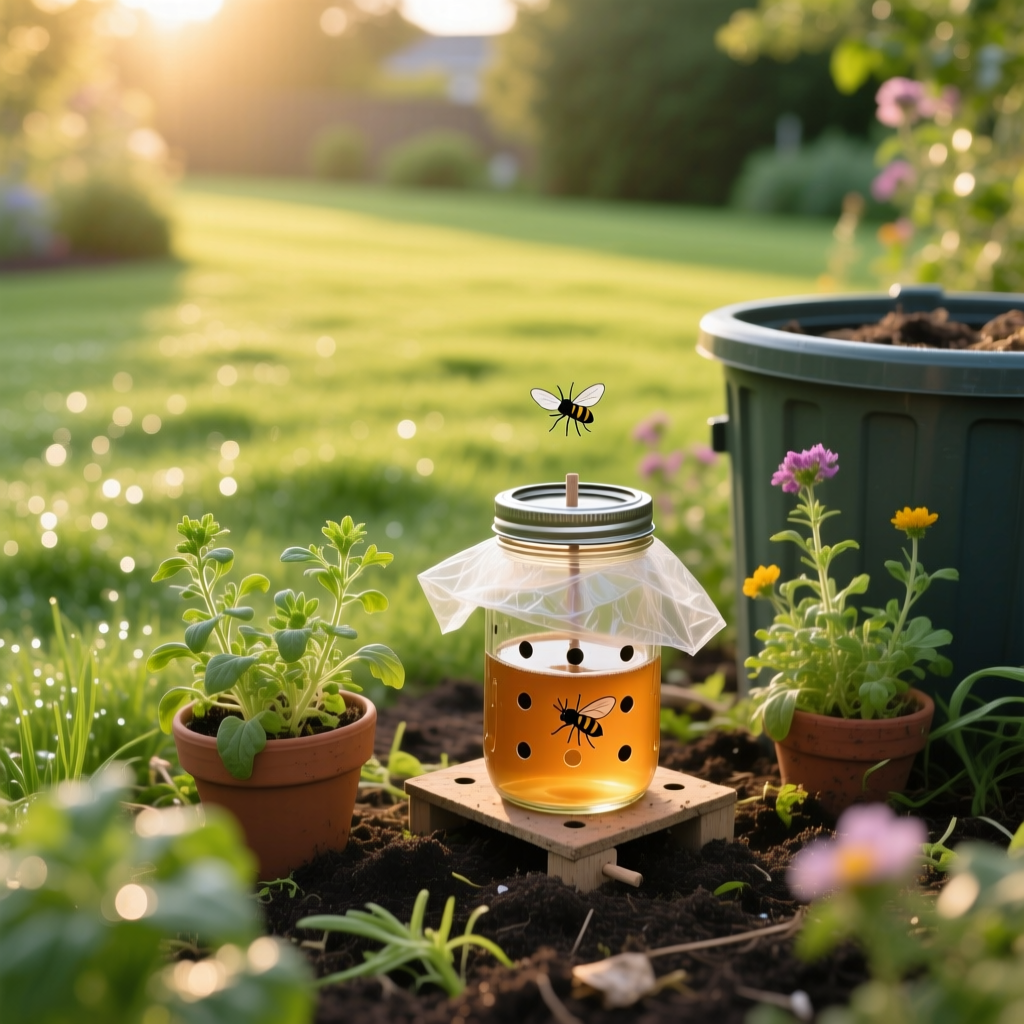
Trap 1: The Classic Apple Cider Vinegar Jar Trap
This is the gold standard of DIY fruit fly traps — simple, cheap, and remarkably effective.
Materials needed:
- A small glass jar, bowl, or cup
- Apple cider vinegar (about 1/2 cup)
- A few drops of liquid dish soap
- Plastic wrap
- A rubber band
- A toothpick or fork
Instructions:
- Pour about 1/2 cup of apple cider vinegar into the jar. The fermented, fruity scent is irresistible to fruit flies.
- Add 2 to 3 drops of liquid dish soap and stir gently. The soap breaks the surface tension of the vinegar, so flies that land on the surface sink and drown instead of floating.
- Cover the top of the jar tightly with plastic wrap and secure it with a rubber band.
- Use a toothpick or fork to poke 8 to 10 small holes in the plastic wrap. The holes should be just large enough for a fruit fly to enter but small enough to discourage escape.
- Place the trap near your compost bin, around fruit-bearing plants, or wherever you've noticed the heaviest fly activity.
Why it works: The apple cider vinegar mimics the scent of fermenting fruit, drawing flies from a surprising distance. Once they crawl through the holes to investigate, they either can't find their way back out or land on the soapy surface and drown. Replace the vinegar every 5 to 7 days or when the trap becomes full of flies.
Trap 2: The Funnel Bottle Trap
This design uses a plastic bottle to create a one-way entry system that's nearly escape-proof.
Materials needed:
- An empty plastic water or soda bottle (16 oz to 2 liter)
- Scissors or a utility knife
- Bait: overripe fruit pieces, apple cider vinegar, or a mixture of sugar, water, and yeast
- A few drops of dish soap (if using liquid bait)
Instructions:
- Cut the top third off the plastic bottle, just below where the neck begins to widen into the body.
- Place your bait in the bottom section of the bottle. A piece of overripe banana, a few chunks of rotting fruit, or a mixture of apple cider vinegar and dish soap all work excellently.
- Invert the top section (the funnel part) and place it into the bottom section so the narrow opening points downward, creating a funnel into the bottle.
- Tape the two sections together around the cut edge to seal any gaps.
- Place the trap in your garden near affected areas or beside your compost bin.
Why it works: Flies are attracted by the scent, enter through the narrow funnel opening, and find themselves unable to navigate back out through the small hole. The angled walls of the funnel make escape virtually impossible. This trap can capture hundreds of flies before needing to be emptied and reset.
Trap 3: The Wine or Beer Bottle Trap
If you have an empty bottle of wine or beer, you already have a ready-made fruit fly trap.
Materials needed:
- An empty wine or beer bottle with a small amount of residual liquid
- Optional: a piece of overripe fruit or a splash of fruit juice
Instructions:
- Leave about an inch of wine or beer in the bottom of the bottle. If the bottle is empty, add a small amount of leftover wine, beer, or fruit juice.
- Optionally, drop in a small piece of overripe fruit to boost the attractant power.
- Place the open bottle near your compost bin or in the garden where fruit flies are active.
Why it works: The narrow neck of a wine or beer bottle acts as a natural funnel. Flies are powerfully attracted to the fermentation byproducts in wine and beer. They enter through the narrow neck and typically cannot find their way back out. This is one of the simplest traps to set up and requires zero cutting or assembly.
Trap 4: The Sticky Paper and Fruit Lure Trap
This trap combines a physical attractant with a sticky surface to capture flies without any liquid.
Materials needed:
- Yellow or white cardstock or heavy paper
- A sticky substance: honey, corn syrup, or a mixture of sugar and water cooked to a syrup
- A piece of very ripe or overripe fruit
- String or a stake for hanging/placing the trap
Instructions:
- Cut the cardstock into strips approximately 3 inches wide and 8 inches long.
- Coat one side of each strip generously with your sticky substance. Honey and corn syrup work well because they stay tacky for days.
- Punch a hole at the top of each strip and thread a piece of string through it for hanging.
- Place a small piece of overripe fruit near or just below the sticky strip to serve as the attractant.
- Hang the strips near fruit trees, berry bushes, or your compost bin.
Why it works: The fruit lures flies to the general area, and the sticky surface captures them when they land nearby. Yellow paper tends to be especially attractive to many flying insects. Replace the strips when they become covered with flies or when the sticky coating dries out.
Trap 5: The Compost Bin Perimeter Trap
This larger-scale trap is designed specifically for use around compost bins where fly populations can be especially dense.
Materials needed:
- Several large containers (quart-sized yogurt containers, large cups, or cut-off bottle bottoms)
- Apple cider vinegar or a fermented fruit mash
- Dish soap
- Cooking oil (optional)
Instructions:
- Fill each container about one-third full with apple cider vinegar or a mash of overripe fruit mixed with water.
- Add a few drops of dish soap to each container.
- Optionally, add a thin layer of cooking oil on top of the liquid. This creates an additional barrier that makes it even harder for flies to escape once they land.
- Place 4 to 6 containers evenly spaced around the perimeter of your compost bin, positioning them about 1 to 2 feet away from the bin itself.
- Replace the bait every 5 to 7 days, or more frequently during hot weather when fermentation accelerates.
Why it works: By placing multiple traps in a perimeter formation, you intercept flies approaching the compost bin from various directions. The traps essentially create a defensive ring that significantly reduces the number of flies reaching the compost itself. This approach is especially effective when combined with the preventive compost management strategies outlined above.
Advanced Tips for Maximizing Trap Effectiveness
Building the traps is only half the battle. These strategic tips will help you get the most out of your DIY fruit fly control efforts:
- Use multiple trap types simultaneously: Different trap designs attract flies in slightly different ways. Using a combination of vinegar traps, bottle traps, and sticky traps casts a wider net and captures a larger percentage of the population.
- Position traps strategically: Place traps between the fly breeding source (compost bin, fallen fruit) and the areas where you spend time. This intercepts flies before they reach you.
- Refresh bait regularly: The attractant power of vinegar, fruit, and fermented liquids diminishes over time. Refresh your traps every 5 to 7 days for peak performance, or more often in hot weather.
- Time your trap deployment: Fruit fly populations peak during warm, humid weather. Deploy traps proactively at the first sign of activity rather than waiting for a full infestation.
- Combine traps with cultural controls: Traps work best when paired with good garden hygiene, proper compost management, and the preventive measures discussed earlier. Think of traps as one tool in an integrated pest management approach.
- Monitor and adapt: Keep track of which traps catch the most flies and where they're most effective. This information helps you refine your strategy over time.
For those managing a larger property or dealing with multiple pest issues simultaneously, a well-maintained lawn and garden is your first line of defense. Explore our organic lawn care methods to build a healthier ecosystem that naturally resists pest outbreaks.
When to Call a Professional for Fruit Fly Control
DIY traps and good garden management handle the vast majority of fruit fly problems in home gardens and compost bins. However, there are certain situations where professional pest control intervention may be warranted:
- Persistent, large-scale infestations: If you've been diligently trapping and managing your compost and garden for several weeks with no noticeable reduction in fly populations, a professional can assess the situation and identify hidden breeding sites you may have missed.
- Indoor infestations spreading from outdoor sources: When fruit fly populations in your garden or compost become so large that they begin invading your home in significant numbers, professional treatment may be necessary to break the cycle.
- Commercial or semi-commercial operations: If you maintain a large vegetable garden, orchard, or market garden where fruit flies threaten your harvest and livelihood, professional integrated pest management services can provide targeted solutions at scale.
- Uncertain pest identification: If you're not sure whether you're dealing with fruit flies or another pest species (such as spotted wing drosophila, which is a more destructive invasive species that targets healthy, ripening fruit), a professional can provide accurate identification and tailored treatment recommendations.
- Recurring annual problems: If fruit flies are a severe problem every season despite your best efforts, a professional can help you develop a long-term management plan that may include biological controls, targeted treatments, and landscape modifications.
For most home gardeners, though, the DIY approaches described in this guide — combined with consistent garden hygiene and proper compost management — will bring fruit fly populations under control within one to two weeks. Patience and consistency are key: traps need to be maintained and refreshed regularly, and preventive practices need to become routine habits.
If your broader lawn and garden ecosystem needs attention, our seasonal lawn care guide offers month-by-month advice for keeping your entire outdoor space healthy and resilient against pests of all kinds.
Frequently Asked Questions
How long does it take for DIY fruit fly traps to work?
You'll typically start catching fruit flies within a few hours of setting your traps, and you should notice a significant reduction in the overall population within 5 to 7 days. For severe infestations, it may take two to three weeks of consistent trapping and preventive measures to bring populations down to a manageable level. The key is to use multiple traps simultaneously and refresh the bait regularly to maintain their effectiveness.
Are DIY fruit fly traps safe to use around vegetables and edible plants?
Yes, absolutely. The DIY traps described in this guide use only natural, food-safe ingredients like apple cider vinegar, dish soap, fruit, and sugar. They pose no risk to your vegetables, herbs, or fruit crops. Unlike chemical pesticides, these traps capture flies physically rather than introducing toxins into your garden environment. They're also safe around children, pets, and beneficial insects like bees and ladybugs, since the traps specifically target fruit flies with fermented bait that doesn't attract most beneficial species.
Why are there so many fruit flies in my compost bin even though I bury my food scraps?
Even well-managed compost bins can develop fruit fly populations because the flies are attracted to the general environment of warmth, moisture, and decomposition — not just exposed food. A few flies may arrive on the food scraps themselves (fruit fly eggs are often already present on the skins of fruits and vegetables from the grocery store). To reduce populations, ensure your compost has enough brown material, turn it frequently to disrupt breeding, maintain adequate heat, and supplement your management with perimeter traps placed around the bin. Adding a thicker layer of brown material on top — at least 6 inches — can make a dramatic difference.
Can I use white vinegar instead of apple cider vinegar in fruit fly traps?
White vinegar is less effective than apple cider vinegar for fruit fly traps because it lacks the fruity, fermented aroma that attracts Drosophila melanogaster. Apple cider vinegar closely mimics the scent of rotting fruit, which is the primary attractant. If apple cider vinegar isn't available, you can use white vinegar mixed with a small amount of sugar and a piece of overripe fruit to boost its attractiveness. Red wine vinegar and leftover beer or wine also make excellent alternatives.
What's the difference between fruit flies and spotted wing drosophila, and should I be concerned?
Spotted wing drosophila (Drosophila suzukii) is a close relative of the common fruit fly, but it's significantly more destructive. While common fruit flies target overripe, damaged, or fermenting fruit, spotted wing drosophila females have a serrated ovipositor that allows them to lay eggs inside healthy, ripening fruit — often before harvest. If you notice small, soft, or collapsing berries and stone fruits that seem to spoil from the inside out, you may be dealing with spotted wing drosophila. The DIY traps described in this guide will catch some spotted wing drosophila, but managing this pest often requires additional measures such as fine-mesh exclusion netting, more aggressive harvest schedules, and potentially professional consultation. If you suspect this invasive species, contact your local agricultural extension office for guidance specific to your region.