
Pest Control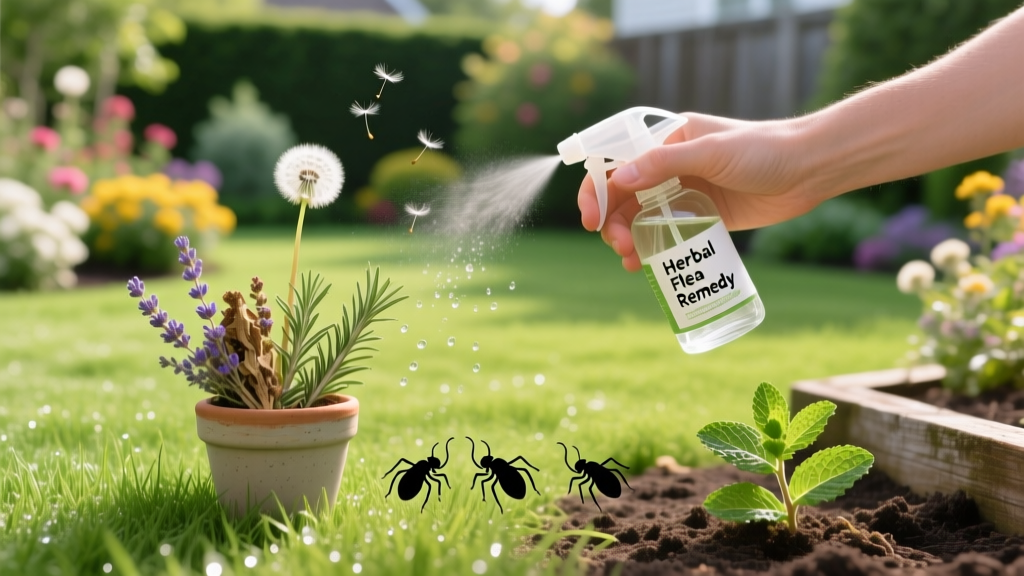
The Ultimate Herbal Flea Remedy Guide for Yard and Garden Defense
The Science Behind Herbal Flea Yard Defense
When managing Ctenocephalides felis (the cat flea, which accounts for 95% of yard flea infestations), synthetic pyrethroids have long been the default. However, as environmental regulations tighten and homeowner preferences shift toward botanical solutions in 2026, a targeted herbal flea remedy has become a cornerstone of integrated pest management (IPM). Botanical sprays do not merely mask scents; they actively disrupt the flea's nervous system.
The efficacy of plant-based remedies relies on specific volatile organic compounds (VOCs) like cedrol, linalool, and limonene. These terpenes bind to the octopamine receptors in the flea's central nervous system. Because octopamine is unique to invertebrates, these compounds effectively paralyze and kill adult fleas on contact while remaining highly toxic to target pests and exceptionally safe for mammals, birds, and turfgrass when properly emulsified.
Why Botanical Repellents Work in the Landscape
Unlike synthetic residuals that degrade into inert soil compounds, essential oils create a volatile vapor barrier. This vapor disrupts the flea's host-seeking behavior, masking the carbon dioxide and lactic acid plumes that adult fleas use to locate pets and humans. According to the EPA's minimum risk pesticide guidelines, specific botanical active ingredients are exempt from standard federal registration requirements precisely because their environmental half-life is short and their mammalian toxicity is negligible.
Top 3 DIY Herbal Flea Remedy Sprays for Yards
Formulating an effective herbal flea remedy requires precise ratios. Essential oils are hydrophobic; applying them directly to your lawn without an emulsifier will result in uneven coverage and potential turf burn. Below are three battle-tested recipes scaled for a standard 2-gallon pump sprayer (covering approximately 1,000 square feet of shaded yard).
1. The Heavy-Duty Cedarwood & Lemongrass Knockdown Spray
This is the most potent herbal flea remedy for active, severe infestations. Texas cedarwood (Juniperus ashei) contains high levels of cedrol, which dehydrates flea exoskeletons.
- Base: 2 gallons of warm water
- Emulsifier: 2 tablespoons of polysorbate 20 (or liquid castile soap)
- Active 1: 80 drops (approx. 4ml) Texas Cedarwood essential oil
- Active 2: 50 drops (approx. 2.5ml) Lemongrass essential oil
- Cost Analysis: A 10ml bottle of high-quality cedarwood oil costs roughly $14. This recipe uses less than half the bottle, bringing the cost per 1,000 sq. ft. application to approximately $3.50.
2. Rosemary & Peppermint Perimeter Drench
Best used as a barrier treatment along fence lines and under decks where rodents (the primary flea vectors) travel.
- Base: 2 gallons of water
- Emulsifier: 2 tablespoons of witch hazel (alcohol-based)
- Active 1: 60 drops Rosemary essential oil (high in 1,8-cineole)
- Active 2: 40 drops Peppermint essential oil
3. Nematode & Herbal Biological Combo
For long-term lifecycle disruption, combine a liquid herbal spray with Steinernema carpocapsae (beneficial nematodes). Apply the herbal spray in the early evening to knock down adults, then water the nematodes into the soil 12 hours later to consume the pupae and larvae.
CRITICAL SAFETY WARNING FOR CAT OWNERS: While these herbal remedies are safe for dogs and humans once dry, cats lack the liver enzyme (glucuronyl transferase) required to metabolize certain terpenes, specifically limonene and linalool found in citrus and lemongrass oils. If you have outdoor cats, substitute lemongrass with pure cedarwood or rosemary, and keep cats off the treated lawn until the spray has completely dried (usually 2-4 hours).
Strategic Application: Targeting Flea Hotspots
Applying an herbal flea remedy uniformly across a sun-baked lawn is a waste of resources. The Centers for Disease Control and Prevention (CDC) notes that fleas cannot survive in direct sunlight where surface temperatures exceed 95°F; the UV radiation and heat rapidly desiccate their eggs and larvae. Therefore, your spray strategy must focus exclusively on microclimates.
Target Zones:
- The Transition Zone: The 3-foot border where sunny lawn meets shaded garden beds.
- Under-Structure Shading: Beneath decks, porches, and raised sheds where humidity remains above 50%.
- Pet Resting Areas: The specific shaded patches where dogs sleep outdoors, as these areas contain the highest concentration of flea eggs dropped from the host.
- Rodent Pathways: Along the base of fences, retaining walls, and brush piles.
Flea Lifecycle vs. Herbal Treatment Timing
Botanical sprays lack the multi-week residual activity of synthetic chemicals like fipronil or bifenthrin. Because essential oils degrade rapidly under UV light and wash away in heavy rain, timing your applications to the flea lifecycle is mandatory for success.
| Flea Lifecycle Stage | Duration in Yard | Herbal Remedy Effectiveness | Required Action |
|---|---|---|---|
| Egg | 2-12 days | Low (Oils do not penetrate egg casings) | Rely on environmental desiccation or nematodes. |
| Larva | 4-18 days | Moderate (Repelled by strong terpenes) | Apply cedarwood spray to shaded soil; keep area dry. |
| Pupa | 3-12 weeks | Zero (Impervious cocoon) | Use vibration (mowing) to trigger emergence, then spray adults. |
| Adult | 1-2 weeks | High (Knockdown on contact) | Spray heavily at dusk when adults are actively host-seeking. |
Common Failure Modes and Troubleshooting
When homeowners report that their herbal flea remedy "didn't work," the failure almost always traces back to one of three formulation or application errors.
Failure Mode 1: Emulsification Breakdown
Essential oils and water do not mix. If you skip the emulsifier (like polysorbate 20), the oils will float to the top of your pump sprayer. This results in the first few sprays being pure water (completely ineffective) and the last few sprays being highly concentrated oil. Concentrated essential oils will cause severe phytotoxicity, literally burning your turfgrass and leaving brown, necrotic patches on your lawn. Always shake the sprayer vigorously every 2 minutes during application.
Failure Mode 2: UV and Heat Degradation
Applying botanical sprays at noon in July is futile. The volatile compounds flash-evaporate before they can penetrate the thatch layer where fleas hide. Always apply herbal flea remedies between 6:00 PM and 8:00 PM. The evening humidity helps the oil droplets adhere to grass blades and soil particles, extending their active lifespan through the night when fleas are most active.
Failure Mode 3: Ignoring the Host Vector
Treating the yard is useless if the primary host remains untreated. If a neighborhood stray cat or an untreated dog continues to visit your yard, they will drop up to 50 new eggs per day, instantly outpacing the mortality rate of your herbal spray. You must pair yard defense with a veterinarian-approved oral isoxazoline (like fluralaner or afoxolaner) for your pets to break the reproductive cycle.
Companion Planting for Long-Term Herbal Defense
To reduce the frequency of manual spraying, integrate flea-repelling flora directly into your landscaping. While planting lavender won't single-handedly cure an infestation, dense plantings create a hostile aromatic environment that deters rodents from nesting near your home.
- Rosemary (Salvia rosmarinus): Plant as a low hedge along fence lines. It thrives in full sun and requires minimal water once established.
- Spearmint (Mentha spicata): Highly effective at repelling rodents and fleas, but highly invasive. Only plant in submerged, bottomless 5-gallon buckets or raised concrete planters to prevent it from choking out your turf.
- Chrysanthemums: Naturally contain pyrethrins (the botanical origin of synthetic pyrethroids). Planting these near your patio creates a localized, natural insect-repelling zone.

