
Pest Control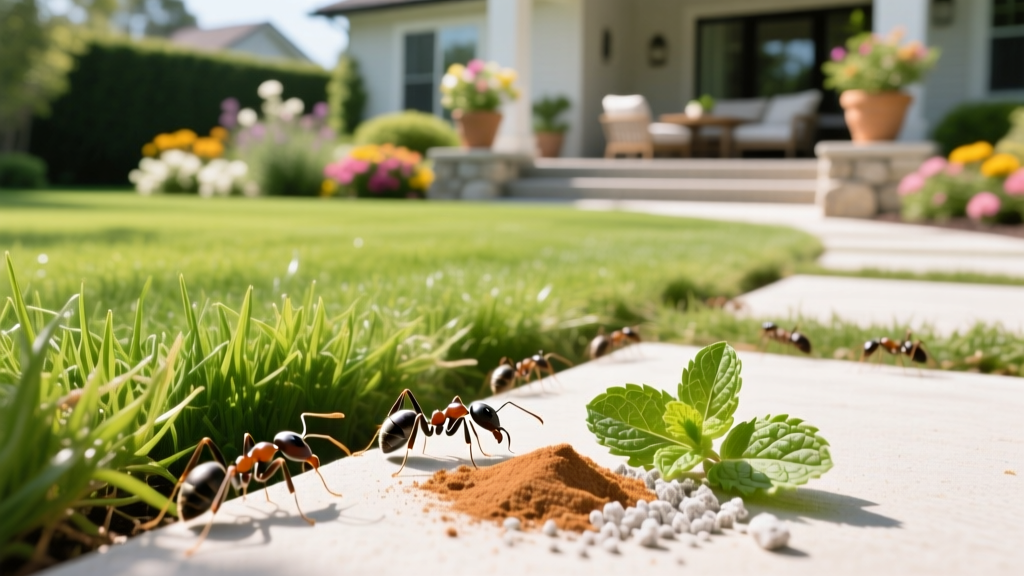
Effective Natural Ant Repellent Strategies for Lawns
The Pheromone Disruption Strategy: How Organic Repellents Work
Ants are a persistent challenge in turfgrass management, primarily because they farm aphids for honeydew and build mounds that smother grass roots and dull mower blades. Before reaching for synthetic pyrethroids, it is critical to understand how a natural ant repellent actually functions. Unlike chemical baits that rely on slow-acting toxins to collapse the colony, organic repellents rely on olfactory disruption and physical barriers.
Ants navigate using complex trail pheromones. When you apply strong botanical volatiles—such as D-limonene from citrus or menthol from peppermint—you effectively mask these chemical highways. According to the University of California Statewide Integrated Pest Management Program (UC IPM), disrupting these foraging trails forces the colony to expend massive energy relocating, often driving them away from high-traffic lawn areas without introducing persistent soil toxins.
Expert Warning: The Aphid Symbiosis
If you see massive ant traffic on your ornamental shrubs bordering the lawn, check for aphids. Ants will aggressively defend aphid colonies to harvest their honeydew. Applying a natural ant repellent to the soil will fail if you do not simultaneously treat the foliage with insecticidal soap to break this symbiotic loop.
If you see massive ant traffic on your ornamental shrubs bordering the lawn, check for aphids. Ants will aggressively defend aphid colonies to harvest their honeydew. Applying a natural ant repellent to the soil will fail if you do not simultaneously treat the foliage with insecticidal soap to break this symbiotic loop.
5 High-Efficacy Natural Ant Repellent Formulations
Not all DIY recipes are created equal. Vinegar, for example, can severely burn Kentucky Bluegrass and alter soil pH if over-applied. Below are five professionally calibrated organic formulations that protect your turf while deterring Formica and Tapinoma species.
| Formulation | Active Mechanism | Est. Cost / Gallon | Turf Safety | Reapplication |
|---|---|---|---|---|
| Peppermint Emulsion | Pheromone masking | $1.85 | 100% Safe | Every 4-5 days |
| Diatomaceous Earth (DE) | Exoskeleton desiccation | $0.75 / lb | 100% Safe | After rain/irrigation |
| Orange Oil (D-limonene) | Waxy cuticle dissolution | $3.20 | Safe (diluted) | Every 7 days |
| Beneficial Nematodes | Biological larval infection | $28.00 / 10M | 100% Safe | Annually (Spring) |
| Cinnamon & Clove Dust | Olfactory irritation | $2.10 / oz | 100% Safe | After heavy wind/rain |
1. The Peppermint & Castile Soap Emulsion
Essential oils and water do not mix. If you simply drop peppermint oil into a sprayer, it will float to the top, resulting in uneven application and potential grass blade burn from concentrated oil. You must use a surfactant.
- Recipe: 16 oz water, 15 drops 100% pure peppermint essential oil, 1 teaspoon liquid castile soap (e.g., Dr. Bronner's).
- Application: Shake vigorously before every spray. Target the perimeter of the lawn, patio edges, and visible mound entrances.
- Failure Mode: UV light degrades menthol rapidly. Apply at dusk or early morning to maximize the 48-hour efficacy window.
2. Food-Grade Diatomaceous Earth (DE) Barriers
DE consists of fossilized diatoms that act like microscopic glass shards, slicing the waxy exoskeleton of ants and causing fatal dehydration. The Environmental Protection Agency (EPA) classifies DE as a minimum-risk substance when used appropriately.
- Protocol: Apply a 1/8-inch thick line of food-grade DE along hardscape borders where ants enter the lawn.
- Crucial Constraint: DE is entirely useless when wet. You must reapply after irrigation or rainfall. Never apply DE directly to flowering clover in your lawn to protect foraging bees.
3. Steinernema feltiae Nematodes (Biological Control)
For deep-rooted mound builders, surface repellents are insufficient. Beneficial nematodes (Steinernema feltiae) are microscopic worms that actively hunt ant larvae and pupae in the soil matrix.
- Cost & Sourcing: Expect to pay $25–$35 for a package of 10 million nematodes, which treats roughly 3,000 square feet of turf.
- Application: Mix with water and apply via hose-end sprayer in the late afternoon. The soil must remain moist for 7 days post-application to allow the nematodes to migrate through the soil pores.
Troubleshooting Common Organic Repellent Failures
Homeowners often abandon natural ant repellents, falsely concluding they 'don't work.' In reality, the failure usually stems from one of three application errors:
- Ignoring the Moisture Variable: Botanical powders (cinnamon, DE) clump and lose efficacy in high humidity or after morning dew. Switch to liquid emulsions during wet spring months.
- Treating the Symptom, Not the Source: Spraying a foraging trail on your driveway does nothing to stop the colony nesting under your oak tree. You must trace the trail back to the primary mound and apply a direct drench (like the Orange Oil formulation) to the nest entrance.
- Overusing Vinegar: While a 50/50 white vinegar and water mix erases pheromone trails instantly, acetic acid is a non-selective herbicide. Spraying it on your Bermuda or Fescue lawn will cause severe chlorosis and necrosis. Restrict vinegar use strictly to concrete and paver joints.
Pro-Tip: The Citrus Rind Mulch Technique
Instead of buying expensive orange oil extracts, save your grapefruit and orange rinds. Blend them with water, let the mixture steep for 48 hours to extract the D-limonene, strain it, and use the liquid as a free, highly effective mound drench. The leftover rinds can be buried near garden beds as a slow-release deterrent.
Instead of buying expensive orange oil extracts, save your grapefruit and orange rinds. Blend them with water, let the mixture steep for 48 hours to extract the D-limonene, strain it, and use the liquid as a free, highly effective mound drench. The leftover rinds can be buried near garden beds as a slow-release deterrent.
Long-Term Soil Health and Ant Deterrence
Ants are heavily attracted to lawns with compacted soil and poor drainage, as these conditions provide the perfect structural integrity for their subterranean galleries. A long-term, chemical-free strategy involves core aeration and top-dressing with compost. By improving soil percolation and introducing predatory ground beetles through organic matter enrichment, you create an environment that is naturally hostile to massive ant colonies. A healthy, deeply rooted lawn with a thick thatch-free canopy is your ultimate, permanent natural ant repellent.

