
Pest Control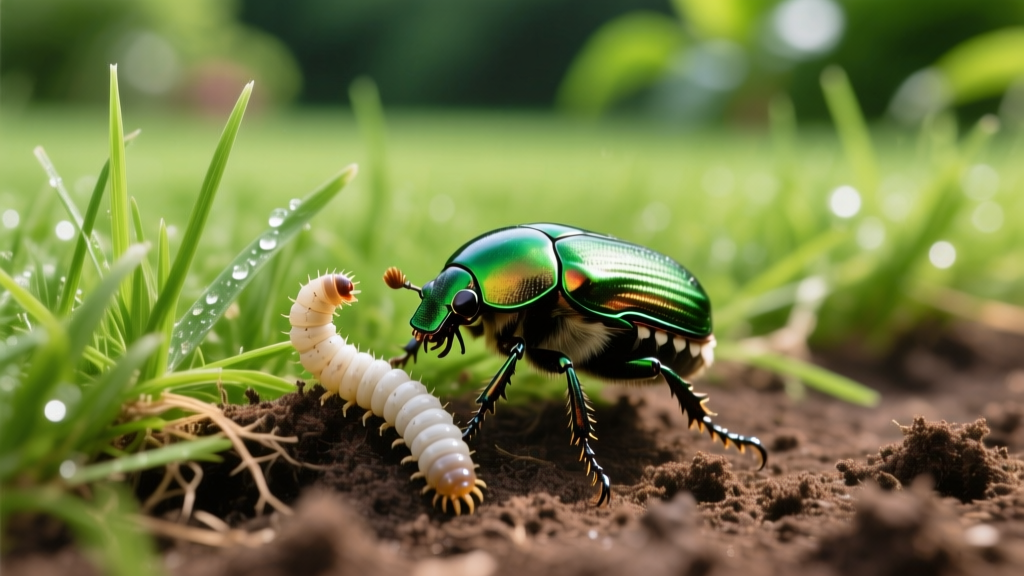
Do Beetles Eat Grass? Identifying and Treating Lawn-Damaging Grubs and Adults
The Short Answer: Do Beetles Eat Grass?
Homeowners dealing with sudden brown patches frequently ask, 'do beetles eat grass?' The accurate answer requires distinguishing between the adult insect and its larval stage. Adult beetles rarely eat turfgrass blades; they prefer the foliage, flowers, and fruit of broadleaf ornamentals, trees, and shrubs. However, their larval stage—commonly known as white grubs—are voracious root-feeders that live entirely underground and consume the root systems of cool-season and warm-season turfgrasses.
While an adult Japanese beetle might occasionally nibble on a blade of Kentucky bluegrass during a heavy swarm, this surface damage is purely cosmetic. The lethal threat to your lawn comes from the C-shaped grub larvae feeding just below the soil line, severing the roots and causing the turf to detach from the soil, roll up like a carpet, and die.
The Real Culprits: Grub Larvae vs. Adult Beetles
Understanding the life cycle of scarab beetles is critical for timing your pest control interventions. Misidentifying the life stage leads to wasted chemical applications and dead turf.
| Characteristic | Adult Beetles | Grub Larvae (White Grubs) |
|---|---|---|
| Primary Diet | Broadleaf plants, roses, linden trees, grapes | Turfgrass roots, organic thatch, soil microbes |
| Habitat | Above ground, active during daylight or dusk | Underground (1-4 inches deep), active spring/fall |
| Damage Type | Skeletonized leaves on ornamentals (cosmetic) | Severed grass roots, dead patches, spongy turf |
| Secondary Damage | None to turf | Attracts skunks, raccoons, and crows that dig up the lawn |
Top 4 Grass-Damaging Beetle Species in North America
Not all beetles produce turf-destroying grubs. According to University of Kentucky Entomology, the vast majority of severe lawn damage in North America is caused by the larvae of four specific scarab beetle species.
1. Japanese Beetle (Popillia japonica)
The most notorious turf pest in the eastern and midwestern United States. The larvae feature a distinct raster pattern (a V-shaped slit in the anal bristles). They feed aggressively from late August through October, causing the most severe fall root loss.
2. June Beetles / May Beetles (Phyllophaga spp.)
Unlike the one-year life cycle of the Japanese beetle, Phyllophaga species can take up to three years to mature. This means you can have overlapping generations of small, medium, and large grubs feeding simultaneously, requiring more aggressive curative treatments in late spring when larger grubs surface.
3. Oriental Beetle (Exomala orientalis)
Often confused with Japanese beetle grubs, the Oriental beetle grub is highly destructive to cool-season grasses in the Northeast. Adults are rarely seen feeding on ornamentals compared to Japanese beetles, making grub damage the primary indicator of their presence.
4. European Chafer (Rhizotrogus majalis)
This species is particularly devastating because its grubs continue feeding later into the winter and start earlier in the spring than other species, as long as the soil is not frozen solid. They prefer the roots of Kentucky bluegrass and tall fescue.
Diagnostic Field Test: Confirming Grub Damage
Before purchasing any pesticides, you must confirm that grubs are the actual cause of the turf decline. Drought stress, fungal pathogens (like brown patch), and dog urine spots can mimic grub damage.
Warning: The Tug Test
Walk to the margin where green grass meets the brown, dead patch. Grab a handful of grass and pull straight up. If the sod rolls back easily like loose carpet with no root resistance, and you see severed white roots, you have a grub infestation. If the grass resists and breaks at the blade, the roots are intact, pointing toward a fungal disease or drought issue.
Walk to the margin where green grass meets the brown, dead patch. Grab a handful of grass and pull straight up. If the sod rolls back easily like loose carpet with no root resistance, and you see severed white roots, you have a grub infestation. If the grass resists and breaks at the blade, the roots are intact, pointing toward a fungal disease or drought issue.
The Soap Flush Method
- Mix 2 tablespoons of liquid dish soap (lemon-scented works best) into 1 gallon of water.
- Mark off a 3-foot by 3-foot test area at the edge of the damaged zone.
- Pour the soapy solution evenly over the marked area.
- Wait 10 minutes. The soap irritates the grubs, forcing them to the surface.
- Count the grubs. According to Rutgers University Extension, the economic threshold for treatment is 5 to 10 grubs per square foot. If you find fewer than 5, your lawn can outgrow the damage without chemical intervention.
Targeted Treatment Protocols: Preventative vs. Curative
Effective management requires matching the active ingredient to the grub's life stage. Applying a fast-acting curative contact killer when grubs are deep in the soil during winter will yield zero results.
| Strategy | Active Ingredient | Trade Name Examples | Application Window | Estimated Cost |
|---|---|---|---|---|
| Preventative | Chlorantraniliprole | Acelepryn, Scotts GrubEx | April to mid-July | $65 - $85 / acre |
| Preventative | Imidacloprid | Merit 0.5G, Bayer Advanced | June to early August | $40 - $60 / acre |
| Curative | Trichlorfon | Dylox 6.2G, Bayer 24-Hour | Late Aug to early Oct | $15 - $25 / 5k sq ft |
| Biological | Heterorhabditis bacteriophora | Beneficial Nematodes (Hb) | September (when grubs are young) | $40 - $60 / 10k sq ft |
| Biological | Bacillus thuringiensis galleriae | grubGONE! G | August to September | $35 - $50 / 5k sq ft |
Execution Rules for Chemical Controls
- Preventatives (Acelepryn/Merit): These are slow-acting systemic insecticides. They must be applied before the eggs hatch in mid-summer. They require 0.5 inches of irrigation immediately after application to move the active ingredient into the root zone where young grubs will ingest it.
- Curatives (Dylox): Trichlorfon has a short half-life in the soil (only a few days). It must be applied exactly when young grubs are actively feeding near the surface in late summer. It degrades rapidly in alkaline soils (pH > 7.5), requiring immediate watering and potentially higher application rates.
Execution Rules for Biological Controls
If you prefer organic lawn care, beneficial nematodes (Heterorhabditis bacteriophora) are highly effective but require strict environmental management. Nematodes are living organisms; they will die if the soil dries out or if exposed to UV light. Apply them in the early evening, irrigate immediately with 0.25 inches of water, and maintain soil moisture for 7 to 10 days post-application. Ensure the product has been stored in a refrigerated environment prior to purchase.
Recovery and Overseeding Strategies
Once the grub population is eliminated, the dead turf will not regenerate. The root systems are entirely gone. You must physically remove the dead thatch and reintroduce grass seed.
- Rake and Prep: Use a heavy-duty thatch rake or a powered dethatcher to remove the dead, detached turf down to the bare soil. This ensures seed-to-soil contact.
- Slice Seed or Core Aerate: For large damaged areas, rent a slice seeder. Set the blade depth to 1/4 inch. For smaller patches, core aerate the area and broadcast seed heavily.
- Select the Right Seed: Match the existing turf. For high-traffic areas, use a blend of Kentucky bluegrass and perennial ryegrass. For shade-heavy zones, use fine fescues.
- Starter Fertilizer: Apply a high-phosphorus starter fertilizer (e.g., a 18-24-12 NPK ratio) at the time of seeding to accelerate root development before the first winter freeze.
- Maintain Moisture: Water lightly 2 to 3 times daily for the first 14 days to keep the top inch of soil consistently moist until germination is complete.

