
Pest Control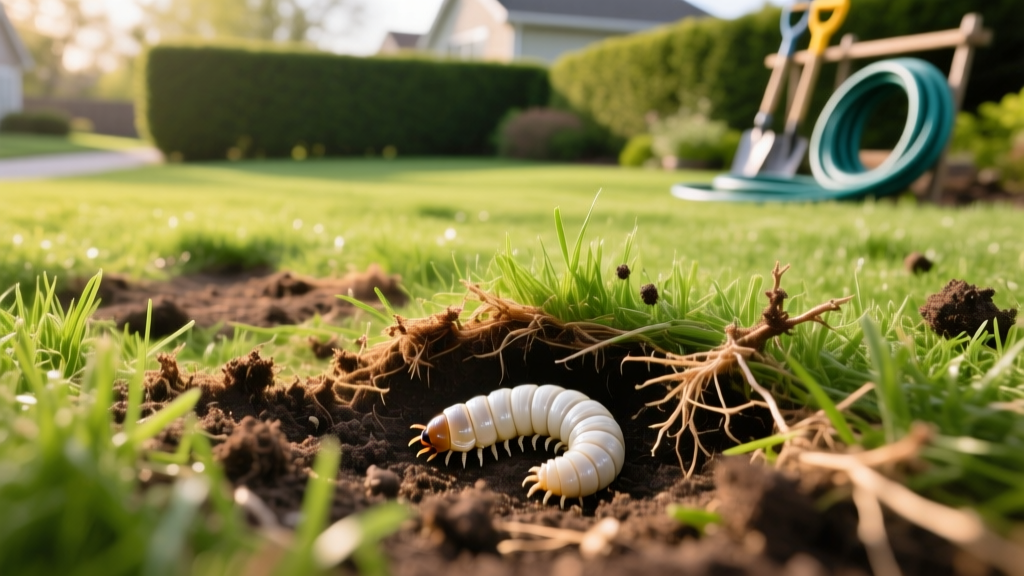
Do Grubs Die in the Winter? The Truth About Overwintering and Spring Lawn Damage
The Short Answer: No, Grubs Do Not Die in the Winter
When homeowners ask, "do grubs die in the winter?" the answer is a definitive no. White grubs—the larval stage of scarab beetles like Japanese beetles, European chafers, and June bugs—are highly adapted to survive freezing temperatures. Instead of dying off, they enter a state of dormancy known as diapause and employ a physical survival mechanism that keeps them safely insulated beneath the frost line.
Understanding this overwintering behavior is critical for turf management. Many homeowners mistakenly believe that a harsh, freezing winter will naturally eliminate their grub population, leading them to skip preventative treatments. By spring, they are left with severe root damage and destroyed turf. This guide breaks down the exact biological mechanisms grubs use to survive the freeze, how to identify overwintering damage, and the precise chemical protocols required to protect your lawn.
Expert Insight: A severe polar vortex or deep freeze rarely impacts grub mortality. In fact, heavy snow cover acts as an insulating blanket, keeping soil temperatures at the 32°F mark and actually protecting the grubs below from extreme ambient air temperatures.
The Biology of Overwintering: Temperature Triggers and Soil Migration
Grub survival is dictated entirely by soil temperature, not air temperature. As autumn progresses and daylight hours shorten, grubs respond to specific thermal thresholds in the soil profile.
- The 50°F Threshold (Cessation of Feeding): When soil temperatures at the root zone drop consistently below 50°F, grubs stop feeding on turfgrass roots. This usually occurs in late October or November, depending on your hardiness zone.
- The 35°F Threshold (Downward Migration): As the soil cools further toward freezing, grubs begin their downward migration. They move from the shallow root zone (1–3 inches deep) down into the subsoil, typically burrowing 6 to 12 inches below the surface to escape the frost line.
- Diapause (Winter Dormancy): Once below the frost line, where soil temperatures remain a stable 35°F to 40°F even when the air above is well below zero, grubs enter diapause. Their metabolic rate drops drastically, allowing them to survive for months without consuming any food.
According to turfgrass researchers at the University of Minnesota Extension, this downward migration is why applying curative grub killers in December or January is entirely ineffective; the chemicals cannot penetrate deep enough into the frozen subsoil to reach the dormant larvae.
Species Breakdown: Winter Hardiness and Spring Emergence
Not all grubs behave identically. The three most common turf-destroying species in North America have slightly different overwintering depths and spring emergence timelines, which dictates your treatment window.
| Grub Species | Overwintering Depth | Spring Emergence Temp | Primary Spring Threat |
|---|---|---|---|
| European Chafer | 8–12 inches | 50°F (Early April) | Severe root pruning before pupation |
| Japanese Beetle | 6–10 inches | 55°F (Late April/May) | Moderate root feeding; secondary animal damage |
| June Bug (Masked Chafer) | 4–8 inches | 60°F (Mid-May) | Rapid, aggressive root consumption |
The Spring Damage Illusion: Grub Feeding vs. Animal Foraging
A common misconception addressed by Penn State Extension is the assumption that all spring lawn damage is caused by grubs eating roots. In reality, a significant percentage of early spring turf destruction is caused by secondary predators.
Because grubs do not die in the winter, they remain a high-protein food source for wildlife. As the ground thaws in March and April, grubs migrate back up to the top 2 inches of soil to resume feeding before pupating. This upward migration signals foraging animals.
Diagnostic Checklist: Is it Grubs or Animals?
- Animal Foraging: Characterized by rolled-back sod, shallow craters, and scattered dirt mounds. Skunks, raccoons, and crows will literally peel the turf back like a carpet to access the grubs. The roots may still be intact, but the physical tearing destroys the lawn.
- Direct Grub Damage: Characterized by spongy turf that detaches easily from the soil (like pulling up a loose rug) with no animal digging present. The roots are visibly sheared off, and the grass turns brown despite adequate spring moisture.
Strategic Treatment Timeline: Chemical Protocols and Costs
Since winter does not kill grubs, chemical intervention must be timed perfectly around their biological lifecycle. Applying the wrong active ingredient at the wrong time is the primary reason homeowners fail to control grub populations.
Preventative Treatments (The Proactive Approach)
Preventatives target young, newly hatched grubs in mid-summer before they can cause damage or prepare for winter. These products must be watered into the soil and take several weeks to become fully active.
- Active Ingredient: Chlorantraniliprole (Brand names: Acelepryn, Scotts GrubEx).
- Application Window: April through mid-July. (Applying in April ensures the chemical is in the root zone when eggs hatch in late July).
- Cost Estimate: $4.00 to $6.00 per 1,000 square feet.
- Efficacy: 95%+ control of young instars. Highly safe for pollinators and earthworms.
Curative Treatments (The Reactive Approach)
If you missed the preventative window and discover active grubs in late summer or early fall (or if you are trying to knock down a population right before they enter winter diapause), you need a fast-acting curative.
- Active Ingredient: Trichlorfon (Brand name: Dylox) or Carbaryl (Sevin).
- Application Window: Late August through September. (Must be applied while grubs are still small and actively feeding near the surface; ineffective once they migrate deep for winter).
- Cost Estimate: $8.00 to $12.00 per 1,000 square feet.
- Efficacy: Kills within 48 to 72 hours, but breaks down rapidly in the soil. Will not provide residual control into the following spring.
The 1-Square-Foot Scouting Protocol
Before spending hundreds of dollars on curative treatments in the fall or early spring, you must verify the grub population density. Treat only if the threshold is met.
- Select Sample Zones: Choose 3 to 5 areas of the lawn, prioritizing south-facing slopes, areas near sidewalks (where soil is warmer), and zones with a history of damage.
- Cut the Plug: Using a flat-edged spade or a specialized turf sampler, cut three sides of a 12-inch by 12-inch square, cutting about 3 inches deep into the soil.
- Peel and Inspect: Pull the sod flap back. Examine the soil surface and the root mass. Use a hand trowel to dig 2 inches deeper into the exposed soil.
- Count and Calculate: Count the number of C-shaped white grubs. Multiply by 1 (since you sampled 1 square foot).
- Compare to Thresholds: If you find 5 to 7 grubs per square foot for European Chafer, or 8 to 10 grubs per square foot for Japanese Beetles, treatment is economically justified. If counts are below these numbers, the turf can naturally outgrow the root damage without chemical intervention.
Frequently Asked Questions
Does a heavy snow cover kill grubs by suffocating them?
No. Snow is highly porous and contains a massive amount of trapped air, which acts as an exceptional insulator. A deep snowpack actually prevents the soil from freezing as deeply as it would under bare, exposed conditions, keeping the overwintering grubs in a stable, survivable thermal pocket.
Will a sudden spring freeze kill grubs that have already migrated to the surface?
It can, but only under specific conditions. If grubs have migrated to the top 2 inches of soil in early April to feed, and a sudden, hard freeze drops the soil temperature below 28°F for several consecutive days, some surface-level mortality will occur. However, grubs deeper in the profile will survive, meaning the population will rebound quickly.
Can I apply nematodes in the winter to kill overwintering grubs?
No. Beneficial nematodes (like Heterorhabditis bacteriophora) are living organisms that require soil temperatures of at least 60°F to remain active and hunt. Applying them in winter or early spring will result in the nematodes dying before they can infect the dormant grubs. Wait until late summer when soil temperatures are optimal.

