
Pest Control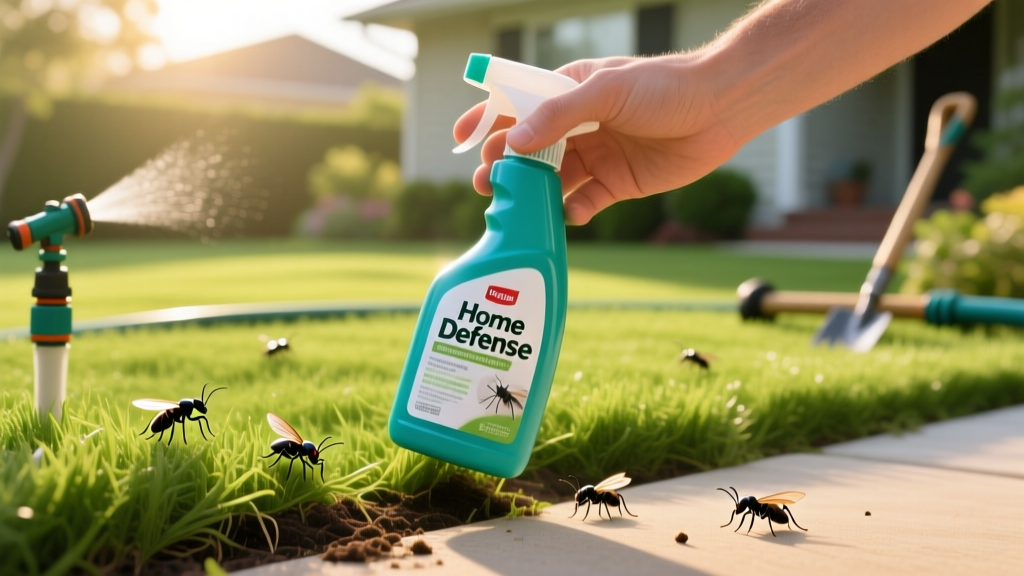
Does Home Defense Kill Fleas? The Chemical Breakdown
The Short Answer: Does Standard Home Defense Kill Fleas?
If you are asking whether the standard Ortho Home Defense Insect Killer for Indoor & Perimeter (the ubiquitous clear jug with the red trigger) kills fleas, the technical answer is yes—but the practical answer is no. The standard formula relies on 0.05% Bifenthrin, a pyrethroid that will kill adult fleas on contact. However, it completely fails to address the flea life cycle. Because it lacks an Insect Growth Regulator (IGR), it cannot stop eggs from hatching or larvae from developing. Applying standard perimeter spray to a flea-infested lawn or carpet will result in a temporary reduction of adult fleas, followed by a massive resurgence 10 to 14 days later when the next generation emerges.
⚠️ Pet Safety Warning: Bifenthrin and related pyrethroids are highly toxic to cats when wet. If you use any Home Defense product indoors or on lawns, keep all felines off the treated area until the chemical has completely dried (typically 2 to 4 hours depending on humidity).
The Chemistry Problem: Bifenthrin vs. The Flea Life Cycle
To understand why standard perimeter sprays fail against fleas, you must look at the active ingredients. According to the EPA's guidelines on flea control, effective eradication requires targeting multiple life stages simultaneously. Standard Home Defense uses Bifenthrin, a sodium channel modulator that causes paralysis and death in adult insects.
Fleas, however, spend up to 95% of their population in the environment as eggs, larvae, or pupae. Bifenthrin does not penetrate the silk-and-debris cocoon of the flea pupa, nor does it mimic the hormones required to stunt larval growth. To break the cycle, a chemical must include an IGR like Pyriproxyfen or S-methoprene. Pyriproxyfen acts as a juvenile hormone analog, tricking the larvae into remaining in an immature state until they die, effectively sterilizing the infestation.
Ortho Home Defense Product Matrix: Which One Actually Works?
Ortho manufactures several products under the "Home Defense" umbrella. As of 2026, retail pricing and formulations vary significantly. Here is how the specific flea-targeted products compare to the standard perimeter spray.
| Product Name | Active Ingredients | Avg. Price (2026) | Flea Efficacy |
|---|---|---|---|
| Standard Indoor & Perimeter | Bifenthrin (0.05%) | $14 - $17 / Gallon | Poor. Kills adults only. No residual IGR. |
| Max Flea & Tick for Lawns (Granules) | Bifenthrin (0.115%) + Zeta-cypermethrin | $25 / 5,000 sq ft | Moderate. Excellent adult knockdown in the thatch layer, but lacks an IGR. |
| Max Flea & Tick for Carpets (Aerosol) | Bifenthrin + Pyriproxyfen (IGR) | $10 / 14 oz can | Excellent. Contains IGR to break the reproductive cycle indoors. |
The 4-Step Lawn and Home Flea Eradication Protocol
Relying on a single chemical application is the primary reason homeowners experience recurring flea issues. University of Kentucky Entomology emphasizes that environmental modification must accompany chemical treatment. Follow this precise protocol to achieve total eradication.
Step 1: Mechanical Stimulation (The Vacuum Phase)
Before applying any chemical, vacuum all carpets, rugs, and upholstery thoroughly. The physical vibrations and heat from the vacuum head stimulate pre-emerged adult fleas to hatch from their chemically impermeable cocoons. This forces them into the environment where they will later contact your residual insecticide. Immediately seal and dispose of the vacuum bag or empty the canister into an outdoor trash receptacle.
Step 2: Outdoor Thatch Treatment
Flea larvae thrive in the shaded, humid thatch layer of your lawn, feeding on organic debris and adult flea feces (flea dirt). Apply Ortho Home Defense Max Flea & Tick Killer for Lawns granules at a rate of 2.5 lbs per 1,000 square feet. Critical Edge Case: Granular bifenthrin must be watered into the thatch layer to be effective. Apply exactly 0.25 inches of irrigation immediately after spreading. If left on dry grass blades, the UV radiation will degrade the pyrethroid within 48 hours, rendering it useless against ground-dwelling larvae.
Step 3: Indoor IGR Application
Use the Ortho Home Defense Max Flea & Tick for Carpets aerosol. The inclusion of Pyriproxyfen is non-negotiable here. Spray in a sweeping motion over carpets, pet bedding, and baseboards. The IGR will remain active in carpet fibers for up to 7 months, preventing any surviving eggs from maturing into biting adults.
Step 4: The Host Treatment
Environmental sprays do not replace veterinary medicine. Your pet acts as the mobile host. Consult your veterinarian for an oral isoxazoline-class treatment (e.g., NexGard, Bravecto, or Simparica), which disrupts the flea's nervous system upon biting the host. Combining a systemic pet treatment with an environmental IGR spray creates an inescapable biological trap.
Why Your Flea Treatment Failed: 3 Hidden Edge Cases
- The Pupal Window: Flea pupae can remain dormant in their cocoons for up to 5 months waiting for environmental cues (heat, carbon dioxide, vibrations). If you spray and then leave the house for a weekend, a massive emergence can occur upon your return. This is not a chemical failure; it is a biological timing issue. Continue vacuuming daily for 14 days post-treatment to force emergence.
- Alkaline Hydrolysis: Bifenthrin degrades rapidly in highly alkaline environments. If you recently applied agricultural lime to your lawn to adjust soil pH, the residual efficacy of your outdoor flea granules will be cut in half. Always apply lime and pyrethroid insecticides at least two weeks apart.
- Wildlife Vectors: If opossums, feral cats, or raccoons are nesting under your deck or shed, they are continuously dropping flea eggs into your yard. No amount of lawn spray will solve the issue until the wildlife vector is excluded using hardware cloth or lattice barriers.
Frequently Asked Questions
Can I spray standard Home Defense directly on my dog or cat?
Absolutely not. Standard Home Defense Insect Killer for Indoor & Perimeter is strictly an environmental surface spray. It is not formulated, tested, or approved for direct application to animals. Applying it to pets can cause severe neurological toxicity, tremors, and potentially death, especially in cats.
How long does it take for Home Defense carpet spray to dry?
Under normal indoor conditions (70°F and 50% humidity), the aerosol carrier agents evaporate within 1 to 2 hours. Keep children and pets out of the treated rooms until the carpet fibers are completely dry to the touch to prevent dermal absorption of the wet pyrethroids.
Will rain wash away the outdoor lawn granules?
Light to moderate rain after the granules have been watered in is actually beneficial, as it helps push the active ingredient deeper into the soil profile and thatch layer where flea larvae reside. However, heavy downpours or flooding immediately after application can cause runoff, requiring a reapplication once the soil drains.

