
Pest Control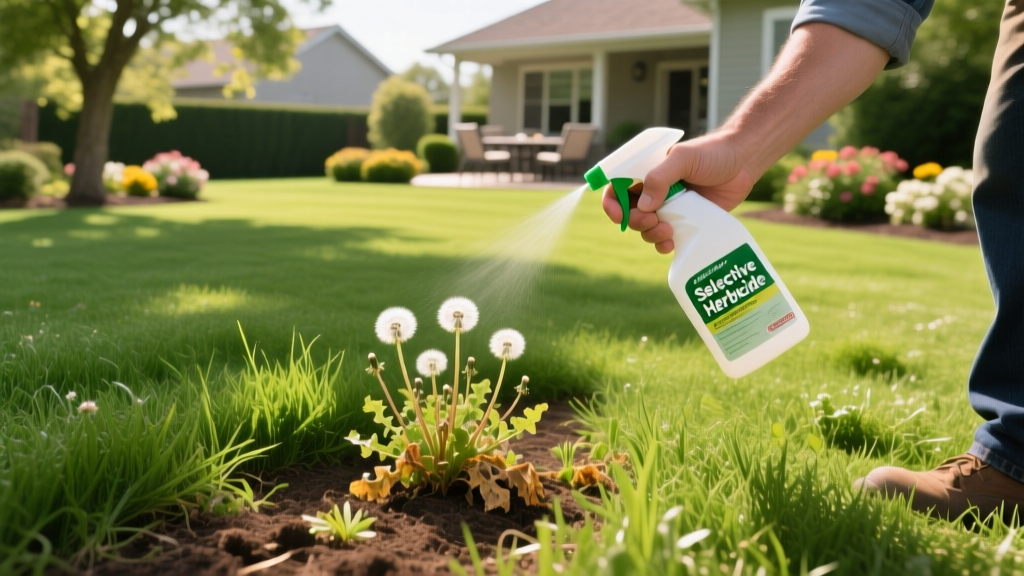
Does Weed Killer Kill Grass? Selective vs Non-Selective Explained
The Short Answer: It Depends on the Active Ingredient
When homeowners ask, "does weed killer kill grass?", the answer is not a simple yes or no. The outcome depends entirely on the chemical formulation in the tank and the specific turfgrass species growing in your yard. Herbicides are broadly categorized into two distinct classes: selective and non-selective. Selective herbicides are engineered to target specific physiological pathways found only in broadleaf weeds or specific grassy weeds, leaving your desirable turf unharmed. Non-selective herbicides, conversely, are designed to destroy any green plant tissue they contact.
Misunderstanding this distinction is the leading cause of accidental lawn destruction. Applying a non-selective systemic killer like glyphosate to a patch of dandelions will eradicate the weeds, but it will also kill the surrounding Kentucky Bluegrass or Bermudagrass, leaving you with a $0.15-per-square-foot reseeding bill. This guide breaks down the biochemical mechanics of herbicide selectivity, common application failures that cause turf burn, and exact recovery protocols for damaged lawns.
The Science of Selectivity: Why Some Herbicides Spare Turf
To understand why certain chemicals kill weeds but spare grass, we must look at plant morphology and metabolism. Most selective broadleaf herbicides (such as 2,4-D, Dicamba, and MCPP) are synthetic auxins. Auxins are plant hormones that regulate growth. When applied to broadleaf plants (dicots), these synthetic auxins cause rapid, uncontrolled cellular division. The weed essentially grows itself to death, twisting and cupping until its vascular system collapses.
Why Grass Survives Auxin Herbicides: Grasses are monocots. They possess a different vascular structure and, more importantly, have the enzymatic ability to rapidly metabolize and detoxify synthetic auxins before they can cause fatal cellular disruption. Furthermore, the upright, narrow leaf structure of grass sheds liquid droplets more efficiently than the broad, flat leaves of a plantain or dandelion.
Non-selective herbicides like glyphosate operate differently. Glyphosate inhibits the EPSP synthase enzyme, a critical component of the shikimic acid pathway responsible for producing essential amino acids. Because this pathway exists in all green plants, glyphosate is universally lethal to both weeds and turfgrass.
Selective vs. Non-Selective Herbicides: Decision Matrix
Choosing the correct product requires matching the active ingredient to your specific weed problem and turf type. Below is a comparison of the most common residential and professional herbicide classes available in 2026.
| Active Ingredient | Type | Target Weeds | Grass Safety Profile | Avg. Cost (Concentrate) |
|---|---|---|---|---|
| 2,4-D + Dicamba + MCPP | Selective (Systemic) | Broadleaf (Dandelion, Clover) | Safe for most cool-season grasses. Can stunt St. Augustine. | $35 - $50 / gal |
| Quinclorac | Selective (Systemic) | Grassy weeds (Crabgrass) | Safe for Bluegrass/Fescue. High burn risk on Zoysia/Centipede. | $60 - $85 / gal |
| Atrazine | Selective (Root/Leaf) | Broadleaf & some grassy | Safe ONLY for St. Augustine and Centipedegrass. Kills Fescue. | $40 - $60 / gal |
| Glyphosate (41%) | Non-Selective (Systemic) | All vegetation | Lethal to all turfgrass. Use only for spot treatment or renovation. | $45 - $65 / gal |
| Pelargonic Acid | Non-Selective (Contact) | All vegetation (burns tops) | Burns grass blades on contact; roots may survive if mature. | $25 - $40 / gal |
4 Reasons Your "Grass-Safe" Weed Killer Killed Your Lawn
If you applied a selective herbicide and your turfgrass is now showing signs of yellowing, stunting, or necrosis, the product did not fail—the application parameters did. Here are the four most common failure modes that cause selective herbicides to damage desirable grass.
1. Temperature Inversion and Ester Volatility
Many older or professional-grade herbicides use an "ester" formulation of 2,4-D to penetrate waxy weed cuticles. However, esters are highly volatile. If you apply an ester-based herbicide when ambient temperatures exceed 85°F (29°C), the chemical vaporizes into the air. As the evening cools, a temperature inversion traps these vapors near the ground, drifting them onto your grass and nearby ornamental shrubs. The result is severe epinasty (twisting and cupping) in your turf. The Fix: Always use "amine" salt formulations for residential summer applications, and never spray when temperatures are above 85°F or expected to rise above 85°F within 24 hours.
2. Warm-Season Grass Sensitivity Mismatch
Selective herbicides are not universally safe for all grass species. St. Augustinegrass and Centipedegrass are highly sensitive to 2,4-D and Dicamba. Applying a standard "Weed and Feed" product containing these chemicals to a St. Augustine lawn in Texas or Florida will result in severe chlorosis (yellowing) and root stunting. Similarly, Quinclorac—the gold standard for killing crabgrass—is notorious for causing severe phytotoxicity (burn) on certain cultivars of Zoysiagrass and Bermudagrass if applied during spring green-up.
3. Surfactant Phytotoxicity
Herbicides require a surfactant (a wetting agent) to break the surface tension of water and allow the chemical to adhere to the weed leaf. While non-ionic surfactants (NIS) are standard, adding too much NIS to your tank mix, or using a crop oil concentrate (COC) during high heat, will strip the protective waxy cuticle right off your grass blades. This causes rapid desiccation and white, bleached spots on the turf. Stick strictly to the label's surfactant rate—usually 0.25% to 0.5% by volume (approx. 1 to 2 teaspoons per gallon of water).
4. Tank-Mix Antagonism and Overdosing
A common homeowner mistake is the "more is better" fallacy. Doubling the concentration of a selective herbicide will not kill the weed twice as fast; it will overwhelm the turfgrass's metabolic ability to detoxify the chemical, resulting in severe burn. Furthermore, mixing a systemic grassy weed killer (like Quinclorac) with a contact broadleaf killer (like Carfentrazone) can cause antagonism, where the rapid leaf burn from the contact chemical prevents the systemic chemical from translocating to the weed's roots, while simultaneously burning your grass.
Emergency Recovery Protocol: Fixing Herbicide Burn
If you have accidentally sprayed your lawn with a non-selective herbicide or overdosed a selective product, immediate action can mitigate the damage. Follow this timeline to salvage your turf.
- Hour 0-24: The Flush Protocol. If you realize the mistake immediately, flood the affected area with water. Apply at least 1 inch of water via sprinkler to dilute the chemical concentration in the soil profile and wash it off the grass blades before it fully translocates. For contact herbicides (like pelargonic acid), washing is less effective, but still recommended.
- Day 3-7: The Tug Test. Wait a week to assess crown viability. Grab a handful of the damaged grass and pull gently. If the grass snaps off at the soil line but the base (crown) remains firm and white, the plant is alive and will push new tillers. If the entire root system pulls up easily and the crown is brown and mushy, the plant is dead.
- Day 14: Soil Activation (For Pre-Emergent Residue). If the damage was caused by a heavy pre-emergent herbicide overdose (like Prodiamine) that is stunting root growth, apply activated charcoal or a specialized soil biostimulant containing humic acid to help bind the excess chemical in the soil.
- Day 21: Renovation vs. Recovery. For areas where the crown is dead, you must renovate. Rake out the dead thatch. For cool-season lawns, overseed with a matching turf-type tall fescue blend at a rate of 5 to 8 lbs per 1,000 sq ft (seed costs approx. $6-$9 per lb). For warm-season lawns, lay fresh sod, which costs between $0.55 and $0.85 per square foot installed. Keep the new seed or sod consistently moist for 21 days to establish root depth.
Authoritative Resources for Turf Management
Proper weed identification and herbicide selection require ongoing education. Consult the following institutional resources for localized turfgrass management data and label specifications:
- University of Minnesota Extension: Weed Control in Lawns – Comprehensive guides on cool-season turfgrass herbicide timing and selectivity.
- EPA Safe Pest Control: Weed Killers – Federal regulatory guidelines on herbicide safety, handling, and environmental impact.

