
Pest Control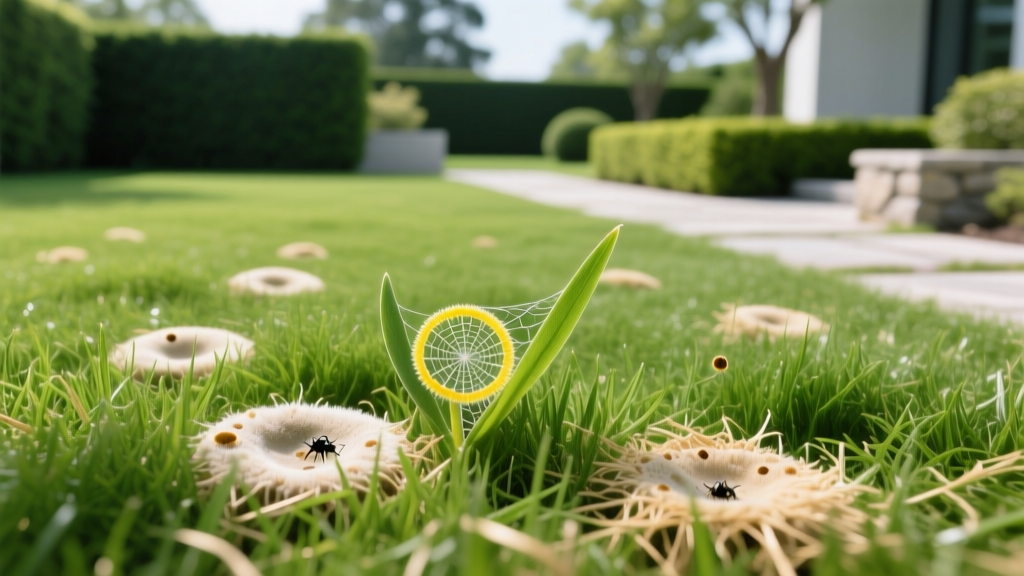
Dollar Spot Fungicide Guide: Symptom Diagnosis and Rescue Fixes
Confirming the Diagnosis: The 3-Point Dollar Spot Check
Before purchasing a dollar spot fungicide, you must definitively confirm the pathogen. Dollar spot, caused by the fungus Clarireedia jacksonii (formerly Sclerotinia homoeocarpa), is frequently misdiagnosed as brown patch or pythium blight. Misidentification leads to wasted chemical applications and further turf decline. According to NC State University's TurfFiles, accurate diagnosis relies on three specific visual markers.
1. Patch Morphology and Coalescence
Dollar spot initially presents as distinct, circular, straw-colored patches roughly the size of a silver dollar (1 to 3 inches in diameter). On closely mowed turf like bentgrass or bermudagrass, these spots remain distinct longer. On taller residential lawns (tall fescue, Kentucky bluegrass), the patches rapidly coalesce into large, irregular blighted areas spanning several feet. If your patches are perfectly circular and larger than 6 inches from the start, suspect brown patch instead.
2. The Morning Dew Mycelium Window
The most definitive field diagnostic tool is the presence of mycelium. Between 5:00 AM and 8:00 AM, while heavy dew is still on the grass, inspect the margins of the affected patches. Dollar spot produces a white, cobweb-like mycelial growth that disappears completely once the sun dries the canopy. If you observe this temporary webbing, you have a confirmed active Clarireedia jacksonii infection.
3. Lesion Microscopy
Pull a single affected grass blade from the margin of a spot. Dollar spot lesions are uniquely hourglass-shaped, featuring a bleached, straw-colored center bounded by sharp, reddish-brown margins. If the lesion spans the entire width of the leaf blade and lacks the distinct hourglass pinching, you are likely dealing with a different foliar disease.
The Pre-Fungicide Rescue: Nitrogen and Moisture Management
Applying a dollar spot fungicide to a nitrogen-starved lawn is a temporary bandage that will fail within 21 days. C. jacksonii is an opportunistic pathogen that aggressively targets slow-growing, nitrogen-deficient turf. If your lawn has not received a nitrogen application in the last 30 days, chemical control will be severely compromised.
Rescue Fix Protocol: Apply 0.25 to 0.5 lbs of quick-release nitrogen (such as Ammonium Sulfate 21-0-0) per 1,000 sq ft immediately prior to or concurrent with your fungicide application. This stimulates rapid leaf growth, allowing the turf to outgrow the infection and physically shed the blighted tissue. Water the nitrogen in immediately to prevent foliar burn.
Furthermore, dollar spot thrives in high-humidity microclimates. If soil moisture is excessive, delay the fungicide application by 24 hours and perform deep core aeration or drag-matting to disrupt the thatch layer holding the canopy moisture.
Dollar Spot Fungicide Matrix: Systemic vs. Contact
Selecting the correct active ingredient (AI) depends on the severity of the outbreak, your budget, and your previous chemical history. Fungicide resistance is a massive issue with dollar spot. The Fungicide Resistance Action Committee (FRAC) strictly mandates rotating chemical classes to prevent the pathogen from developing immunity. Never apply two consecutive treatments from the same FRAC code.
| Active Ingredient | Brand Example | FRAC Code | Action Type | Cost / 1k sq ft | Best Rescue Use Case |
|---|---|---|---|---|---|
| Azoxystrobin | Heritage SC | 11 | Systemic | $0.018 | Curative rescue for active outbreaks; excellent plant health benefits. |
| Propiconazole | Bayer Interface | 3 | Systemic | $0.025 | Rapid knockdown of severe infections; stress tolerance enhancement. |
| Fluazinam | Daconcil / Contact | 29 | Contact | $0.012 | Resistance management rotation; prevents spore germination on leaf surface. |
| Boscalid | Honor Intrinsic | 7 | Systemic | $0.030 | Premium curative fix for FRAC 11-resistant dollar spot strains. |
Exact Application Protocol for Lawn Rescue
The efficacy of your chosen dollar spot fungicide drops by up to 40% if application mechanics are flawed. Because dollar spot is primarily a foliar and crown disease, the chemical must remain in the upper canopy and thatch layer, not be washed immediately into the soil profile.
- Calibrate for Canopy Coverage: Set your sprayer to deliver 2.0 Gallons Per Acre (GPA), which translates to roughly 0.5 to 0.75 gallons of water per 1,000 sq ft. Use a standard flat-fan nozzle (e.g., TeeJet XR11004) operating at 30 PSI. Avoid air-induction nozzles (AIXR), which produce coarse droplets that bounce off the grass blade and fail to coat the lesion sites.
- Add a Non-Ionic Surfactant (NIS): Unless the product label explicitly forbids it, add a high-quality NIS (like Lesco Aquax or similar) at a rate of 1 to 2 pints per 100 gallons of water. This breaks the surface tension of the dew and ensures the fungicide spreads evenly across the waxy grass cuticle.
- Timing the Spray Window: Apply the fungicide in the late afternoon or early evening. Spraying at 6:00 PM allows the chemical to dry on the leaf surface overnight without being degraded by UV radiation. Do not spray if rain is forecasted within 12 hours.
- The Watering Decision: For purely curative rescue of foliar dollar spot, do not water in systemic fungicides like Azoxystrobin or Propiconazole immediately. Allow the plant 12 to 24 hours to absorb the chemical through the stomata. If you are targeting the soil-borne sclerotia (survival structures) for future prevention, water in with 0.1 inches of irrigation immediately after application.
Warning: Phytotoxicity Risk. When using DMI fungicides (FRAC 3, like Propiconazole) during summer temperatures exceeding 85°F, you risk phytotoxicity (chemical burn) on cool-season grasses like Kentucky Bluegrass. If daytime highs are above 85°F, switch to a QoI (FRAC 11) or SDHI (FRAC 7) chemistry to avoid burning the turf while attempting to cure it.
Troubleshooting Failed Treatments
If the dollar spot patches continue to expand 7 to 10 days after your fungicide application, do not immediately reapply the same chemical. Investigate the following failure modes:
1. Fungicide Resistance
According to Penn State Extension, C. jacksonii has documented, widespread resistance to FRAC 1 (Thiophanate-methyl) and severe shifts in sensitivity to FRAC 11 (Azoxystrobin). If your first rescue application was a strobilurin (FRAC 11), your follow-up application must be a multi-site contact (FRAC M05, like Chlorothalonil) or an SDHI (FRAC 7, like Boscalid).
2. Thatch Lockout
If your lawn has a thatch layer exceeding 0.5 inches, the fungicide is binding to the hydrophobic organic matter and never reaching the crown where the infection originates. If thatch is the culprit, you must perform a liquid aeration or physical core aeration before your next chemical application, followed by a heavy wetting agent (surfactant) to penetrate the organic barrier.
3. Misdiagnosis: Pythium Blight
If the patches are rapidly expanding during periods of extreme heat (above 85°F) and high nighttime humidity, and the grass feels greasy or matted to the touch, you are likely fighting Pythium blight, not dollar spot. Pythium requires completely different chemistry, specifically Phosphonates (FRAC 33) or Metalaxyl (FRAC 4). Re-evaluate the lesion structure before spending more money on the wrong active ingredient.
Successful dollar spot eradication requires a synthesis of precise diagnosis, aggressive nitrogen feeding, and strict adherence to FRAC rotation protocols. By treating the underlying cultural deficiency while deploying targeted chemistry, you can halt the pathogen and restore canopy density within 14 to 21 days.

