
Pest Control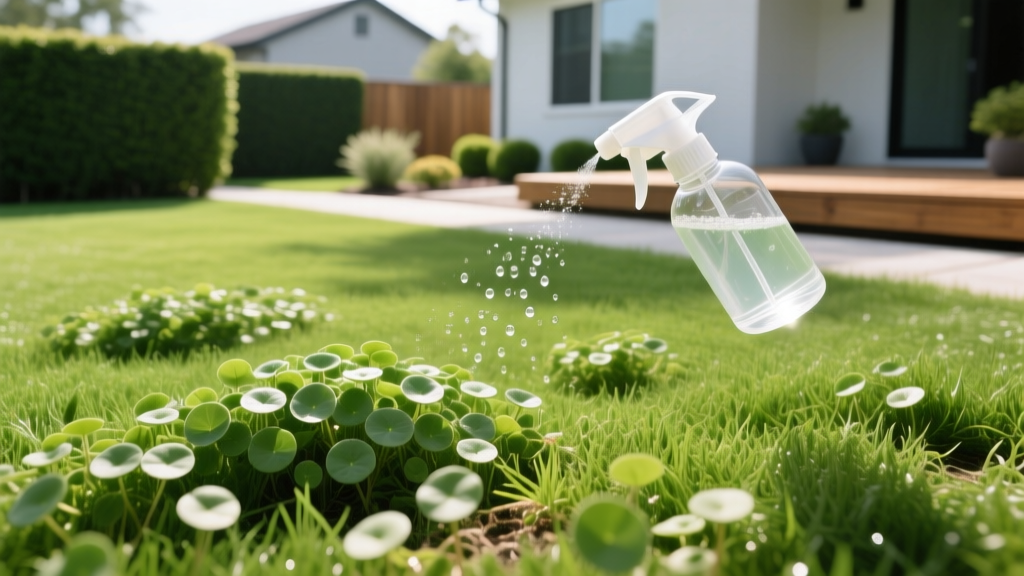
Best Dollarweed Herbicide Choices for Lawn Spot Treatment
The Moisture-Weed Connection: Why Dollarweed Invades
Dollarweed (Hydrocotyle spp.) is an aggressive, broadleaf perennial weed that thrives in environments where turfgrass struggles: specifically, areas with excessive soil moisture, poor drainage, and compacted earth. Unlike many weeds that exploit dry, nutrient-poor soil, dollarweed requires consistent dampness to establish its shallow, rhizomatous root system. When addressing an infestation, selecting the correct dollarweed herbicide is only half the battle; the other half involves correcting the underlying hydrological issues in your soil.
Because dollarweed often appears in localized patches near downspouts, shaded garden beds, or low-lying yard zones, broadcast spraying the entire lawn is frequently unnecessary and economically inefficient. A targeted spot-treatment approach minimizes chemical load, reduces turf stress, and cuts product costs by up to 80% compared to blanket applications.
Accurate Identification: Dollarweed vs. Lookalikes
Before mixing any chemical, confirm the weed's identity. Dollarweed is frequently misidentified as creeping charlie (ground ivy) or dichondra, leading to ineffective herbicide selection. According to NC State TurfFiles, the definitive identification marker is the petiole (stem) attachment.
- Dollarweed: The stem attaches directly to the center of the circular leaf, resembling a tiny umbrella. The leaf margins are slightly scalloped, and the surface is glossy.
- Creeping Charlie: The stem attaches to the edge of the leaf. It features a distinctly minty odor when crushed and square stems.
- Dichondra: The stem attaches to the edge of the leaf, and the leaves are kidney-shaped rather than perfectly circular.
Expert Tip: If the soil is soggy and the leaves are perfectly round with the stem in the middle, you are dealing with dollarweed. Proceed with broadleaf-specific post-emergent herbicides.
Spot-Treatment vs. Broadcast: Cost and Efficacy Breakdown
For a standard 5,000 sq. ft. lawn with dollarweed confined to three 10x10 ft. problem zones (300 sq. ft. total), spot-treating yields massive financial and environmental benefits. The table below illustrates the difference using a standard professional-grade sulfentrazone/2,4-D blend.
| Metric | Broadcast Application (5,000 sq. ft.) | Spot Treatment (300 sq. ft.) |
|---|---|---|
| Herbicide Volume Required | ~7.5 fl. oz. | ~0.45 fl. oz. |
| Water Carrier Volume | ~10 Gallons | ~0.6 Gallons |
| Chemical Cost (Approx.) | $12.50 | $0.75 |
| Turf Stress Risk | Moderate (systemic shock) | Minimal (localized) |
Top Dollarweed Herbicide Active Ingredients
Dollarweed possesses a thick, waxy leaf cuticle that repels water-based solutions. To penetrate this barrier, your herbicide must contain specific active ingredients and be paired with a surfactant. The most effective active ingredients for post-emergent control include:
- Sulfentrazone + 2,4-D + MCPP + Dicamba: A four-way blend that attacks the weed through multiple modes of action, preventing resistance. Sulfentrazone provides rapid burndown, while the others offer systemic root kill.
- Penoxsulam: Highly effective on warm-season grasses (like St. Augustine) where high doses of 2,4-D can cause phytotoxicity.
- Metsulfuron-methyl: An ALS-inhibitor that works exceptionally well on mature, deeply rooted dollarweed patches, though it acts slowly (14-21 days for full necrosis).
Critical Surfactant Requirement: Never apply a dollarweed herbicide without a Non-Ionic Surfactant (NIS). The waxy cuticle of Hydrocotyle leaves will cause the spray to bead up and roll off. Add NIS at a rate of 0.25% v/v (approximately 1/2 teaspoon per gallon of mixed solution) to ensure the chemical adheres to and penetrates the leaf tissue.
Recommended Herbicide Products for Spot Treatment
Selecting the right commercial product depends entirely on your turfgrass species. Applying a cool-season herbicide to warm-season turf will result in severe yellowing or death of your lawn. Texas A&M Turfgrass emphasizes strict adherence to label rates based on turf type.
1. SpeedZone Southern (Warm-Season Safe)
Best for: St. Augustine, Centipede, Zoysia, and dormant Bermuda grass.
Active Ingredients: Carfentrazone-ethyl, 2,4-D, MCPP, Dicamba.
Spot-Treatment Mix Rate: 1.0 to 1.5 fl. oz. per 1 gallon of water (covers ~1,000 sq. ft.).
Cost: ~$48.00 for a 20 oz. bottle (yields over 13 gallons of spot-treatment mix).
Why it works: The carfentrazone provides visible burn-down of the waxy leaves within 48 hours, while the systemic auxins kill the rhizomes over the next two weeks.
2. Blindside SG (Professional Grade)
Best for: All warm-season grasses and select cool-season grasses (check label for Fescue/Bluegrass restrictions).
Active Ingredients: Sulfentrazone, Metsulfuron-methyl.
Spot-Treatment Mix Rate: 0.5 oz (by weight) per 1 gallon of water per 1,000 sq. ft.
Cost: ~$65.00 for an 8 oz. bottle.
Why it works: Metsulfuron is devastating to broadleaf weeds but gentle on most southern turfgrasses. It is the industry standard for stubborn, mature dollarweed colonies.
3. Ortho WeedClear Lawn Weed Killer (Cool-Season Safe)
Best for: Kentucky Bluegrass, Tall Fescue, Perennial Ryegrass.
Active Ingredients: 2,4-D, Quinclorac, Dicamba.
Spot-Treatment Mix Rate: 4.0 fl. oz. per 1 gallon of water.
Cost: ~$22.00 for a 32 oz. concentrate.
Why it works: Formulated specifically to avoid the phytotoxicity that standard agricultural 2,4-D causes in northern lawns, while still delivering a lethal dose to dollarweed.
Step-by-Step Spot-Treatment Application Protocol
Follow this exact procedure to maximize herbicide uptake and prevent turf damage.
- Calibrate Your Sprayer: Use a dedicated 1-gallon or 2-gallon pump sprayer. Do not use a sprayer previously used for glyphosate or systemic brush killers, as residue will kill your turfgrass.
- Mow First: Mow the lawn 24 hours before application. This encourages the dollarweed to push new, tender growth, which absorbs herbicides more rapidly than older, hardened leaves.
- Mix the Solution: Fill the sprayer halfway with water. Add the precise herbicide dose. Add the Non-Ionic Surfactant (1/2 tsp per gallon). Fill the rest of the sprayer with water and agitate gently.
- Target the Foliage: Spray the dollarweed patches until the leaves are uniformly wet, but not dripping. Over-spraying leads to soil pooling, which can harm turfgrass roots.
- Observe the Weather Window: Apply when temperatures are between 65°F and 85°F. Applications made above 85°F risk volatilization, where the herbicide turns into a gas and drifts onto desirable plants, causing cupping and stunting.
- Wait to Water: Do not irrigate the lawn or allow rainfall for at least 24 hours post-application to ensure the chemical fully translocates to the rhizomes.
Warning: Do not reapply the herbicide if you do not see immediate results. Systemic herbicides like metsulfuron and 2,4-D take 14 to 21 days to cause complete plant collapse. A second application within 7 days will overdose the soil and damage your turf.
Cultural Controls: Fixing the Root Cause
No dollarweed herbicide will provide long-term control if the environment remains favorable for its return. Dollarweed is an indicator weed; its presence screams "poor drainage." To permanently eradicate it, pair your chemical spot-treatments with these cultural practices:
- Core Aeration: Perform deep-tine core aeration in the fall (cool-season) or late spring (warm-season) to alleviate soil compaction and improve water percolation.
- Irrigation Auditing: Dollarweed thrives on daily, shallow watering. Switch your irrigation schedule to deep, infrequent watering (e.g., 0.5 inches twice a week) to encourage deep turf roots while allowing the topsoil to dry out between cycles.
- French Drains and Grading: If dollarweed continually returns to the same low-lying corner of your yard, install a French drain or regrade the soil to divert surface runoff away from the turf.
- Canopy Thinning: If the weed is growing under dense tree canopies where the soil never dries, hire an arborist to perform selective limb raising to increase sunlight penetration and evaporation.
Frequently Asked Questions
Will pulling dollarweed by hand work?
Hand-pulling is generally ineffective for established colonies. Dollarweed spreads via underground rhizomes and tubers. If you pull the top growth, the remaining rhizome nodes will simply sprout new leaves within a week. Spot-treating with a systemic herbicide is required to kill the root network.
Can I use vinegar or boiling water to kill dollarweed?
Horticultural vinegar (20% acetic acid) and boiling water will burn off the top foliage, but they possess no systemic action. The rhizomes will survive and regenerate. Furthermore, boiling water will destroy beneficial soil microbes and severely damage the roots of your surrounding turfgrass.
Is dollarweed toxic to pets?
Dollarweed itself is non-toxic to dogs and cats. However, the herbicides used to treat it can be harmful if ingested while wet. Keep pets off the treated areas until the liquid application has completely dried on the leaf surfaces, typically 2 to 4 hours after spraying.

