
Pest Control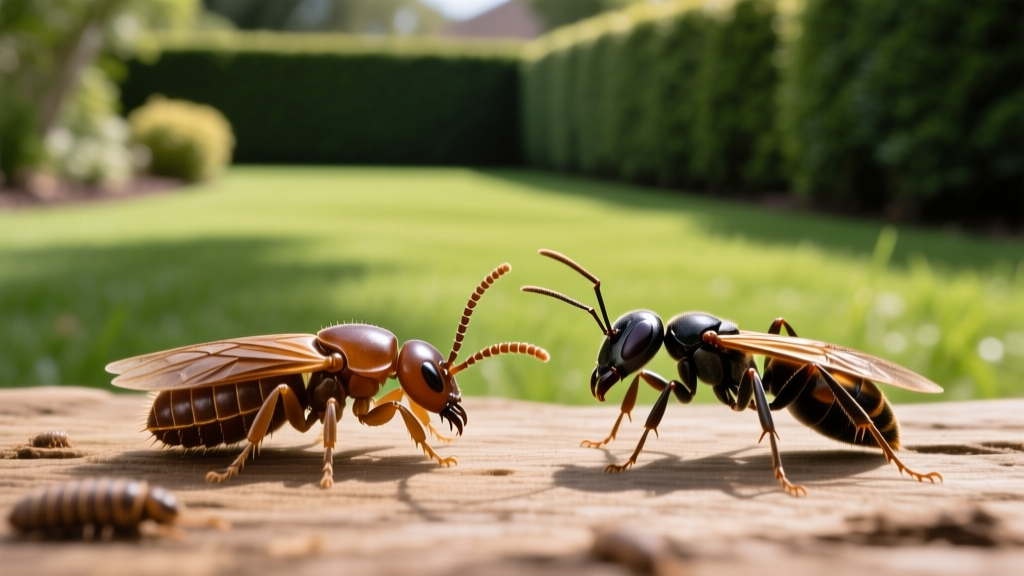
Drywood Termites vs. Bugs That Look Like Termites: ID Guide
The Hidden Threat of Drywood Termites
Unlike their subterranean cousins, drywood termites (primarily Incisitermes minor in the western U.S. and Cryptotermes brevis in the southeast) do not require soil contact to survive. They extract sufficient moisture directly from the wood they consume, allowing them to infest attic framing, hardwood floors, and structural joists entirely undetected. Because they live completely inside the wood, misidentifying the swarmers or the damage they leave behind is a common and costly mistake for homeowners. Accurately separating drywood termites from bugs that look like termites is the critical first step before committing to a treatment plan that can range from $150 for localized injections to over $2,500 for whole-structure tenting.
Anatomy of a Drywood Termite: What to Look For
To correctly identify these pests, you must examine their physical morphology. According to the National Pest Management Association, drywood termite swarmers (alates) and soldiers possess distinct anatomical markers that separate them from other wood-destroying insects.
- Body Shape: They have a broad, uniform waist. The thorax and abdomen are broadly joined without a distinct pinch.
- Antennae: Their antennae are moniliform (bead-like) and straight, lacking the sharp elbow bend seen in ants.
- Wings (Alates):strong> Swarmers possess two pairs of translucent wings that are exactly equal in length, extending well past the abdomen. The wings feature three to four heavy, distinct veins.
- Size: Workers and soldiers typically measure between 1/4 to 3/8 of an inch, while swarmers can reach up to 1/2 inch including their wings.
Comparison Matrix: Drywood Termites vs. Common Lookalikes
When a swarm occurs or wood damage is discovered, use this matrix to cross-reference the physical evidence.
| Feature | Drywood Termites | Carpenter Ants | Dampwood Termites | Powderpost Beetles |
|---|---|---|---|---|
| Waist | Broad, no pinch | Narrow, pinched | Broad, no pinch | N/A (Hard shell) |
| Antennae | Straight, bead-like | Elbowed (bent) | Straight, bead-like | Short, clubbed |
| Wings | Equal length, 3-4 veins | Front longer than hind | Equal length, dark veins | Hard wing covers |
| Droppings | Hard, hexagonal pellets | Sawdust-like with insect parts | Paste-like or soft pellets | Fine, powdust dust |
| Wood Damage | Smooth galleries across grain | Rough galleries with mud/debris | Galleries in high-moisture wood | Small exit holes, fine powder |
5 Bugs That Look Like Termites (And How to Tell Them Apart)
1. Carpenter Ants
Carpenter ants are the most frequently confused termite lookalike. While they excavate wood to build nests, they do not consume it. You can differentiate them by their pinched waist and elbowed antennae. Furthermore, carpenter ant swarmers have front wings that are noticeably longer than their hind wings. Their frass (debris pushed out of nests) resembles coarse sawdust and often contains dead insect parts, unlike the uniform pellets of drywood termites.
2. Dampwood Termites
Dampwood termites (Zootermopsis species) share the broad waist and straight antennae of drywood termites but are significantly larger—soldiers can exceed 3/4 of an inch. As detailed by University of Kentucky Entomology, dampwood termites require wood with very high moisture content (usually above 20%). If you find large termites in a dry attic joist, they are drywood; if you find them in a rotting fence post or under a leaking sink, they are likely dampwood.
3. Subterranean Termites
Subterranean termite swarmers are dark brown to black, whereas drywood termite swarmers are often lighter, sometimes with a reddish-brown head. Subterranean termites require soil contact and build distinct mud tubes to travel above ground. They do not kick out dry fecal pellets; instead, they use their liquid-like excrement to pack and seal their mud tubes.
4. Acrobat Ants
Acrobat ants are small and often swarm in the spring. When alarmed, they raise their heart-shaped abdomen over their thorax. They have a pinched waist and elbowed antennae. They do not damage structural wood but may nest in existing termite galleries or foam insulation, leading homeowners to mistakenly blame them for the wood damage.
5. Powderpost Beetles
Lyctid and anobiid powderpost beetles leave behind small, circular exit holes (1/16 to 1/8 inch) that can be mistaken for termite kick-out holes. However, beetles leave behind a fine, flour-like powder (frass) that feels soft to the touch, whereas drywood termite frass feels gritty and granular, like coarse sand.
Secondary Clues: Frass, Kick-Out Holes, and Tunnels
Because drywood termites spend their entire life cycle inside wood, visual confirmation of the insects is rare until a swarm occurs. Pest control professionals rely heavily on secondary evidence:
💡 The Frass Test: Drywood termites excrete fecal pellets that are exactly 1 millimeter long, oval-shaped, and feature six distinct concave sides (hexagonal) when viewed under a 10x jeweler's loupe. They push these pellets out of the wood through 1-2mm 'kick-out holes.' If you sweep up a pile of what looks like sand beneath a wooden sill, and the pile reappears 48 hours later, you have an active drywood termite colony.
Wood Sounding: Tap suspected wood with the handle of a screwdriver. Infested wood will yield a hollow, papery thud rather than a solid knock. In advanced stages, a thin layer of wood or paint may blister outward due to the moisture and gas buildup inside the gallery.
Treatment Protocols and 2026 Cost Expectations
Once drywood termites are positively identified, treatment must be tailored to the extent of the infestation. Misidentifying the pest and treating for subterranean termites (e.g., trenching and soil rodding) will waste thousands of dollars and leave the drywood colony untouched.
Whole-Structure Fumigation (Tenting)
For widespread or inaccessible infestations, structural fumigation using sulfuryl fluoride (brand name Vikane) is the gold standard. The home is sealed under a tarp, and the gas penetrates every piece of wood.
- Cost: $1,200 to $2,500 for a standard 2,000 sq. ft. home.
- Timeline: 3 days (prep, fumigation, and aeration).
- Efficacy: 100% eradication of all life stages, but leaves no residual protection against future swarms.
Localized Wood Injection
If the infestation is isolated to a single accessible area (e.g., a window frame or a specific fascia board), localized treatment is highly effective.
- Orange Oil (d-limonene): Injected directly into galleries. It destroys the exoskeleton and waxy cuticle of the termites. Costs $150 to $300 per injection site. Requires precise drilling to hit the exact gallery.
- Bora-Care (Disodium octaborate tetrahydrate): A borate-based liquid applied to raw, unfinished wood. It diffuses into the wood and acts as a permanent stomach poison to termites. A gallon of Bora-Care concentrate costs approximately $120 and treats up to 800 square feet of wood surface.
⚠️ Critical Inspection Warning: Never spray over-the-counter aerosol insecticides on exposed termite swarmers or kick-out holes before a professional inspection. Repellent sprays will cause the colony to seal off the kick-out holes and retreat deeper into the wood, making them nearly impossible for a pest control technician to locate and accurately diagnose.
Frequently Asked Questions
Do drywood termites swarm at night or during the day?
Unlike subterranean termites that often swarm on warm, humid mornings, drywood termites typically swarm in the late afternoon or early evening during late summer and early fall. They are highly attracted to light, which is why you will often find discarded wings on window sills or near exterior porch lights.
Can I treat drywood termites myself?
While you can apply borate treatments like Bora-Care to exposed, unfinished wood in an attic or crawlspace as a preventative measure, eradicating an active colony hidden deep inside structural framing requires professional drilling and injection equipment. DIY surface sprays will not penetrate deep enough to reach the queen or the core of the colony.
How fast do drywood termites eat wood?
Drywood termites consume wood much slower than subterranean species. A mature colony of drywood termites might only consume a few pounds of wood per year. However, because they operate silently inside critical structural joints and load-bearing beams, even slow consumption can lead to catastrophic structural failure over a 5 to 10-year period if left untreated.

