
Pest Control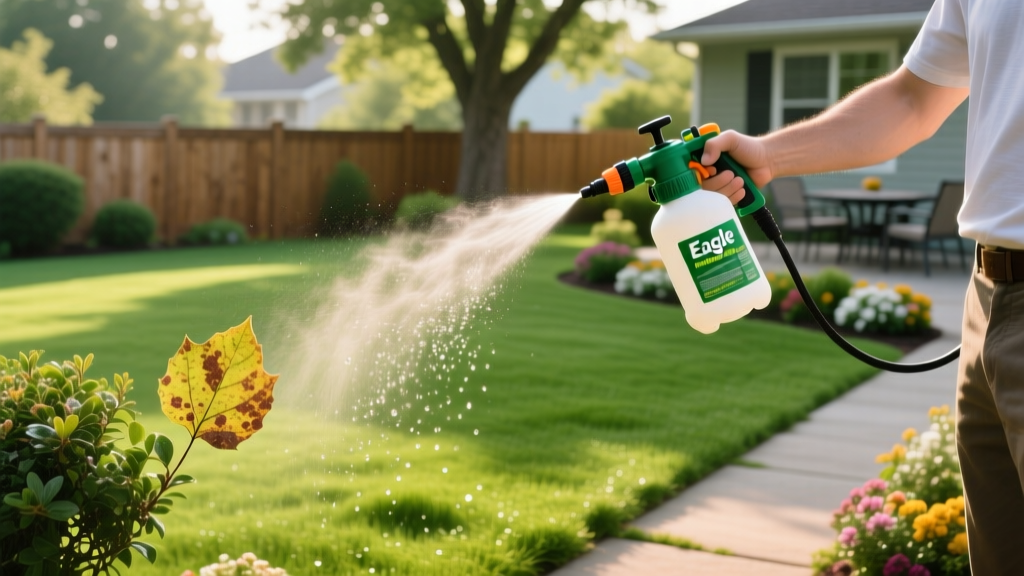
How to Apply Eagle Fungicide for Lawn Disease Control
The Beginner's Guide to Eagle 20EW Fungicide
Summer heat and humidity create the perfect breeding ground for destructive turf diseases like brown patch and dollar spot. For homeowners looking for a reliable, systemic solution, Eagle fungicide (specifically the Eagle 20EW formulation) is a cornerstone product in turf management. The active ingredient, myclobutanil, belongs to the Demethylation Inhibitor (DMI) class of fungicides. Unlike contact sprays that only wash over the surface, Eagle is absorbed by the plant tissue and moves acropetally (upward through the grass blade), protecting new growth and stopping fungal pathogens from synthesizing ergosterol, a vital component of their cell membranes.
While professional landscapers rely on this chemistry, it is entirely accessible for beginners who understand the correct calibration, mixing ratios, and application timing. According to the National Pesticide Information Center, myclobutanil is highly effective when used as a preventative or early-curative treatment, but it requires precise execution to avoid wash-off and resistance buildup.
Disease Targeting and Exact Mixing Rates
The most common beginner mistake is guessing the mixture ratio. Eagle 20EW contains 19.7% myclobutanil, and the required volume changes based on the specific pathogen you are targeting. Always use a dedicated 1-gallon or 2-gallon pump sprayer or a backpack sprayer for turf applications to ensure even distribution.
| Target Disease | Rate per 1,000 Sq Ft | Water Volume | Application Interval |
|---|---|---|---|
| Brown Patch (Rhizoctonia) | 1.2 fl oz | 1.0 - 2.0 gallons | 14 - 21 days |
| Dollar Spot | 1.2 fl oz | 1.0 - 2.0 gallons | 14 - 21 days |
| Rust (Puccinia spp.) | 0.5 - 1.2 fl oz | 1.0 - 2.0 gallons | 14 - 21 days |
| Powdery Mildew (Ornamentals) | 0.5 fl oz per 100 gal | Varies by canopy | 14 days |
Note: For turfgrass applications, a non-ionic surfactant (NIS) is generally not required unless specified by your local extension office, but adding a spray indicator dye (like blue marker) is highly recommended to prevent overlapping and missed strips.
Step-by-Step Calibration and Application
Proper application is about mathematics, not just spraying until the tank is empty. Follow this exact sequence for a 2,000 square foot lawn targeting brown patch:
- Calculate the Area: Measure the length and width of your treatment zone. (e.g., 50 ft x 40 ft = 2,000 sq ft).
- Determine Product Volume: At 1.2 fl oz per 1,000 sq ft, you need 2.4 fl oz of Eagle 20EW for a 2,000 sq ft area.
- Calibrate Water Volume: Mark a 1,000 sq ft area. Fill your sprayer with a known amount of water (e.g., 2 gallons) and spray that area evenly at your normal walking pace. If you use exactly 2 gallons, your water volume is 2 gallons per 1,000 sq ft. Therefore, you will need 4 gallons of total water for your 2,000 sq ft lawn.
- Mix the Solution: Fill the sprayer tank halfway with clean water. Add the 2.4 fl oz of Eagle fungicide. Agitate or shake the tank thoroughly. Add the remaining water to reach the 4-gallon mark.
- Apply Evenly: Spray in a steady, sweeping motion. Keep the nozzle 18 to 24 inches above the turf canopy. Walk at a consistent pace to avoid pooling, which can cause phytotoxicity (chemical burn).
⚠️ CRITICAL WARNING: Fungicide Resistance Management
Eagle 20EW is a FRAC Group 3 fungicide. Fungal pathogens can develop resistance to Group 3 chemistry if it is used repeatedly without rotation. To protect the efficacy of this product, you must rotate it with a fungicide from a different mode of action group—such as a Group 11 (e.g., Azoxystrobin/Heritage) or Group 7 (e.g., Fludioxonil/Medallion)—on subsequent applications. Never apply more than two consecutive Group 3 treatments.
Why Treatments Fail: Beginner Troubleshooting
If your lawn continues to decline after applying Eagle fungicide, one of the following failure modes is likely to blame:
- Wash-Off from Rain: Myclobutanil requires approximately 2 hours to fully absorb into the leaf tissue. If a heavy rainstorm occurs within 60 minutes of application, the product will wash off into the soil, rendering it ineffective against foliar diseases. Check the radar before spraying.
- Late-Stage Curative Application: Eagle has mild curative properties (up to 72 hours after infection). However, if the grass blades are already completely necrotic (dead and brown), the fungicide cannot resurrect dead tissue. It will only protect the remaining healthy grass. As noted by NC State Extension Turfgrass Pathology, preventative applications when nighttime temperatures consistently hit 65°F to 70°F with high humidity yield the best results.
- Misdiagnosis: Fungicides do not cure abiotic stress. If your lawn is browning due to chinch bugs, grub root-feeding, or shallow irrigation drought, Eagle 20EW will not help. Always perform a tug-test and soil inspection to rule out insects and moisture deficits before spending money on chemicals.
- Mowing Too Soon: Wait at least 24 hours after application before mowing. Mowing immediately removes the treated leaf surface, physically stripping the fungicide from the plant.
Cost Breakdown: DIY vs. Professional Service
Understanding the economics of Eagle 20EW helps justify the upfront investment. A standard 32 oz bottle of Eagle 20EW typically retails between $160 and $190. While this seems expensive, the math favors the DIY homeowner.
At the maximum turf rate of 1.2 fl oz per 1,000 sq ft, a 32 oz bottle treats approximately 26,600 square feet. This breaks down to an exact material cost of $0.0065 per square foot (or $6.50 per 1,000 sq ft). By contrast, professional lawn care companies typically charge between $15.00 and $25.00 per 1,000 sq ft for a systemic fungicide application. Over a 5,000 sq ft lawn requiring three summer applications, DIY mixing saves roughly $150 to $250 annually, easily paying for the initial bottle and a quality backpack sprayer.
Frequently Asked Questions
Can I mix Eagle fungicide with liquid fertilizer?
Yes, Eagle 20EW is generally compatible with liquid nitrogen or micronutrient blends. However, you must perform a 'jar test' first. Mix small proportional amounts of both in a glass jar, wait 15 minutes, and check for separation, clumping, or heat generation. If the mixture remains uniform, it is safe to tank-mix.
Is it safe for pets and children?
The Restricted Entry Interval (REI) for turf is 24 hours, or until the spray has completely dried. Keep pets and children off the lawn during application and until the grass is dry to the touch. Once absorbed and dried, the risk of dermal exposure is negligible.
Will Eagle kill mushrooms in my yard?
No. Mushrooms are the fruiting bodies of basidiomycete fungi, which often feed on decaying organic matter (like buried wood or thatch) deep in the soil profile. Eagle 20EW is formulated for specific ascomycete and deuteromycete pathogens that attack living turf leaves and crowns. To reduce mushrooms, focus on core aeration, thatch removal, and improving soil drainage.

