
Pest Control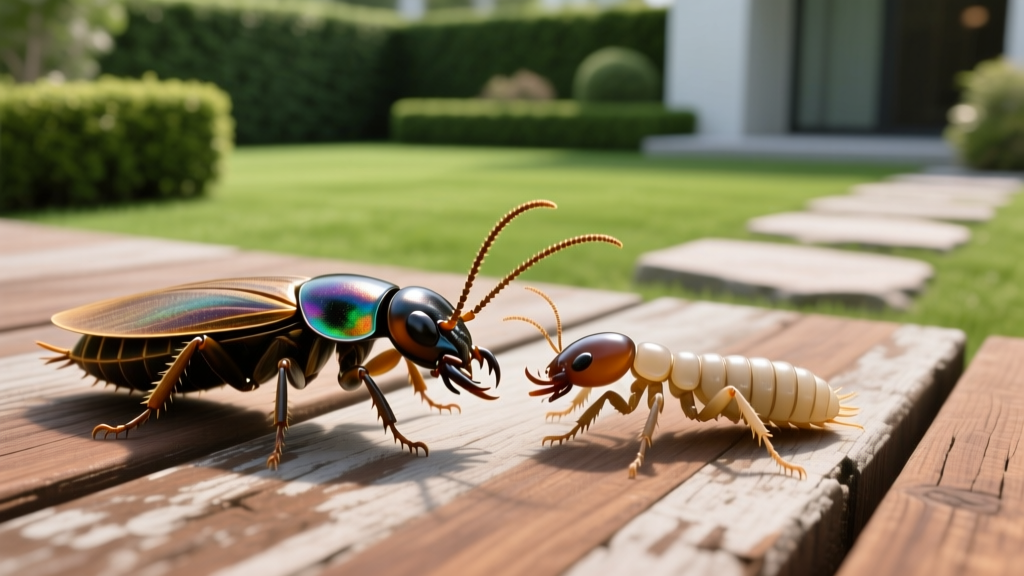
Earwig vs Termite: Yard Defense Guide for Wood-Dwelling Pests
Homeowners frequently encounter insects clustering around damp mulch, rotting landscape timbers, and wooden fence posts. When you spot a wood-adjacent pest, the immediate fear is structural damage. However, confusing a nuisance scavenger with a structural destroyer can lead to wasted money on unnecessary exterminators or, worse, ignored damage to your home's foundation. Understanding the distinct biology, behavior, and treatment protocols in an earwig vs termite comparison is the first step in effective yard defense.
While both insects thrive in moist environments and are often found near decaying organic matter, their ecological roles and threat levels are entirely different. The European earwig (Forficula auricularia) is primarily a nocturnal scavenger that feeds on decaying plant material and soft-tissue seedlings. The Eastern subterranean termite (Reticulitermes flavipes) is a relentless cellulose consumer capable of compromising the structural integrity of your home. This guide provides actionable, field-tested strategies to identify, assess, and eradicate both pests from your yard.
Physical Identification: Earwig vs Termite
Accurate identification dictates your treatment strategy. Earwigs and termites differ drastically in morphology, though untrained eyes might mistake a termite swarm for flying ants or misidentify earwig nymphs. Use the comparison matrix below to confirm which pest is invading your yard.
| Morphological Feature | European Earwig | Eastern Subterranean Termite (Worker) |
|---|---|---|
| Body Length | 1/4 to 1 inch (6-25 mm) | 1/8 to 3/8 inch (3-9 mm) |
| Coloration | Reddish-brown to dark brown head and thorax, yellowish-brown legs | Creamy white to pale translucent body, workers lack dark pigmentation |
| Distinctive Appendages | Prominent rear pincers (cerci) used for defense and folding wings | No pincers; straight, bead-like antennae; broad waist |
| Wings (Swarmers/Alates) | Short, leathery forewings covering delicate, fan-folded hindwings | Two pairs of equal-length, pale, translucent wings that extend past the body |
| Movement | Fast, erratic running; capable of brief, clumsy flight | Slow, deliberate crawling; swarmers fly briefly during mating flights |
Habitat and Yard Behavior
Earwig Micro-Habitats
Earwigs require high humidity and tight, dark refuges during daylight hours. In a yard setting, you will find them concentrated in the top two inches of soil, beneath damp mulch, inside rolled-up garden hoses, and under flat stones. They are nocturnal foragers, emerging at dusk to feed on decaying plant matter, aphids, and tender garden seedlings. They do not burrow into sound wood; they only occupy wood that is already heavily degraded by fungal rot.
Termite Subterranean Networks
Subterranean termites nest deep within the soil to maintain the high moisture levels required for their survival. They travel to food sources via elaborate, pencil-sized mud tubes constructed from soil, saliva, and feces. These tubes protect them from desiccation and predators. In your yard, you will spot these tubes climbing concrete foundations, wrapping around wooden fence posts, or bridging gaps across stone retaining walls. According to the Clemson Home and Garden Information Center, finding these mud tubes is the most reliable indicator of an active subterranean colony.
Damage Assessment: Nuisance vs. Structural Threat
Financial Impact Warning: Termites cause an estimated $5 billion in property damage annually in the United States. Earwigs cause zero structural damage. Misidentifying the pest can lead to catastrophic financial oversight.
Earwig Damage Profile
- Garden Impact: Chewed, ragged edges on soft leaves (e.g., hostas, marigolds, lettuce).
- Wood Impact: None. They may rest inside rotted landscape timbers but do not consume the wood.
- Indoor Impact: Accidental invaders that cause psychological distress but no physical harm to structures or humans (the myth of earwigs burrowing into human ears is entirely false).
Termite Damage Profile
- Structural Impact: Consumption of sound cellulose, hollowing out support beams, floor joists, and sill plates from the inside out.
- Yard Impact: Destruction of wooden fences, decks, landscape timbers, and living trees with compromised heartwood.
- Visual Signs: Wood that sounds hollow when tapped, blistered or dark spots on drywall, and discarded swarmer wings on window sills.
Targeted Treatment Protocols
Eradication strategies must match the biology of the pest. Applying broad-spectrum yard sprays will not eliminate a subterranean termite colony, and trenching termiticides is a massive overreaction for an earwig problem.
Earwig Control Strategies
Because earwigs are largely nuisance pests, focus on low-toxicity, localized treatments and habitat modification.
- Spinosad Baits and Sprays: For severe garden infestations, apply a Spinosad-based product like Monterey Garden Insect Spray (retailing around $18 for 16 oz). Spinosad is a bacterial fermentation product that is highly lethal to earwigs but safe for pets and humans once dried. Apply in the late evening when earwigs are active.
- Diatomaceous Earth (DE): Create a physical barrier using food-grade DE (e.g., Harris Diatomaceous Earth, approx. $12 for 4 lbs). Dust a thin line around the base of vulnerable plants and foundation perimeters. DE works mechanically, lacerating the earwig's exoskeleton and causing fatal dehydration. Note: DE must be reapplied after rainfall or heavy irrigation.
- Moisture and Mulch Management: Pull mulch back at least 12 inches from your home's foundation. Switch from moisture-retaining wood mulch to inorganic gravel or rubber mulch in high-risk perimeter zones.
Termite Eradication Protocols
Subterranean termite control requires aggressive, colony-wide elimination. The National Pest Management Association strongly recommends professional intervention for active structural infestations, but DIY yard perimeter defense is viable using professional-grade materials.
Pro-Tip for DIY Trenching: If applying liquid termiticide yourself, you must use a non-repellent active ingredient like Fipronil (9.1%). Repellent chemicals (like Bifenthrin) only deter termites, causing them to simply bypass the treated zone and find an untreated gap into your home.
- Liquid Trenching (Termidor SC): Termidor SC (approx. $75 for 20 oz) utilizes the "Transfer Effect." Termites cannot detect Fipronil, so they walk through the treated soil, pick up a lethal dose, and transfer it to the colony through grooming and trophallaxis (food sharing).
- Application Specs: Dig a trench 6 inches wide and 6 inches deep directly against the foundation. Apply 4 gallons of finished solution per 10 linear feet of trench. Backfill the trench with the treated soil.
- Bait Station Systems (Trelona ATBS): If trenching is impossible due to concrete patios or hardscaping, install bait stations. The Trelona Advanced Termite Baiting System (approx. $130 for a 15-station kit) uses Novaluron, a chitin synthesis inhibitor. Place stations every 10 feet around the perimeter. When termites intercept the cellulose matrix laced with Novaluron, they are unable to molt, leading to colony collapse within 60 to 90 days.
Preventative Yard Defense Matrix
Long-term yard defense requires altering the environment to make it inhospitable to both moisture-loving earwigs and cellulose-seeking termites. Implement the following checklist to secure your property perimeter.
| Defense Action | Earwig Efficacy | Termite Efficacy | Implementation Details |
|---|---|---|---|
| Foundation Grading | High | High | Ensure soil slopes away from the foundation at a minimum grade of 6 inches of fall over the first 10 feet to prevent pooling. |
| Downspout Extensions | High | High | Install rigid PVC extenders to discharge roof runoff at least 5 feet away from the foundation perimeter. |
| Wood-to-Soil Clearance | Medium | Critical | Maintain an 18-inch vertical clearance between soil/mulch and any wooden siding, deck joists, or fence rails. |
| Cellulose Debris Removal | Low | Critical | Remove buried stumps, discarded lumber, and dead tree roots within 20 feet of the home's footprint. |
| Ventilation & Vapor Barriers | High | High | Install 6-mil polyethylene vapor barriers in dirt-floor crawl spaces to reduce ambient humidity that attracts both pests. |
By accurately identifying whether you are dealing with a harmless earwig population or a destructive termite colony, you can deploy the exact chemical and environmental controls required. Routine yard inspections—specifically checking for mud tubes on foundation walls and monitoring mulch moisture levels—will ensure your landscape remains a recreational asset rather than a vector for structural decay. For further reading on safe pesticide application around residential zones, consult the Clemson HGIC Earwig Management guidelines to ensure compliance with local environmental standards.

