
Pest Control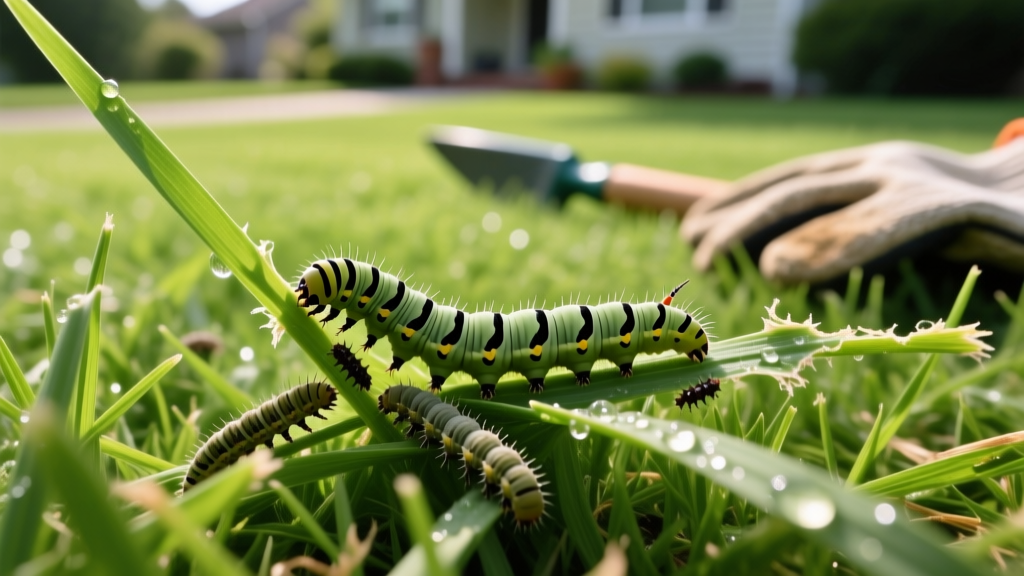
Army Worms in Grass: Rapid Identification and Treatment Guide
When fall armyworms (Spodoptera frugiperda) invade a turf ecosystem, the damage is rarely gradual. Unlike soil-borne pests that quietly sever roots over weeks, army worms in grass act as a surface-level defoliation force capable of stripping a healthy bermudagrass, zoysia, or tall fescue lawn down to bare soil in 48 to 72 hours. Effective defense requires immediate recognition, precise product selection, and strict adherence to application timing. This guide provides the exact protocols, product rates, and recovery frameworks required to halt an active infestation and protect your turf investment.
The 48-Hour Threat: Understanding Armyworm Biology
The suddenness of an armyworm outbreak is directly tied to their larval development cycle. The caterpillar stage consists of six distinct growth phases, known as instars. During the first four instars (roughly the first 10 to 14 days of their life), the larvae are less than half an inch long and consume only about 15% of their total lifetime food requirement. Because they are tiny and hide deep in the thatch layer during daylight, early-stage infestations go entirely unnoticed.
The catastrophic damage occurs when the larvae reach the 5th and 6th instars. In their final four to five days of life, these caterpillars grow to 1.5 inches in length and consume over 80% of their total biomass. By the time you notice the grass turning brown, the larvae are already in their most destructive, hardest-to-kill phase. According to Texas A&M AgriLife Extension, a heavy infestation can host 10 to 20 large larvae per square foot, meaning a standard 5,000-square-foot lawn could be harboring up to 100,000 active caterpillars.
Scouting and Identification: Confirming the Invasion
Do not wait for brown patches to appear. Proactive scouting from mid-July through October (depending on your hardiness zone) is critical. Look for three primary indicators:
- Frosted Grass Tips: Early-stage larvae do not chew through the entire leaf blade; they skeletonize it, leaving the transparent epidermal layer intact. This gives the grass a frosted or whitish appearance.
- Frass Accumulation: Look closely at the base of the grass blades and on the soil surface for bright green to brownish, pellet-like excrement (frass) that resembles coarse sand or sawdust.
- The Inverted 'Y': Mature fall armyworms feature a distinct, pale, inverted 'Y' shape on the front of their dark brown head capsules, alongside four dark spots forming a square on the top of their eighth abdominal segment.
Field Test: The Soap Flush Protocol
If you suspect army worms in grass but cannot see them, force them to the surface. Mix 2 tablespoons of liquid dish soap (such as Dawn) into 1 gallon of water. Pour this solution evenly over a 1-square-yard area of suspected turf at the border of healthy and damaged grass. Within 3 to 5 minutes, the irritation will force any hidden larvae, as well as beneficial predators like ground beetles, to writhe to the surface. Finding 3 or more larvae per square yard warrants an immediate, full-lawn treatment.
Damage Matrix: Armyworms vs. Other Lawn Pests
Misidentifying the pest leads to wasted chemical applications and dead turf. Use this diagnostic matrix to differentiate armyworm damage from other common lawn threats.
| Pest | Damage Location | Visual Symptoms | Time of Day Active |
|---|---|---|---|
| Fall Armyworms | Surface / Leaf Blades | Ragged chewing, entire blades sheared off, green frass on soil | Night and early morning |
| Sod Webworms | Surface / Thatch | Silk webbing in thatch, notched blade edges, slower damage progression | Night |
| White Grubs | Subsurface / Roots | Turf rolls back like a carpet, roots severed, secondary animal digging | Continuous (underground) |
| Chinch Bugs | Base of Stems / Thatch | Yellowing to brown patches in hot, sunny areas; toxic saliva injection | Daytime (peak heat) |
Tactical Treatment Plan: Chemical and Organic Defenses
Once the threshold is crossed, eradication must be swift. Choose your defense strategy based on your lawn's ecological management plan and the size of the larvae.
Strategy A: Conventional Knockdown (For Large Infestations & 5th/6th Instars)
When caterpillars exceed 0.5 inches in length, biological controls lose efficacy. You must use a fast-acting synthetic pyrethroid or carbamate.
- Active Ingredient: Bifenthrin (0.1% to 0.2% concentration) or Carbaryl.
- Recommended Product: Talstar P Professional Insecticide or Sevin SL.
- Application Rate: 0.5 to 1.0 fluid ounces of Talstar P per 1,000 square feet. Mix with 1.5 gallons of water to ensure deep penetration into the thatch layer where larvae hide during the day.
- Cost Estimate: A 3/4-gallon bottle of Talstar P costs approximately $45 to $55 and will treat up to 10,000 square feet, making it highly cost-effective for large properties.
Strategy B: Biological Controls (For Early Instars & Eco-Sensitive Zones)
If the soap flush reveals only tiny, early-stage larvae (less than 0.5 inches), biological insecticides are highly effective and preserve beneficial insect populations.
- Active Ingredient: Bacillus thuringiensis var. kurstaki (Btk) or Spinosad.
- Recommended Product: Monterey B.t. or Captain Jack's Deadbug Brew.
- Application Rate: 2 fluid ounces of Monterey B.t. per gallon of water, covering 500 square feet. Spinosad requires roughly 4 ounces per gallon per 1,000 square feet.
- Cost Estimate: Monterey B.t. retails for about $25 for a 16-ounce bottle. Spinosad products generally range from $30 to $40 for 32 ounces.
- Limitation: Btk must be ingested to work and degrades rapidly in UV light. It will not kill mature 6th-instar armyworms.
Application Timing and Environmental Triggers
The success of your treatment hinges entirely on when you spray. NC State Extension entomologists emphasize that armyworms are primarily nocturnal feeders. During the heat of the day, they curl up tightly at the base of the grass or burrow into the top inch of soil to avoid desiccation.
Critical Pre-Spray Protocol
- Mow Low: Mow the lawn to 1.5 inches before treatment. Do not bag the clippings if they contain frass, but removing excess top-growth removes the caterpillars' protective canopy and allows the chemical to reach the soil surface.
- Irrigate Lightly: Apply 0.1 inches of water (about 10 minutes of standard sprinkler runtime) two hours before spraying. This moisture forces the larvae to move higher up into the thatch and grass canopy, exposing them to the insecticide.
- Spray at Dusk: Apply your chosen treatment between 6:00 PM and 8:00 PM. This targets the larvae exactly as they emerge to feed and prevents rapid UV degradation of the active ingredients.
Post-Treatment Recovery and Prevention
Killing the army worms in grass is only half the battle; the turf must be rehabilitated immediately to prevent weed invasion in the bare spots left behind.
Immediate Recovery Steps
Within 48 hours of confirming the larvae are dead (check the soap flush test again), apply a fast-release nitrogen fertilizer. Use a product with a 20-0-10 or 24-0-6 NPK ratio, applying exactly 0.5 lbs of actual nitrogen per 1,000 square feet. This specific dosage pushes rapid leaf blade generation without causing excessive top-growth stress. Follow this with a deep irrigation cycle of 0.5 inches of water to move the nitrogen into the root zone and hydrate the stressed crown tissue.
Long-Term Preventative Framework
If your region experiences annual armyworm migrations (particularly the Southeast and Transition zones), shift to a preventative model the following spring. Products containing Chlorantraniliprole (e.g., Acelepryn) applied in late May to early June provide up to 90 days of residual control. While Acepryn is an investment (approximately $130 for a 16-ounce bottle), the application rate is incredibly low at 0.2 fluid ounces per 1,000 square feet, making the cost per application roughly $15 for a standard 5,000-square-foot lawn. This binds to the soil organic matter and stops larvae the moment they hatch and take their first bite, eliminating the need for curative summer spraying.

