
Pest Control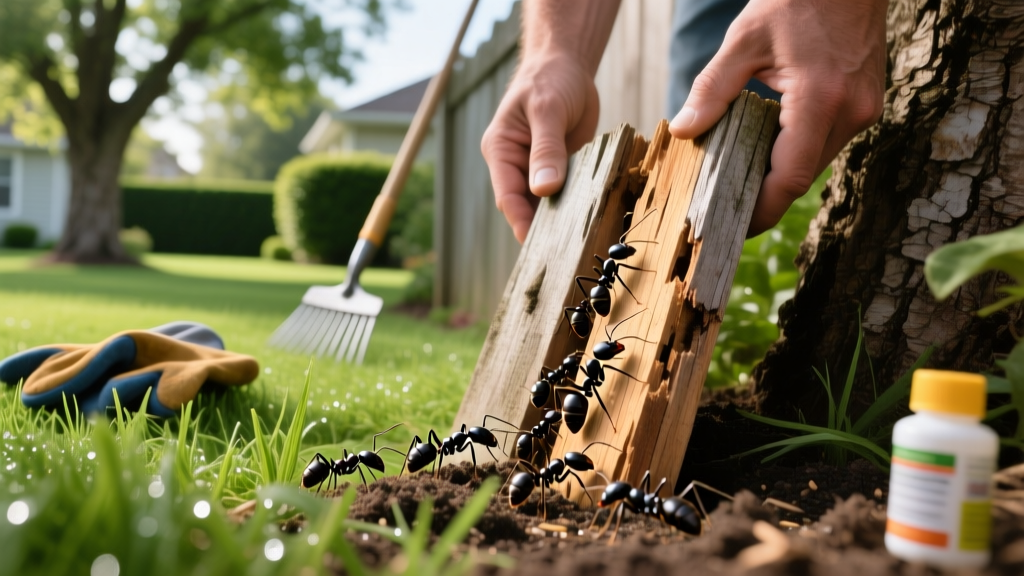
How Do I Get Rid of Carpenter Ants? Yard & Tree Defense
The Hidden Threat in Your Landscape
Carpenter ants (Camponotus spp.) do not consume wood for nutrition; they excavate it to build expansive nesting galleries. While homeowners often panic when they spot these large insects indoors, the primary parent colony is almost always located outside in your yard, trees, or stumps. Indoor infestations are typically satellite colonies spawned from an outdoor parent nest. If you are trying to figure out how do I get rid of carpenter ants permanently, you must shift your focus from interior baseboards to your exterior landscape perimeter.
According to the University of Minnesota Extension, a mature carpenter ant colony can contain over 10,000 workers and multiple satellite nests. Eradicating them requires a targeted approach that exploits their foraging behaviors and nesting preferences, rather than relying on over-the-counter contact killers that only address surface-level scouts.
Identifying Carpenter Ant Activity in Your Yard
Before deploying treatments, you must locate the nesting sites. Carpenter ants prefer moisture-damaged or decaying wood, making rotting stumps, hollow tree cavities, and damp landscape timbers prime real estate.
- Frass Accumulation: Look for coarse sawdust-like material called frass. Unlike termite frass (which looks like uniform pellets), carpenter ant frass resembles rough pencil shavings and often contains tiny insect body parts.
- Auditory Cues: Press your ear or a stethoscope against the base of suspect trees or wooden retaining walls at night. You may hear a faint, dry rustling sound caused by thousands of ants moving through their galleries.
- Foraging Trails: Spotting a few large black ants on your fence or tree trunk at dusk is a strong indicator of a nearby colony. They are most active between sunset and midnight.
⚠ CRITICAL WARNING: The Repellent Trap
Never use pyrethroid-based repellent sprays (like bifenthrin, cypermethrin, or standard hardware store aerosols) on carpenter ant trails. According to UC Davis Integrated Pest Management, repellents kill the visible foragers but cause the surviving colony to panic and undergo "budding." This splits the colony into multiple new satellite nests, exponentially worsening your infestation.
The Two-Pronged Eradication Strategy
Successful yard defense relies on a combination of slow-acting baits and non-repellent transfer sprays. This dual approach ensures the queen and the deep-gallery brood are eliminated.
Step 1: Targeted Baiting (Dietary Switching)
Carpenter ants change their dietary preferences based on the season and the colony's developmental stage. In the spring, they actively seek proteins to feed developing larvae. By mid-summer and fall, they switch to carbohydrates and sugars for worker energy.
- Spring/Early Summer (Protein): Deploy Advance 375A Select Granular Ant Bait (Active ingredient: Abamectin 0.011%). Apply 1 ounce of granules per 1,000 square feet near the base of infested trees and along fence lines. Cost: ~$45 for a 2lb container.
- Late Summer/Fall (Carbohydrate): Switch to a sugar-based gel like Maxforce Fleet Ant Bait Gel (Active ingredient: Imidacloprid 0.01%). Apply small dime-sized droplets directly onto foraging trails on tree bark and retaining walls. Cost: ~$35 for a 4-tube pack.
Place baits in the evening when foragers are most active. Do not disturb the trails or apply any sprays near the bait stations.
Step 2: Non-Repellent Perimeter and Tree Banding
To intercept foragers returning to the nest, apply a non-repellent insecticide. The ants cannot detect the chemical, so they walk through it and transfer the active ingredient to the rest of the colony via grooming and trophallaxis (food sharing).
- Alpine WSG (Dinotefuran 40%): This is the current industry gold standard for yard defense. Mix one 10-gram packet per gallon of water. Spray a 3-foot wide band around the base of infested trees (up to 3 feet high on the trunk) and a 1-foot up / 1-foot out barrier along your home's foundation. Cost: ~$40 per box of 5 packets.
- Termidor SC (Fipronil 9.1%): An excellent alternative for soil drenching. Mix 0.8 fl oz per gallon of water. Trench 6 inches deep and 6 inches wide around wooden retaining walls or stump perimeters, applying 1.5 gallons of solution per 10 linear feet. Cost: ~$75 for a 20oz bottle.
Application Note: Allow sprays to dry completely before allowing pets or children back into the treated yard areas. Non-repellents can take 14 to 21 days to fully collapse a mature colony; patience is mandatory.
Landscape Modifications: The Vulnerability Audit
Chemical treatments will fail if your yard continues to provide ideal nesting conditions. Use the table below to audit your landscape and implement necessary corrections.
| Landscape Condition | Risk Level | Corrective Action Required |
|---|---|---|
| Dead Tree Stumps | Severe | Hire a stump grinding service to remove the stump and major roots at least 12 inches below grade. |
| Mulch Depth & Placement | High | Limit mulch to a maximum depth of 3 inches. Maintain a strict 12-inch bare-soil gap between mulch beds and your home's foundation. |
| Overhanging Tree Branches | High | Prune all branches to maintain a minimum 3-foot clearance from your roofline, gutters, and siding to eliminate aerial bridges. |
| Wood-to-Soil Contact | Severe | Ensure fence posts are set in concrete or gravel, and grade soil so it sits at least 6 inches below wooden siding or sill plates. |
When to Call a Professional vs. DIY
A comprehensive DIY yard defense kit (Alpine WSG, Advance Bait, and a 2-gallon pump sprayer) will cost between $90 and $130. This is highly effective for exterior perimeter and single-tree treatments. However, you should hire a licensed pest control professional ($250 to $500 for exterior/interior combination treatments) if you observe the following edge cases:
"If you see carpenter ants emerging from your ceiling fixtures, light switches, or interior window sills during the winter months, the parent colony has likely relocated entirely inside your wall voids. Exterior yard treatments will not resolve an interior structural infestation; professional drill-and-inject wall void dusting is required."
— Structural Pest Control Best Practice Guideline
Frequently Asked Questions
Will boiling water kill a carpenter ant nest in a tree stump?
While boiling water can kill surface-level workers and shallow brood, it rarely penetrates deep enough into the soil or the heartwood of a stump to kill the queen. Furthermore, it destroys beneficial soil microbes. Stick to slow-acting baits and non-repellent transfer sprays for total colony collapse.
Are carpenter ants dangerous to my pets?
Carpenter ants possess mandibles capable of pinching, and they can spray formic acid into the wound, causing a mild, temporary burning sensation. However, they do not possess stingers and are not considered dangerous to dogs or cats. The primary risk to pets comes from improper application of pesticides, which is why using targeted baits in pet-inaccessible crevices is recommended.
How do I treat a live tree with a carpenter ant colony inside?
Do not inject liquid insecticides directly into the trunk of a live tree, as this can damage the cambium layer. Instead, use the Penn State Extension recommended method: apply a non-repellent spray band around the exterior base of the trunk and place granular baits in the root flare area. The foragers will pick up the active ingredient and carry it into the tree cavity to share with the colony.

