
Pest Control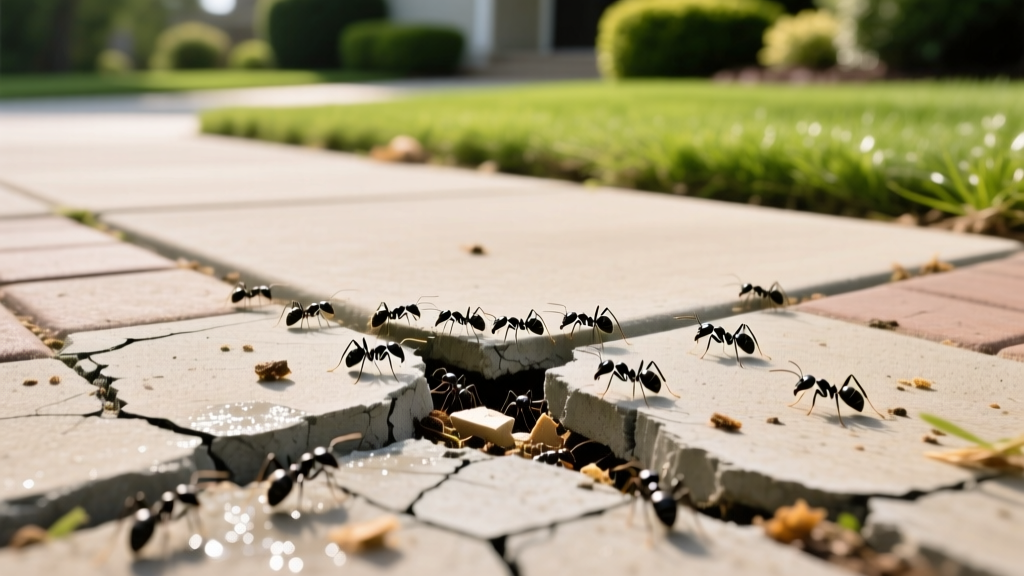
How to Eliminate Cement Ants in Driveway and Patio Cracks
The 'Cement Ant' Misnomer: What You Are Actually Dealing With
Homeowners frequently search for ways to kill cement ants after noticing small, conical mounds of fine dirt accumulating between driveway pavers, sidewalk slabs, or patio expansion joints. However, from an entomological standpoint, there is no insect species classified as a 'cement ant.' The insects you are observing are almost exclusively Pavement Ants (Tetramorium caespitum), an invasive species that has thoroughly colonized North American urban environments.
According to Ohio State University Extension, pavement ants do not consume concrete, nor do they structurally damage the cement itself. Instead, they excavate the soil and sand base beneath the concrete slabs. The dirt mounds you see are the result of worker ants pushing excavated soil up through cracks and joints to expand their subterranean galleries. Over time, this continuous excavation can wash away during heavy rains, leading to slab subsidence, uneven pavers, and trip hazards.
Why Concrete and Pavement? The Nesting Logic
To effectively eliminate cement ants, you must understand why they are drawn to hardscapes. Pavement ants select concrete environments for three primary biological reasons:
- Thermal Mass: Concrete absorbs solar radiation during the day and releases it slowly at night. This creates a microclimate that keeps the colony warm during early spring and late fall, extending their foraging season.
- Moisture Retention: The soil directly beneath slabs retains moisture longer than exposed lawn soil, protecting the colony from desiccation during summer droughts.
- Physical Protection: The concrete slab acts as an impenetrable shield against predators, lawn equipment, and surface-applied insecticides.
Critical Eradication Rule: Never seal a concrete crack while ants are still active. Sealing an active nest traps the colony inside, forcing them to excavate a new exit route. This frequently redirects their tunneling toward your home's foundation or forces them to emerge inside your basement or slab-on-grade living spaces.
Step-by-Step Eradication Protocol
Successfully eradicating a pavement ant colony requires a two-phase approach: biological elimination followed by physical exclusion. Skipping the first phase guarantees the problem will return.
Phase 1: Colony Collapse via Slow-Acting Baits
Spraying visible worker ants with contact killers (like bifenthrin or permethrin) is counterproductive. Contact sprays only kill the 5% to 10% of the colony that is foraging above ground. Worse, the chemical shock can trigger 'colony budding,' where the surviving queen splits the colony into multiple satellite nests, multiplying your problem.
Instead, use slow-acting gel or granular baits containing non-repellent active ingredients like Fipronil, Indoxacarb, or Thiamethoxam. The National Pest Management Association (NPMA) recommends allowing worker ants to carry the toxicant back to the subterranean nest to feed the queen and larvae.
- Identify Trails: Locate the specific cracks where ants are entering and exiting. Look for the highest concentration of dirt mounds.
- Apply Gel Bait: Use a professional-grade gel like Optigard Ant Bait (Thiamethoxam) or Maxforce Fleet (Fipronil). Apply pea-sized drops every 12 to 18 inches directly adjacent to the active cracks. Do not smear it; discrete drops mimic natural food sources.
- Wait 7 to 14 Days: You will see an initial spike in ant activity as they swarm the bait. This is normal. After 5 to 7 days, activity will plummet as the poison cascades through the colony's trophallaxis (food-sharing) network.
- Alternative for Dry Climates: If gel baits dry out too quickly in hot, arid weather, switch to Advance 375A Select Granular Ant Bait. Sprinkle 1/4 teaspoon directly into the crack openings.
Phase 2: Physical Exclusion and Crack Sealing
Once you have confirmed zero ant activity for at least 48 hours, it is time to seal the hardscape to prevent re-infestation and protect the structural integrity of your concrete.
- Prep the Crack: Use a stiff wire brush to remove loose debris, old failing caulk, and ant-excavated soil from the crack. Follow up with a wet/dry shop vacuum to extract fine dust. The sealant will fail if applied over dust.
- Insert Backer Rod (For Large Gaps): If the crack is deeper than 1/2 inch or wider than 3/4 inch, push a foam backer rod into the gap. This prevents you from wasting expensive sealant and ensures a proper hourglass adhesion shape.
- Apply Polyurethane Sealant: Avoid cheap silicone or acrylic latex caulks; they lack the adhesion and flexibility required for exterior concrete subjected to freeze-thaw cycles. Use a self-leveling polyurethane sealant like Sikaflex Self-Leveling Sealant or Loctite PL Concrete Fix. These cost between $9 and $14 per 10.1 oz tube in 2026 and will cover approximately 12 to 15 linear feet of standard 1/2-inch driveway cracks.
- Cure Time: Polyurethane sealants actually require ambient moisture to cure. Lightly misting the crack with water before application can accelerate the curing process, which typically takes 24 to 48 hours to become tack-free.
Product Comparison Matrix: Baits vs. Sprays vs. Sealants
Choosing the right combination of products is critical for long-term defense. Below is a comparison of the most effective product categories for pavement ant management.
| Product Category | Active Ingredient / Material | Primary Function | Avg. Cost (2026) | Time to Result |
|---|---|---|---|---|
| Gel Baits (Optigard, Maxforce) | Thiamethoxam / Fipronil | Colony elimination via ingestion | $15 - $25 / tube | 7 - 14 Days |
| Non-Repellent Liquids (Alpine WSG) | Dinotefuran | Perimeter barrier and transfer kill | $35 - $45 / box | 3 - 7 Days |
| Contact Sprays (Raid, Ortho) | Bifenthrin / Cypermethrin | Kills visible workers only (Not Recommended) | $6 - $10 / can | Instant (but causes budding) |
| Self-Leveling Sealants (Sikaflex) | Polyurethane | Physical exclusion and slab protection | $9 - $14 / tube | 24 - 48 Hours to cure |
Common Eradication Mistakes (And How to Avoid Them)
Even with the right products, application errors can render your efforts useless. Avoid these frequent pitfalls identified by Purdue University Entomology and structural pest experts:
- Using Borax and Sugar Water in Cracks: While DIY borax baits work for indoor sugar ants, they fail outdoors in concrete cracks. The mixture crystallizes rapidly when exposed to UV light and dry concrete, rendering it inedible to the ants before it can be carried back to the queen.
- Power Washing Active Nests: Blasting dirt mounds out of cracks with a high-pressure washer destroys the visible trail but floods the shallow sub-slab galleries. The colony will simply retreat deeper and emerge in a new, less visible location.
- Applying Repellent Sprays Near Bait: If you apply a repellent perimeter spray (like Talstar P) on the same day you place gel bait near the crack, the chemical residue will deter the ants from approaching the bait. Always bait first, wait for colony collapse, and use non-repellents if a liquid barrier is necessary.
When to Call a Professional Pest Control Service
While a single driveway crack or isolated patio colony is easily managed with a $25 DIY baiting kit, widespread infestations require professional intervention. You should hire a licensed exterminator if:
- Ants are emerging from cracks within 5 feet of your home's foundation, indicating a high risk of indoor migration.
- You have interlocking pavers covering a large area (e.g., a 400+ sq. ft. patio). Pavers have hundreds of linear feet of joints, making DIY crack-by-crack baiting and sealing economically and physically unfeasible.
- The colony is located beneath a stamped concrete slab where no visible cracks exist, meaning the nest is accessed via deep underground lateral tunnels.
Professional treatment for exterior pavement ants typically costs between $150 and $300 for a targeted perimeter and slab drench using commercial-grade non-repellent termiticides/ant baits that provide 6 to 12 months of residual control.
Frequently Asked Questions
Do cement ants bite or sting?
Pavement ants possess a stinger, but it is generally too small and weak to pierce human skin. They are considered a nuisance pest rather than a health threat. However, they can contaminate food sources if they migrate indoors to forage for sweets and grease.
Will pouring boiling water into the crack kill the colony?
Boiling water will kill the workers and larvae in the immediate upper galleries, but it rarely penetrates deep enough to reach the queen, who resides in the cooler, deeper soil layers beneath the frost line. Furthermore, repeated use of boiling water can degrade the concrete aggregate and wash away the foundational sand base.
How deep do pavement ant nests go under concrete?
While the majority of the foraging galleries are located in the top 2 to 3 inches of soil directly beneath the slab, the main queen chamber and overwintering brood can be located 12 to 36 inches deep, safely below the frost line. This depth is why surface sprays are entirely ineffective.

