
Pest Control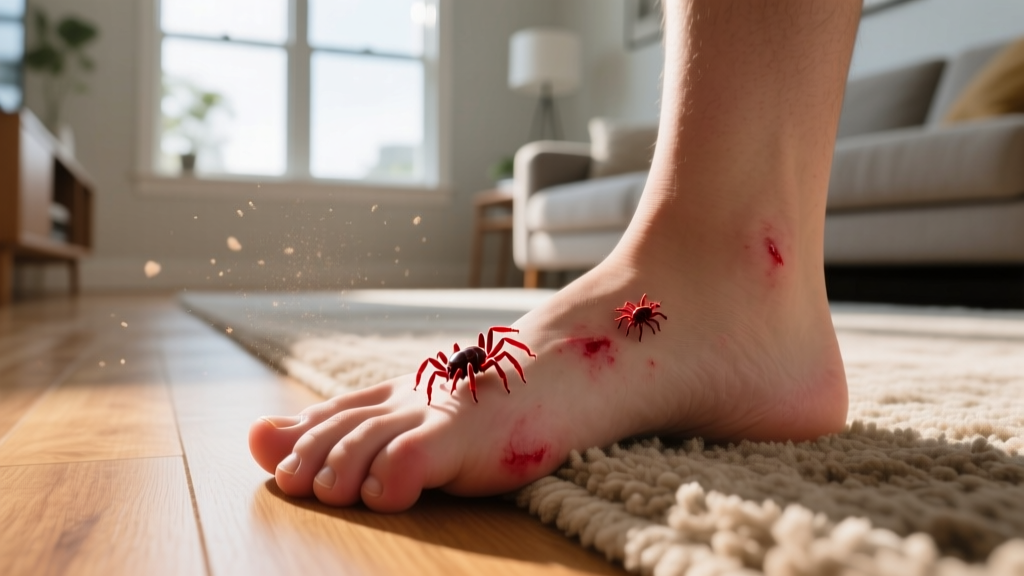
How to Get Rid of Chiggers in House: The Truth About Indoor Bites
The Biological Reality: Chiggers Do Not Infest Houses
If you are waking up with itchy, red welts and searching for how to get rid of chiggers in house, you are dealing with a severe case of mistaken identity. Chiggers (trombiculid mites) cannot and do not infest indoor environments. They do not live in carpets, they do not breed in mattresses, and they will not establish a colony in your baseboards.
The intense itching associated with chigger bites often takes 12 to 48 hours to peak. Homeowners frequently spend time outdoors in infested grass, return inside, and begin itching the following morning. Because the itching occurs indoors, the natural assumption is that the pests are inside the home. In reality, the chiggers that bit you are already dead, and you are likely dealing with either a delayed allergic reaction to an outdoor encounter or an entirely different indoor pest.
Myth Buster: The Burrowing Fallacy
A persistent myth claims chiggers burrow into the skin and lay eggs indoors. According to University of Kentucky Entomology, chigger larvae do not burrow. They inject digestive enzymes into the skin that dissolve tissue, creating a feeding tube called a stylostome. Once they drop off (usually within 3 days), they die quickly indoors without the 100% relative humidity found at the soil surface.
Identify the Real Culprit: Indoor Biting Pests vs. Chiggers
Before spending hundreds of dollars on indoor foggers—which are completely useless against chiggers—you must correctly identify the pest actually biting you inside your home. Use the diagnostic matrix below to determine the true source of your indoor bites.
| Pest | Primary Habitat | Indoor Survival | Bite Pattern & Location |
|---|---|---|---|
| Chiggers | Tall grass, brush, shade | Hours (requires high humidity) | Ankles, waistline, tight clothing areas |
| Fleas | Pet bedding, carpets, rugs | Months (thrives indoors) | Lower legs, random clusters, jumping pests visible |
| Bed Bugs | Mattress seams, furniture | Years (thrives indoors) | Exposed skin, linear rows of 3 ('breakfast, lunch, dinner') |
| Bird/Rodent Mites | Nests, wall voids, attics | Weeks (seeking new host) | Random, intense crawling sensation, tiny moving dots on skin |
If your bites are occurring in linear rows on exposed skin while you sleep, you have bed bugs. If you have pets and the bites are concentrated on your shins, you have fleas. If you recently removed a bird nest from your eaves or have a mouse problem, suspect bird or rodent mites. If you spent time in overgrown brush yesterday and the bites are wrapped around your ankles or underwear lines today, you brought chiggers in from the yard—but they are already dead.
How to Stop Chiggers at the Perimeter: Yard Defense Protocol
Since the University of Florida IFAS Extension confirms that chiggers originate exclusively in outdoor microclimates, the only way to stop them from entering your house on your clothes or pets is to eliminate them in your yard. Chiggers thrive in the 'transition zone'—the border where manicured lawn meets dense woods, fences, or unmaintained brush.
Step 1: Habitat Disruption (Cultural Control)
Chiggers require deep shade and high humidity at the soil level. You must destroy this microclimate:
- Mow frequently: Keep turfgrass at exactly 2.5 to 3 inches. Anything taller traps the moisture they need to survive.
- Clear the transition zone: Rake out all leaf litter, pine straw, and organic debris within 3 feet of your home's foundation and fence lines.
- Prune lower branches: Remove tree and shrub branches up to 24 inches from the ground to allow UV sunlight to penetrate the soil surface, which rapidly desiccates chigger larvae.
Step 2: Targeted Chemical Barrier Application
Do not waste money on indoor bug bombs. Instead, apply a residual outdoor insecticide to your yard's perimeter. The industry standard for chigger control is Bifenthrin (7.9% concentration), widely available under the brand name Talstar P Professional.
- Purchase: A 1-quart bottle of Talstar P costs approximately $45 to $55 and will treat over 32,000 square feet.
- Mix Rate: Combine exactly 1 fluid ounce of Talstar P per 1 gallon of water for every 1,000 square feet of treatment area.
- Application: Using a 2-gallon pump sprayer, apply the mixture to the transition zones, fence lines, and shaded brush edges. Do not broadcast spray the entire sunny lawn; chiggers avoid direct sunlight.
- Timing: Apply in the early morning when dew is present. The moisture helps carry the active ingredient down to the soil surface where the larvae reside. Reapply every 30 days during peak season (late spring through early fall).
The Hitchhiker Protocol: Decontaminating Clothes and Pets
While chiggers won't infest your home, they will hitch a ride inside on your clothing and your dog's fur, dropping off onto your carpet where they might bite another family member before dying. Implement this strict decontamination protocol after spending time in high-risk areas.
Clothing Decontamination
Chiggers are highly susceptible to heat and desiccation. When you return indoors:
- Remove clothing in the garage or mudroom, not the bedroom.
- Wash garments in hot water. The water temperature must reach a minimum of 130°F (54°C) to kill mites on contact.
- Run the clothes through a dryer on the highest heat setting for at least 45 minutes. The combination of heat and tumbling guarantees 100% mortality.
- Preventative measure: Treat your yard-work clothing with 0.5% Permethrin spray (such as Sawyer Premium Insect Repellent, approx. $16 per 24oz bottle). Spray the clothing, let it dry for 4 hours, and it will repel and kill chiggers on contact for up to 6 washes.
Pet Defense
Dogs running through brush act as chigger taxis. While chiggers do not reproduce on dogs like fleas do, they will bite your pet and be carried indoors.
- Wipe your dog down with a damp microfiber towel immediately upon entering the house to physically remove unattached larvae.
- Ensure your pet is on a systemic isoxazoline flea and tick preventative (such as NexGard or Bravecto, typically $25-$35 per dose). While primarily labeled for fleas and ticks, these oral medications are highly effective at killing mites that attempt to feed on the host.
Summary: What to Do Right Now
If you are currently experiencing bites indoors, stop treating the house for chiggers. Inspect your mattress seams for bed bugs, check your pets for fleas, and look for abandoned bird nests near your attic vents. Once you have identified the true indoor pest, treat accordingly. To prevent future chigger bites, shift your focus entirely to the outdoor transition zones of your property, applying a bifenthrin barrier and maintaining strict landscape hygiene to eliminate the humid microclimates they require to survive.

