
Pest Control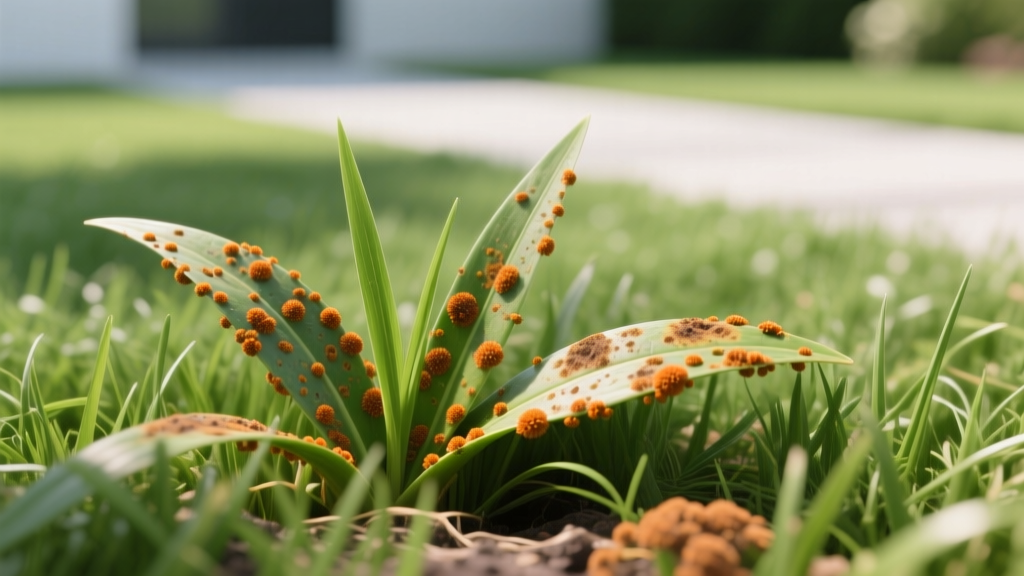
How to Identify and Eliminate Grass Rust: A Step-by-Step Maintenance Guide
Diagnosing Grass Rust: The 'White Shoe' Test
Grass rust, primarily caused by Puccinia coronata (crown rust) and Puccinia graminis (stem rust), is a fungal pathogen that targets slow-growing, nitrogen-deficient turfgrass. It most frequently attacks Kentucky bluegrass, perennial ryegrass, and tall fescue during late summer and early fall when daytime temperatures hover between 70°F and 85°F with high humidity.
The White Shoe Test: The most reliable field diagnosis for grass rust does not require a microscope. Walk through your lawn wearing white canvas shoes or socks. If the fabric is coated in a distinct, bright orange-yellow powdery dust upon exiting the turf, you have an active rust infection. This dust consists of millions of urediniospores that easily become airborne and spread across the property.
Unlike brown patch, which creates distinct circular lesions on the leaf blade, or dollar spot, which forms hourglass-shaped bleached bands, rust manifests as tiny, raised pustules that eventually rupture to release the orange spore mass. Left untreated, severe rust infections will thin the turf canopy, opening the door for opportunistic weeds like crabgrass and Poa annua.
Phase 1: Immediate Cultural Interventions (Days 1-7)
Fungicides are rarely the first line of defense for grass rust. The pathogen thrives on environmental stress and poor cultural habits. Your first seven days must focus on altering the microclimate and physically removing the spore load.
Step 1: Modify the Irrigation Schedule
Rust spores require a minimum of 6 to 8 hours of continuous leaf wetness to germinate and infect plant tissue. If you are watering in the evening, you are providing the exact incubation environment the fungus needs.
- Shift to Early Morning: Program your irrigation controller to run between 4:00 AM and 6:00 AM. This allows the grass blades to dry rapidly once the sun rises.
- Deep, Infrequent Cycles: Apply 0.6 to 0.75 inches of water per session, twice a week, rather than light daily sprinklings. Use a straight-sided tuna can placed on the lawn to measure output.
Step 2: Alter Mowing Protocols
Standard mulching protocols must be temporarily suspended. While returning clippings is normally beneficial for soil health, rust-infected clippings act as a vector, redistributing millions of spores back onto the turf canopy.
- Bag the Clippings: Attach the bagger to your mower and dispose of the clippings in the municipal green waste bin. Do not compost them, as standard home compost piles do not reach the 140°F+ temperatures required to kill Puccinia spores.
- Raise the Cutting Height: Set your mower deck to 3.0 or 3.5 inches. Taller grass shades the soil, reducing soil-surface humidity, and provides more leaf surface area for photosynthesis to fuel recovery.
- Wash the Undercarriage: After mowing, use a pressure washer to clean the mower deck. Rust spores cling to wet grass clumps trapped under the deck and will reinfect the lawn during the next cut.
Phase 2: Nutritional Correction & The 'Nitrogen Push'
Grass rust is fundamentally a disease of starvation. The fungus attacks turf that lacks the nitrogen required to push new, vigorous growth. By applying a targeted, fast-release nitrogen fertilizer, you force the grass to outgrow the infection, pushing the diseased leaf tissue up and out of the canopy where it can be mowed off.
According to NCSU TurfFiles, applying 0.5 lbs of actual nitrogen per 1,000 square feet is the standard curative rate to stimulate growth without causing excessive, disease-susceptible lushness.
Fertilizer Calculation Matrix
Homeowners often miscalculate fertilizer rates by confusing 'product weight' with 'actual nitrogen weight'. Use the table below to calculate the exact product needed for a 5,000 sq ft lawn to achieve the 0.5 lbs N / 1,000 sq ft target.
| Fertilizer Type | N-P-K Ratio | Product per 1,000 sq ft | Total Product for 5,000 sq ft | Estimated Cost |
|---|---|---|---|---|
| Urea | 46-0-0 | 1.08 lbs | 5.4 lbs | ~$4.00 |
| Ammonium Sulfate | 21-0-0 | 2.38 lbs | 11.9 lbs | ~$6.50 |
| Standard Lawn Food | 32-0-4 | 1.56 lbs | 7.8 lbs | ~$8.00 |
Critical Timing: Do not apply the nitrogen push if a heavy rainstorm is forecasted within 24 hours. Fast-release nitrogen like Urea will wash away into storm drains before the root zone can absorb it. Water the fertilizer in lightly with 0.25 inches of irrigation immediately after application to move it into the soil profile.
Phase 3: Fungicidal Treatment Decision Matrix
If the nitrogen push and cultural modifications do not halt the spread of the orange spores within 14 days, or if the aesthetic damage to a highly visible front lawn is unacceptable, chemical intervention is required. Research from the University of Minnesota Extension indicates that fungicides are most effective when used as a last resort to protect newly emerging, uninfected leaf tissue.
Active Ingredients & Product Specifics
When selecting a fungicide, you must rotate Fungicide Resistance Action Committee (FRAC) codes to prevent the Puccinia population from developing chemical resistance.
- FRAC Code 11 (QoI / Strobilurins): Azoxystrobin is the gold standard for homeowner rust control. Product: Scotts DiseaseEX (0.31% Azoxystrobin). Rate: 2.0 lbs per 1,000 sq ft for preventative, 4.0 lbs per 1,000 sq ft for curative treatment. Cost: ~$25 per 10 lb bag.
- FRAC Code 3 (DMI / Triazoles): Propiconazole halts fungal growth by inhibiting sterol synthesis. Product: Syngenta Banner MAXX II (14.3% Propiconazole) or generic equivalents like Honorable. Rate: 1.1 to 2.2 fl oz per 1,000 sq ft mixed in 1 to 2 gallons of water. Cost: ~$45 per pint (commercial concentrate).
Application Protocol: Apply the fungicide using a pump sprayer calibrated to deliver exactly 1.5 gallons of mixed solution per 1,000 square feet. Add a non-ionic surfactant (like LescoSpread) at a rate of 0.25% v/v to break the surface tension of the water, ensuring the chemical coats the waxy cuticle of the grass blade rather than beading up and rolling off.
Preventative Maintenance Calendar for Rust-Prone Lawns
Lawns that suffer from chronic grass rust infections usually have underlying soil compaction or genetic susceptibility. Implement this annual calendar to break the disease cycle permanently.
- Early Spring (April): Conduct a soil test. Rust often exploits lawns with low potassium (K) levels, which weakens the plant's cellular defense mechanisms. Amend with sulfate of potash (0-0-50) if soil tests indicate deficient potassium levels.
- Late Summer (August): Perform core aeration. Compacted soil restricts root growth, leading to the slow-growing top-growth that rust exploits. Rent a walk-behind core aerator and pull plugs at least 3 inches deep.
- Early Fall (September): Overseed with rust-resistant cultivars. If your lawn is dominated by older, susceptible Kentucky bluegrass varieties, overseed with modern, genetically resistant blends. Cultivars like 'Midnight', 'NuGlade', and 'Award' exhibit high genetic resistance to Puccinia coronata.
- Late Fall (November): Apply a winterizer fertilizer (high potassium, moderate nitrogen) to harden the turf cell walls before winter dormancy, ensuring the grass emerges vigorously the following spring.
By combining immediate cultural shifts, precise nutritional math, and targeted chemical applications only when necessary, you can eradicate grass rust and restore a dense, dark green turf canopy without relying solely on expensive fungicide regimens.

