
Pest Control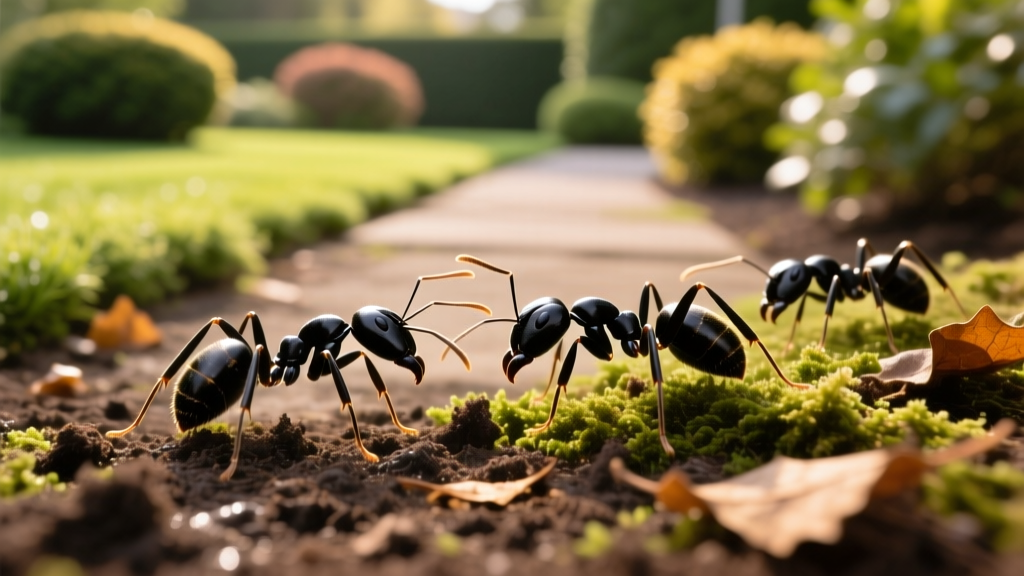
How to Get Rid of Large Black Ants in Your Yard and Garden
The Biology of Large Black Yard Ants
When homeowners spot large black ants foraging across their lawn or patio, they are typically dealing with one of two species: Camponotus (carpenter ants) or Formica (field ants). While field ants build conspicuous soil mounds and primarily farm aphids for honeydew, carpenter ants pose a severe structural threat to your home's wooden elements. According to Penn State Extension, carpenter ants do not consume wood; they excavate it to create smooth, hollow galleries for their colonies, pushing out a sawdust-like debris called frass.
Successfully eradicating these colonies requires abandoning the instinct to spray visible foragers with over-the-counter contact killers. To achieve total colony collapse, you must leverage non-repellent transfer technologies and seasonal baiting strategies tailored to the colony's current nutritional cycle.
Species Identification Matrix
Correct identification dictates your treatment protocol. Use this matrix to determine which species has invaded your yard.
| Characteristic | Carpenter Ants (Camponotus) | Field Ants (Formica) | Pavement Ants (Tetramorium) |
|---|---|---|---|
| Size | 1/4 to 1/2 inch (Major workers are massive) | 1/8 to 1/4 inch | 1/16 to 1/8 inch (Very small) |
| Nest Location | Decaying wood, stumps, structural timbers, wall voids | Large soil mounds in sunny lawn areas | Under concrete slabs, driveway cracks, pavers |
| Visual Evidence | Frass (sawdust + insect parts), smooth wood galleries | Crater-like soil mounds, aphid farming on plants | Sand/soil pushed up through pavement joints |
| Primary Threat | Structural wood damage, moisture intrusion | Lawn aesthetics, aphid-induced plant damage | Slab undermining, indoor food contamination |
⚠️ Critical Warning: The Repellent Trap
Never use pyrethroid-based repellents (e.g., Bifenthrin, Permethrin, Cypermethrin) found in common hardware store sprays like Ortho Home Defense or Raid on carpenter ant trails. These chemicals kill foragers on contact but act as a chemical barrier that the rest of the colony detects. When a carpenter ant colony senses a lethal perimeter, it triggers colony budding—the queen splits the colony into multiple satellite nests, effectively multiplying your infestation and pushing it deeper into your home's structure.
The 3-Phase Yard Eradication Protocol
Eliminating large black ants requires a phased approach that targets the hidden parent colony and its satellite nests without alerting the workers.
Phase 1: Habitat and Moisture Audit
Carpenter ants require high moisture to survive and prefer wood with a moisture content above 15%. Before applying chemicals, alter the yard's micro-environment:
- Stump & Debris Removal: Grind down dead stumps within 50 feet of the foundation. Remove railroad ties, stacked firewood, and rotting landscape timbers.
- Mulch Management: Pull mulch back 12 inches from the foundation. If using mulch, limit the depth to 2 inches and opt for cedar or cypress, which are naturally less attractive to nesting ants than pine bark.
- Moisture Correction: Extend downspouts at least 5 feet away from the house and grade the soil to slope 1/4 inch per foot away from the foundation to prevent soil saturation.
Phase 2: Non-Repellent Liquid Trenching
The gold standard for perimeter defense is a non-repellent liquid termiticide/insecticide. Products containing Fipronil (9.1%) or Dinotefuran are undetectable to ants. Workers walk through the treated soil, pick up the active ingredient on their tarsi, and transfer it to the queen and brood through trophallaxis (food sharing).
Application Specifics for Taurus SC (Fipronil):
- Mixing Ratio: Mix 0.8 fluid ounces of Taurus SC per gallon of water. (A standard 20 oz bottle yields roughly 24 gallons, treating over 240 linear feet).
- Trenching: Dig a trench 6 inches deep and 6 inches wide directly against the foundation.
- Application Rate: Apply 1 gallon of the finished solution per 10 linear feet of trench. Pour slowly to ensure deep soil penetration.
- Drilling (If Necessary): If you have a concrete patio or slab abutting the house where carpenter ants are entering, drill 1/2-inch holes every 12 inches through the concrete and inject the solution directly into the sub-slab soil.
Note: Fipronil degrades slowly in soil, providing a continuous transfer barrier for 6 to 12 months. Expect total colony collapse within 21 to 30 days post-application.
Phase 3: Seasonal Baiting Strategy
According to the University of California IPM, ant colonies cycle through nutritional preferences based on the reproductive calendar. Offering the wrong bait matrix results in complete bait refusal.
- Spring / Early Summer (Protein Cycle): The colony is rearing brood (larvae) and requires protein. Use Advance Carpenter Ant Bait (active ingredient: Abamectin B1 0.011%), which is a protein-based granular bait. Broadcast 1.5 to 2 pounds per acre in targeted yard zones, or place small pinches near visible foraging trails.
- Late Summer / Fall (Carbohydrate Cycle): The colony is storing energy for winter and foragers seek sugars. Switch to a sweet, liquid/gel matrix like Maxforce Quantum (active ingredient: Imidacloprid 0.03%) or Optigard Ant Bait Gel (Thiamethoxam). Apply in outdoor bait stations to protect the gel from UV degradation and rain.
💡 Pro Tip: The Pre-Baiting Technique
Before deploying toxic baits, place small dabs of untreated peanut butter and honey near ant trails to confirm whether the colony is currently seeking protein or carbohydrates. Once you observe which food source they swarm, deploy the corresponding toxic bait matrix.
Organic and Biological Controls
For homeowners managing edible gardens or sensitive ecosystems where synthetic neurotoxins are prohibited, biological and desiccant controls offer viable alternatives, though they require higher labor inputs.
Beneficial Nematodes (Steinernema feltiae)
For soil-dwelling field ant colonies or carpenter ant satellite nests in the lawn, apply entomopathogenic nematodes. These microscopic worms actively seek out ant larvae in the soil, entering their bodies and releasing bacteria that kill the host within 48 hours.
- Application Rate: 1 million nematodes per 1,500 square feet.
- Execution: Mix with water and apply via a hose-end sprayer in the late afternoon or evening. The soil must remain moist for at least 7 days post-application to prevent the nematodes from desiccating.
- Cost: Approximately $35 to $45 per million nematodes.
Food-Grade Diatomaceous Earth (DE)
DE acts as a mechanical desiccant, scratching the waxy exoskeleton of the ants and causing them to dehydrate. It is highly effective for treating localized mounds or creating dry barriers under decks.
- Limitation: DE loses all efficacy when wet. It must be applied in dry weather and reapplied after every rainfall or irrigation cycle. Use a bulb duster to puff DE deep into ant galleries and soil cracks.
Cost Analysis: DIY vs. Professional Extermination
Determining whether to handle the infestation yourself or hire a licensed pest management professional depends on the colony's proximity to your home and your comfort with handling restricted-use application methods like sub-slab drilling.
| Treatment Approach | Estimated Cost (2026 Pricing) | Efficacy Timeline | Best Use Case |
|---|---|---|---|
| DIY Liquid & Bait Combo | $85 - $140 (Initial chemical investment) | 21 - 45 days | Accessible perimeters, visible yard stumps, standard soil trenching. |
| Professional Perimeter Spray | $250 - $400 (One-time service) | 14 - 30 days | Homeowners lacking time or equipment for proper 6x6 trenching. |
| Professional Sub-Slab Injection | $600 - $1,200+ | 30 - 60 days | Colonies nesting beneath concrete driveways, patios, or basement slabs. |
Long-Term Yard Maintenance Framework
Eradication is only half the battle. Large black ants are driven by resource availability and shelter. Implement this annual maintenance checklist to prevent recolonization:
- Spring Tree Trimming: Prune all tree branches and shrubs so they maintain at least an 18-inch gap from the roofline and siding. This eliminates the "highway bridges" carpenter ants use to bypass your soil-level chemical barriers.
- Bi-Annual Gutter Clearing: Clogged gutters cause water to overflow and saturate the fascia boards and soffits, creating the exact high-moisture wood environment carpenter queens seek for satellite nesting.
- Perimeter Inspections: Every May and September, inspect the base of your foundation for fresh frass, which looks like coarse pencil shavings mixed with dead insect parts. Early detection of new excavation prevents structural compromise.
By combining non-repellent soil barriers with biologically timed baits, you force the colony to unknowingly distribute the lethal active ingredient directly to the reproductive core, ensuring permanent removal from your landscape.

