
Pest Control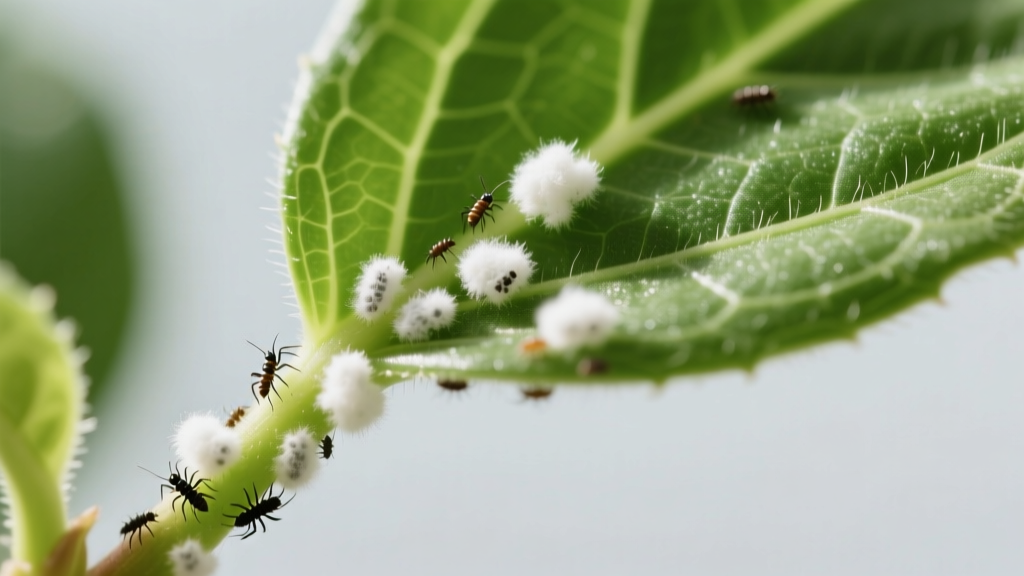
How to Eliminate Mealy Bugs on Plant Foliage and Stems
The Anatomy of an Infestation: Spotting the White Fuzz
Mealybugs (family Pseudococcidae) are unarmored scale insects that pierce the phloem tissue of outdoor ornamentals, fruit trees, and garden vegetables to drain vital sap. Unlike hard scale insects, mealybugs secrete a distinctive white, waxy, cotton-like filament over their bodies. This wax acts as a physical shield against many contact insecticides, making eradication notoriously difficult for home gardeners.
When you spot mealy bugs on plant stems or the undersides of leaves, you are likely looking at species such as the citrus mealybug (Planococcus citri) or the longtailed mealybug (Pseudococcus longispinus). The immediate damage includes chlorotic (yellowing) leaves, stunted terminal growth, and premature fruit drop. However, the secondary damage is often worse: mealybugs excrete a sugar-rich waste called honeydew, which rapidly cultivates black sooty mold (Capnodium species) that blocks photosynthesis.
⚠️ Critical Yard Defense Warning: The Ant Symbiosis
You cannot eliminate a mealybug infestation without first addressing local ant populations. Argentine ants (Linepithema humile) and fire ants actively 'farm' mealybugs, protecting them from natural predators in exchange for honeydew. If you see ants swarming the stems of your infested plants, your mealybug treatment will fail until the ant trails are broken.
Organic vs. Conventional Treatment Matrix
Selecting the right chemical intervention depends on your plant type, the severity of the infestation, and your tolerance for synthetic pesticides. Below is a comparison of the most effective active ingredients for outdoor yard defense.
| Active Ingredient | Product Example & Cost | Mode of Action | Best Use Case |
|---|---|---|---|
| Insecticidal Soap (Potassium salts of fatty acids) | Safer Brand Insect Killing Soap ($10 / 32 oz RTU) | Desiccates the insect cuticle on direct contact. | Light infestations on sensitive foliage; requires direct spray contact. |
| Azadirachtin (Neem Oil Extract 4.5%) | Bonide Neem Oil Concentrate ($18 / 16 oz) | Suffocates adults; acts as an insect growth regulator (IGR) for nymphs. | Moderate infestations; safe for most ornamentals when applied at dusk. |
| Spinosad | Captain Jack's Deadbug Brew ($18 / 32 oz) | Neurotoxin causing paralysis; works via contact and ingestion. | Heavy outbreaks on fruit trees and vegetables; OMRI listed. |
| Dinotefuran | Safari 20SG Systemic Insecticide ($115 / 1 lb) | Systemic neonicotinoid; absorbed by roots and translocated to foliage. | Severe, recurring infestations on non-edible outdoor ornamentals. |
Step-by-Step Eradication Protocol for Outdoor Gardens
Do not rely on a single spray application. Mealybugs reproduce rapidly, with females laying 300 to 600 eggs in an ovisac over a two-week period. Follow this phased approach to break their life cycle.
Phase 1: Mechanical Removal and Pruning
Before applying any chemicals, reduce the pest population mechanically. Using sterilized bypass pruners, cut away heavily infested terminal growth and dispose of it in sealed bags—never add it to your compost pile. For localized clusters on thick stems, dip a cotton swab in 70% isopropyl alcohol and dab the mealybugs directly. The alcohol instantly dissolves their waxy protective coating, killing them on contact.
Phase 2: High-Pressure Water and Horticultural Oil
Attach a nozzle capable of delivering 40 to 50 PSI to your garden hose. Blast the undersides of the leaves and stem crotches to physically dislodge nymphs (crawlers). Wait two hours for the foliage to dry, then apply a horticultural oil or Neem oil concentrate. Mix cold-pressed neem oil at a rate of 2 tablespoons per gallon of water, adding half a teaspoon of mild liquid dish soap as an emulsifier. Spray thoroughly until the plant is dripping.
💡 Pro Tip: Avoid Phytotoxicity
Never apply horticultural oils or insecticidal soaps when outdoor temperatures exceed 85°F or when plants are drought-stressed. The combination of oil and intense UV radiation will severely burn the leaf cuticle, causing irreversible necrotic spotting. Always spray at dusk.
Phase 3: Deploying Ant Baiting Stations
To stop ants from reintroducing mealybug crawlers, deploy borax-based liquid ant baits, such as Terro T300B ($8 for a 6-pack). Place the bait stations along the base of the plant and on known ant trails. The worker ants will carry the toxic bait back to the colony, eliminating the queen and the protective army within 48 to 72 hours.
Biological Warfare: Introducing Natural Predators
For large yards, orchards, or greenhouse environments where chemical spraying is impractical, augmentative biological control offers a sustainable defense. According to UC Agriculture and Natural Resources, the mealybug destroyer (Cryptolaemus montrouzieri) is the most effective commercial predator for outdoor mealybug management.
- Purchasing: You can order live C. montrouzieri larvae from specialized insectaries like Arbico Organics or BioQuip. Expect to pay approximately $35 to $45 for a shipment of 1,000 larvae.
- Release Rates: Release 2 to 5 larvae per square foot of plant canopy. For a standard 10-foot citrus tree, 500 to 1,000 larvae are recommended.
- Release Protocol: Release the predators at dusk to prevent immediate dispersal and bird predation. Mist the plant foliage lightly before release, as the larvae require humidity to establish.
Green lacewings (Chrysoperla rufilabris) are another excellent option, particularly for consuming mealybug eggs before they hatch into mobile crawlers.
Preventative Yard Defense Strategies
Mealybugs are highly attracted to plants with high nitrogen levels and succulent, rapid new growth. Over-fertilizing your garden with high-nitrogen synthetic fertilizers (such as 28-0-3 lawn formulations) makes your ornamentals highly susceptible to infestation.
Transition to a balanced, slow-release fertilizer like Osmocote 14-14-14, which provides a steady nutrient drip without triggering the explosive, soft-tissue growth that mealybugs prefer. Additionally, maintain a 2-inch layer of organic mulch around the base of your plants to retain soil moisture and reduce plant stress, as drought-stressed plants emit volatile organic compounds (VOCs) that actively attract sap-sucking pests.
For authoritative guidance on identifying specific mealybug species and understanding their regional life cycles, consult the Clemson University Cooperative Extension. Consistent monitoring, breaking the ant symbiosis, and utilizing targeted botanical oils will keep your yard defense perimeter secure against these persistent pests.

