
Pest Control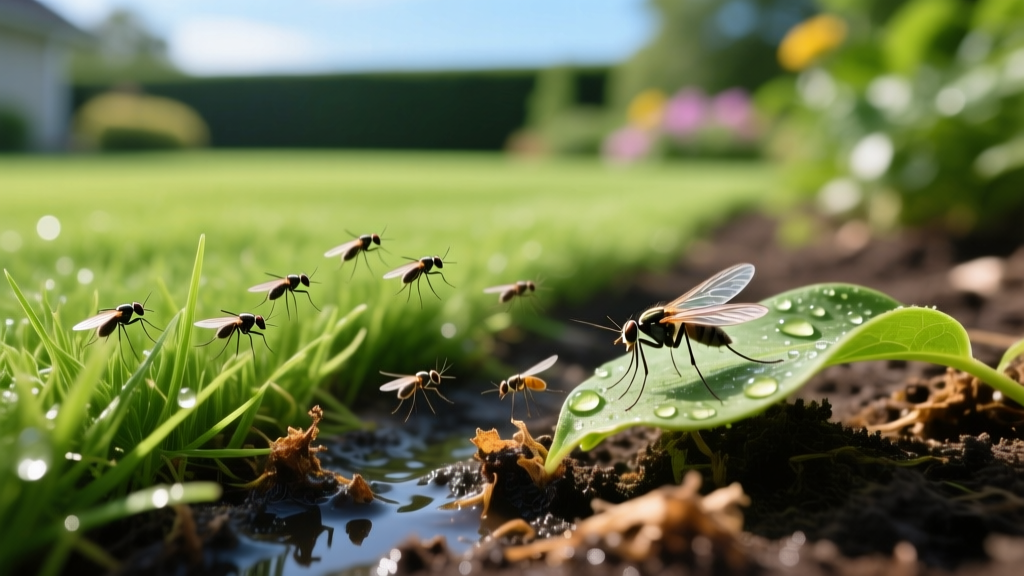
How to Eliminate Nat Bugs (Gnats and Midges) in Your Yard
Decoding the "Nat Bug" Search Intent
When homeowners search for "nat bugs," they are almost always referring to gnats—specifically two distinct pests that plague yards and garden beds: fungus gnats (Bradysia spp.) and biting midges (family Ceratopogonidae, commonly called no-see-ums or sand gnats). While the phonetic spelling "nat" is a common typo, the frustration these pests cause is very real. Fungus gnats destroy plant root systems in damp soil, while biting midges turn outdoor living spaces into unbearable, itchy zones.
As of 2026, modern Integrated Pest Management (IPM) protocols heavily favor targeted biological controls and precise perimeter treatments over broad-spectrum fogging. Eradicating these pests requires identifying which species you are fighting, as the larval habitats and adult behaviors of fungus gnats and biting midges are entirely different.
The Identification Matrix: Fungus Gnats vs. Biting Midges
Before purchasing any treatments, confirm which pest is invading your yard. Misidentifying the target leads to wasted chemicals and ongoing infestations.
| Feature | Fungus Gnats (Bradysia spp.) | Biting Midges / No-See-Ums |
|---|---|---|
| Size & Appearance | 1/8 inch, dark gray/black, long legs, delicate wings. | 1/32 to 1/8 inch, grayish, mottled wings, robust bodies. |
| Primary Habitat | Damp potting soil, decaying organic matter, compost piles. | Marshy edges, muddy shorelines, damp mulch, tree holes. |
| Human Impact | Nuisance flyers; do not bite humans or pets. | Painless but intensely itchy bites; blood-feeders. |
| Plant Impact | Larvae chew on fine root hairs, stunting plant growth. | None; adults feed on nectar and blood, not plants. |
| Peak Activity | Morning and evening; weak, erratic flyers. | Dawn and dusk; highly sensitive to wind (grounded by breezes >5 mph). |
Phase 1: Fungus Gnat Eradication (Soil & Root Defense)
According to Penn State Extension, fungus gnat populations explode when the top two inches of soil remain consistently moist. The goal is to break the 21-to-28-day life cycle by targeting the larval stage in the soil, not just the flying adults.
Step 1: Deploy BTI (Bacillus thuringiensis israelensis)
BTI is a naturally occurring bacterium that produces proteins toxic only to gnat and mosquito larvae. It is entirely safe for pets, earthworms, and beneficial soil microbes. The EPA recognizes BTI as a cornerstone of biological pest control.
- Product Recommendation: Summit Mosquito Bits (BTI granules).
- Cost: Approximately $22 for a 20 oz. shaker bottle (treats up to 2,000 sq. ft.).
- Application: Sprinkle 4 tablespoons of granules per gallon of potting soil, or broadcast over garden beds at a rate of 1 cup per 50 square feet. Water immediately to release the BTI into the root zone.
Step 2: Introduce Beneficial Nematodes
For severe infestations where BTI alone isn't enough, introduce Steinernema feltiae nematodes. These microscopic worms actively hunt and parasitize gnat larvae in the soil.
- Product Recommendation: Arbico Organics NemaShield or BioLogic NemAttack.
- Cost: ~$38 for 50 million nematodes (treats ~5,000 sq. ft.).
- Crucial Application Rule: Soil temperature must be between 60°F and 90°F. Apply at dusk or on overcast days, as UV light kills nematodes instantly. Keep the soil moist for 7 days post-application to allow them to establish.
Step 3: Adult Population Control
While biologicals handle the larvae, use yellow sticky traps (like Gnat Stix or generic 3x5 inch yellow cards) placed 2 inches above the soil line to capture egg-laying females. Replace traps every 14 days until the population crashes.
Phase 2: Biting Midge & No-See-Um Yard Defense
If your "nat bugs" are biting you, you are dealing with biting midges. The University of Florida IFAS notes that these pests breed in highly specific, moisture-retaining micro-habitats. Eliminating them requires a combination of habitat modification and residual perimeter spraying.
⚠️ Habitat Warning: Biting midges do not breed in open water like mosquitoes. They breed in the moist mud-water interface. Filling in low spots with topsoil and ensuring French drains are functioning will eliminate 80% of your yard's breeding grounds without using a single drop of pesticide.
Conventional Perimeter Treatment: Bifenthrin
For immediate, heavy-duty relief, a synthetic pyrethroid like Bifenthrin provides a 30-to-45-day residual barrier on foliage and fence lines where midges rest during the day.
- Product Recommendation: Control Solutions Talstar P (7.9% Bifenthrin).
- Cost: ~$48 for a 3/4 gallon jug.
- Mix Rate: 1 fluid ounce per gallon of water per 1,000 square feet.
- Target Zones: Spray the underside of broadleaf shrubs, tall ornamental grasses, and the lower 3 feet of wooden privacy fences. Do not spray blooming flowers to protect foraging pollinators.
Organic Alternative: Essential Oil Emulsions
If you have a sensitive ecosystem, koi ponds, or prefer organic yard care, use a contact-kill essential oil blend. These do not provide long-term residual control but will knock down active midge swarms immediately.
- Product Recommendation: Essentria IC3 (Rosemary, Geraniol, and Peppermint oils).
- Cost: ~$42 for 16 oz.
- Mix Rate: 2 to 4 fluid ounces per gallon of water. Apply via a backpack mist blower at dusk when midges are actively swarming.
The 14-Day Integrated Eradication Protocol
Follow this exact timeline to collapse both fungus gnat and biting midge populations in a standard 5,000 sq. ft. suburban yard.
- Day 1 (Assessment & Habitat Fix): Rake out thick, damp mulch layers (keep mulch under 2 inches deep). Clear leaf litter from gutters and drain catch basins. Set out 10 yellow sticky traps in garden beds to monitor fungus gnat density.
- Day 2 (Biological Soil Drench): Apply Summit Mosquito Bits (BTI) to all garden beds, potted plants, and compost bins. Water deeply to activate the BTI into the top 2 inches of soil.
- Day 5 (Perimeter Spray): Mix and apply Talstar P (or Essentria IC3 for organic yards) to shrub undersides, fence lines, and the perimeter of the home. Spray at dusk to avoid pollinator exposure and UV degradation.
- Day 9 (Nematode Application): Apply Steinernema feltiae nematodes via a hose-end sprayer (using a nematode-safe filter screen) to heavily infested soil zones. Water the soil lightly beforehand and immediately after.
- Day 14 (Evaluation): Check yellow sticky traps. If fungus gnat counts are below 5 per trap, the life cycle is broken. If midge biting has ceased, the perimeter barrier is holding. Reapply BTI every 30 days during wet seasons as a preventative.
Expert Insight: Many homeowners waste money on "bug zappers" for biting midges. UV light traps are largely ineffective against no-see-ums because they are weak flyers and are rarely drawn to the fan suction of standard zappers. Furthermore, zappers kill the predatory insects that naturally keep midge populations in check. Rely on targeted biologicals and residual barriers instead.
Common Mistakes That Guarantee Re-infestation
Avoid These Critical Errors
- Overwatering after BTI application: While BTI needs moisture to activate, flooding the soil creates anaerobic conditions that kill plant roots and beneficial nematodes, ultimately creating more decaying organic matter for future gnat generations to feed on.
- Using adult aerosol sprays indoors: Spraying Raid or similar pyrethrin aerosols in the air only kills the adults currently flying. It does zero to address the thousands of larvae developing in your potted plant soil. The swarm will return in 48 hours.
- Ignoring the compost pile: Compost bins are ground-zero for both fungus gnats and biting midges. Always cover active compost with a 2-inch layer of dry "browns" (shredded cardboard or dry leaves) to deny pests the moist surface they need to lay eggs.
Successfully defending your yard against "nat bugs" requires shifting your focus from the air to the ground. By combining BTI soil treatments, beneficial nematodes, and precise perimeter spraying, you can reclaim your outdoor spaces and protect your landscape investments without relying on outdated, broad-spectrum chemical foggers.

