
Pest Control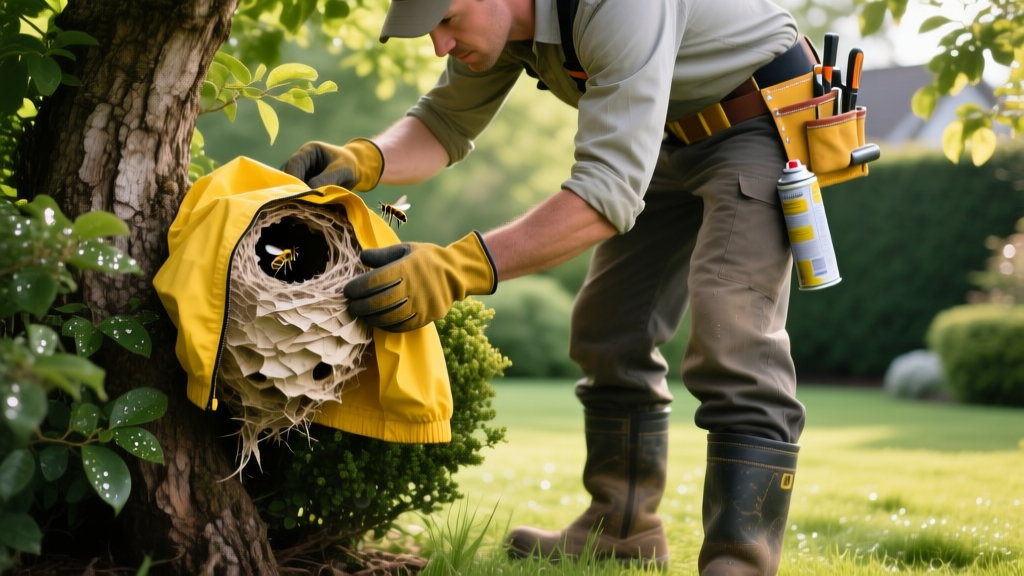
How to Eliminate a Yellow Jacket Nest: Emergency Rescue Fixes
Symptom Diagnosis: Identifying the Threat Level
Before executing a rescue fix, you must accurately diagnose the pest. Homeowners frequently confuse yellow jackets (Vespula and Dolichovespula species) with honeybees or paper wasps, leading to disastrous treatment choices. Yellow jackets are hairless, feature stark black and bright yellow banding, and fly in a rapid, darting pattern close to the ground. Unlike honeybees, which die after a single sting, yellow jackets possess smooth stingers capable of delivering multiple, venomous injections.
By late summer, a single mature ground nest can harbor 3,000 to 5,000 highly defensive workers. If you observe a steady stream of insects entering and exiting a small, unlined hole in your lawn, a cracked retaining wall, or a gap beneath a shed, you have located a ground nest. According to the University of California Integrated Pest Management program, ground-nesting yellow jackets are particularly dangerous because their subterranean colonies are easily disturbed by lawnmowers, weed whackers, or foot traffic, triggering immediate mass-swarming events.
⚠️ Critical Warning: If the nest is located inside a wall void, soffit, or structural cavity of your home, abort DIY elimination immediately. Spraying interior voids forces trapped colonies to chew through drywall and enter your living spaces. Structural nests require professional pest control intervention.
The Rescue Protocol: DIY vs. Professional Decision Matrix
Not every yellow jacket infestation is a DIY job. Use the matrix below to determine if your situation requires immediate professional rescue or if it can be handled with over-the-counter chemistry.
| Nest Scenario | Colony Size / Location | Action Plan | Estimated Cost |
|---|---|---|---|
| Open Lawn / Garden Bed | Visible entrance, < 3 ft wide | DIY Night Dusting | $35 - $50 |
| Under Deck / Shed | Multiple entrances, high traffic | DIY Foaming Agent or Pro | $25 - $150 |
| Aerial (Eaves / Trees) | Visible paper envelope, > 10 ft high | DIY Jet-Stream Aerosol | $10 - $20 |
| Wall Void / Attic Soffit | Hidden, audible buzzing in walls | Hire Licensed Exterminator | $250 - $600+ |
| Allergy Concerns | Any size or location | Hire Licensed Exterminator | Varies |
Step-by-Step Rescue Fix: Eliminating Ground Nests at Night
Liquid sprays are largely ineffective and actively dangerous for subterranean nests. Liquids soak into the soil, fail to reach the deep central comb, and often agitate the colony enough to cause them to dig secondary emergency exits. The definitive rescue fix for ground nests is insecticidal dusting.
1. Reconnaissance and Marking (Daytime)
Locate the exact entrance hole during daylight hours from a safe distance (at least 15 feet). Mark the perimeter with a brightly colored landscaping flag or a weighted plastic cup. Do not cast shadows over the hole or vibrate the ground, as this triggers guard wasps to emerge.
2. Timing the Strike (Nighttime)
Wait until at least two hours after sunset, ideally between 9:00 PM and 2:00 AM. According to Penn State Extension entomologists, yellow jacket foragers return to the nest at dusk, and cooler nighttime temperatures (below 60°F) significantly slow their metabolism and reaction times. Use a flashlight fitted with a red lens filter; yellow jackets cannot perceive red light wavelengths, preventing you from painting a target on your back.
3. Equipment and Application
You will need a hand-operated bellow duster (such as the JT Eaton Bellow Hand Duster, approx. $15) and a desiccant-based insecticidal dust like DeltaDust (deltamethrin, approx. $28 for a 1 lb shaker) or Tempo Dust (cyfluthrin).
- Fill the duster only 1/3 full to allow adequate air compression.
- Approach the nest slowly from the side, not head-on.
- Insert the duster nozzle near the entrance and puff 3 to 4 heavy clouds of dust directly into the hole.
- The foragers will track the dust deep into the nest on their bodies, effectively poisoning the queen and the brood within 24 to 48 hours.
4. The Golden Rule: Leave the Hole Open
Never plug, cover, or flood the entrance after dusting. Trapping the colony inside forces them to excavate new tunnels, frequently leading them upward into root systems, under patio slabs, or into adjacent basement walls.
Emergency Aerial Nest Takedown
If the nest is suspended from an eave, tree branch, or deck joist, the rescue protocol shifts from dust to a rapid-knockdown foaming aerosol. Products like Spectracide Wasp & Hornet Killer ($6 to $8 per can) utilize prallethrin and cypermethrin to deliver a jet stream up to 22 feet.
- Dress for the hazard: Wear a thick hoodie, gloves, safety goggles, and long pants tucked into socks.
- Target the pedicel: The pedicel is the single stem attaching the nest to the structure. Spray this attachment point first for 3 seconds.
- Saturate the envelope: Immediately sweep the spray up and down, completely coating the paper envelope until it drips.
- Retreat immediately: Do not stand beneath the nest to watch it fall. Flee the area along a pre-planned route.
- Removal: Return the following afternoon. Once the nest is completely quiet, scrape it off with a long-handled shovel and dispose of it in a sealed trash bag.
Catastrophic Mistakes That Trigger Mass Swarming
When panicked, homeowners often resort to internet myths that exacerbate the infestation. Avoid these critical errors:
- Flooding with Water or Gasoline: Pouring liquids into a ground nest rarely drowns the colony; the soil simply absorbs it. Using flammable liquids like gasoline is illegal, environmentally devastating, and poses a severe explosion risk if ignited.
- Sealing the Hole Prematurely: Shoving a rock or dirt into the entrance before the colony is dead guarantees they will chew a new exit, often resulting in hundreds of enraged wasps emerging from the turf three feet away from the original hole.
- Using Bug Bombs (Total Release Foggers): Foggers do not penetrate subterranean cavities or thick aerial paper envelopes. They only kill the few guards on the surface while enraging the thousands inside.
Frequently Asked Rescue Questions
How long does it take for DeltaDust to kill a yellow jacket colony?
While individual workers die on contact, the colony-wide collapse typically takes 24 to 72 hours. You will notice a sharp decrease in traffic the morning after application, but stragglers may emerge for up to three days as the dust circulates through the comb via trophallaxis (food sharing) and physical contact.
Can I use diatomaceous earth (DE) instead of chemical dust?
Food-grade diatomaceous earth can kill yellow jackets by desiccating their exoskeletons, but it acts much slower than synthetic pyrethroids and loses efficacy if the soil is damp. For an emergency rescue fix where immediate threat reduction is required, synthetic dusts like DeltaDust are waterproof and far more reliable.
Will the yellow jackets reuse the same underground hole next year?
No. Yellow jacket colonies are annual. The workers and old queen die in late autumn, and only newly mated queens survive the winter by hibernating in hollow logs or under bark. They will start entirely new colonies in different locations the following spring. However, filling the abandoned hole with topsoil and compacting it prevents other pests from utilizing the void.

