
Pest Control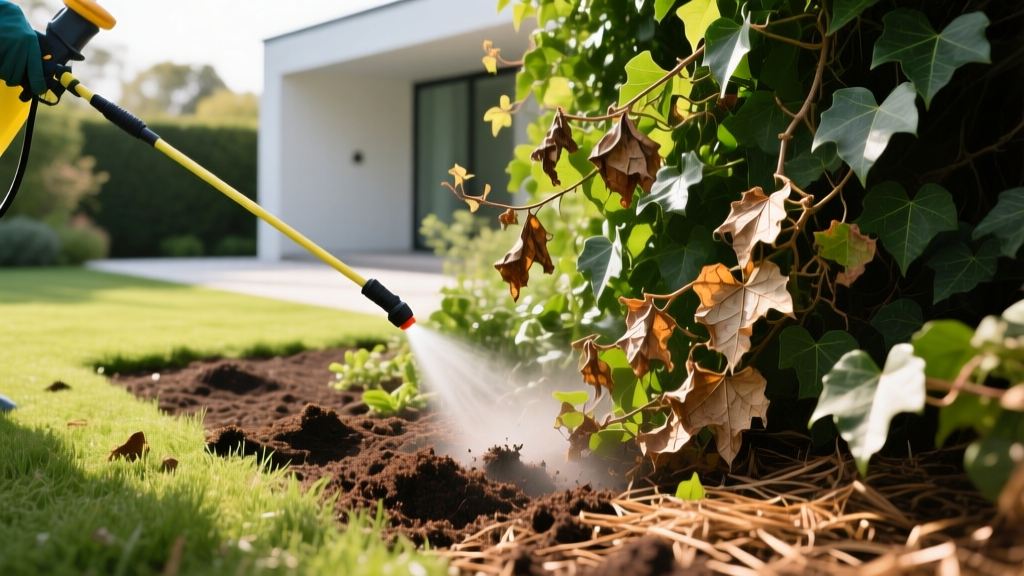
English Ivy Herbicide Options & Post-Treatment Soil Care
The Hidden Cost of English Ivy: Soil Degradation
English ivy (Hedera helix) is widely recognized as an aggressive structural pest that climbs trees and suffocates turfgrass. However, from a soil nutrition perspective, the damage occurring beneath the surface is equally destructive. Ivy forms a dense, waxy canopy that intercepts up to 80% of rainfall, leading to severely hydrophobic (water-repellent) soil conditions. Furthermore, the heavy accumulation of ivy leaf litter alters the soil's carbon-to-nitrogen (C:N) ratio. As the high-carbon leaves decompose, soil microbes consume available nitrogen, effectively starving surrounding turf and ornamental roots of this critical macronutrient.
Successfully managing this invasive weed requires a dual approach: selecting a highly effective english ivy herbicide that neutralizes the plant without sterilizing the soil, followed by an aggressive fertilization protocol to rebuild the degraded soil food web.
⚠️ Soil Nutrition Warning: Avoid Imazapyr
Many commercial 'brush killer' products contain Imazapyr alongside Glyphosate or Triclopyr. While highly effective on ivy, Imazapyr has a soil half-life of up to 12 months and acts as a soil sterilant. If your goal is to restore soil nutrition and replant turfgrass or ornamentals after ivy removal, never use an herbicide containing Imazapyr. It will prevent seed germination and root development for an entire growing season.
Selecting a Soil-Safe English Ivy Herbicide
The waxy cuticle of mature English ivy leaves repels water-based herbicide sprays. To achieve systemic kill without leaving toxic soil residuals that block future fertilization efforts, you must choose the correct active ingredient and pair it with a high-quality non-ionic surfactant.
| Active Ingredient | Product Example | Avg. Cost (2026) | Soil Residual & Safety |
|---|---|---|---|
| Triclopyr (Amine) | Ortho Brush-B-Gon / Garlon 3A | $45 - $60 / quart | Low (1-3 months). Safe for soil microbes once degraded. Broadleaf selective. |
| Glyphosate (41%) | Roundup Pro / Accord | $35 - $45 / gallon | Zero. Binds tightly to soil particles upon contact and deactivates immediately. |
| Triclopyr + 2,4-D | Speedzone / 3-Way Ester | $50 - $70 / gallon | Moderate. Excellent for spot-treating ivy in active turfgrass without killing the grass. |
According to weed management data compiled by the Bugwood Network Invasive Species database, mature ivy requires a minimum of a 2% to 3% solution of Glyphosate 41% or a 1.5% solution of Triclopyr amine for effective foliar control. For mature, woody vines, the cut-stump method using a 20% Triclopyr ester solution is vastly superior and uses less overall chemical volume.
Step-by-Step Eradication and Soil Preservation
Applying herbicide to English ivy requires mechanical preparation to ensure the chemical reaches the root system without excessive runoff that could impact surrounding soil biology.
- Mechanical Scoring: Use a machete or heavy pruning shears to sever thick, woody ivy vines at the base. Do not pull the vines from trees or soil immediately; allow the attached foliage to desiccate for 14 days to reduce soil disturbance and erosion.
- Cut-Stump Treatment: Within 3 minutes of cutting the woody base, apply a 20% Triclopyr ester solution directly to the outer cambium ring of the stump. Pro Tip: Mix the ester with a dye marker to track treated stumps and prevent accidental soil over-spray.
- Foliar Surfactant Application: For ground-cover ivy, mix your chosen herbicide with a non-ionic surfactant at a rate of 0.25% v/v (roughly 1/3 ounce per gallon of water). The surfactant breaks the waxy leaf tension, allowing the systemic herbicide to translocate to the roots rather than pooling on the leaf surface and dripping into the topsoil.
- Wait and Desiccate: Allow 21 to 30 days for the root system to absorb the herbicide and die. Removing the dead mat too early tears up the fragile topsoil layer, exposing weed seeds to sunlight.
Post-Herbicide Soil Nutrition & Recovery Protocol
Once the ivy mat is dead and carefully raked away, you will likely expose compacted, hydrophobic soil devoid of microbial life. The NC State Plant Toolbox notes that ivy's aggressive shading suppresses the understory soil food web. Re-establishing turf or ornamentals requires an immediate nutritional intervention.
1. Correcting pH and Hydrophobicity
Ivy thrives in slightly acidic conditions (pH 5.5 to 6.5), but most desirable turfgrasses and native ornamentals require a pH between 6.0 and 7.0 for optimal nutrient uptake. Submit a soil sample to a local extension office, such as the NC State Soil Testing Lab, before applying amendments.
- Hydrophobic Soil Fix: Apply a liquid yucca extract soil wetting agent (at 3 oz per 1,000 sq ft) to break the surface tension of the water-repellent soil. This must be done before applying granular fertilizers, or the nutrients will simply wash away.
- pH Adjustment: If your soil test indicates a pH below 6.0, apply pelletized calcitic lime at a rate of 40-50 lbs per 1,000 sq ft. Pelletized lime integrates into the soil profile faster than powdered lime when watered in.
2. The Re-Establishment Fertilizer Matrix
Because the decomposing ivy litter has tied up soil nitrogen, your initial fertilization must prioritize nitrogen and phosphorus to stimulate rapid root growth in the disturbed soil.
Recommended N-P-K Recovery Schedule:
- Day 1 (Post-Rake): Apply a high-phosphorus starter fertilizer (e.g., 18-24-12) at 4 lbs per 1,000 sq ft to promote deep root initiation for new seed or sod.
- Day 30: Apply a slow-release, methylene-urea based nitrogen fertilizer (e.g., 30-0-4) at 1 lb of actual nitrogen per 1,000 sq ft. This feeds the recovering soil microbes without causing a rapid, unsustainable flush of top growth.
- Day 60: Top-dress with 1/4 inch of screened compost to reintroduce beneficial mycorrhizal fungi that ivy suppression typically destroys.
"The most common mistake homeowners make after killing English ivy is immediately broadcasting grass seed over the dead mat. The decomposing ivy acts as a massive carbon sink, robbing the soil of the nitrogen the new grass seed needs to germinate. You must physically remove the dead mat and apply a fast-acting nitrogen source to the bare soil before seeding."
Troubleshooting: Regrowth vs. Nutrient Deficiency
Monitoring the treated area over the next 6 to 12 months is critical. Homeowners often confuse herbicide failure with soil-induced stress. Use this diagnostic framework to determine your next steps:
- Symptom: Yellowing, stunted new turfgrass in the treated zone.
Diagnosis: Nitrogen tie-up from remaining ivy root decomposition. Fix: Apply a fast-acting liquid iron and urea mix (e.g., 20-0-0 liquid) to bypass the soil microbial tie-up. - Symptom: Small, waxy, heart-shaped leaves emerging from the soil.
Diagnosis: English ivy regrowth from untreated deep taproots. Fix: Do not re-spray the entire area. Use a 2% Triclopyr amine solution with a sponge applicator to dab the new leaves directly, protecting your newly established turfgrass. - Symptom: Water pooling on the soil surface after irrigation.
Diagnosis: Severe soil compaction and residual hydrophobicity. Fix: Perform deep-tine core aeration (pulling 3-inch plugs) and apply a humic acid soil conditioner to improve cation exchange capacity (CEC) and water infiltration.
By pairing a targeted, soil-safe english ivy herbicide strategy with a rigorous post-treatment soil nutrition plan, you transition your landscape from a degraded, weed-prone environment into a resilient, nutrient-rich ecosystem.

