
Pest Control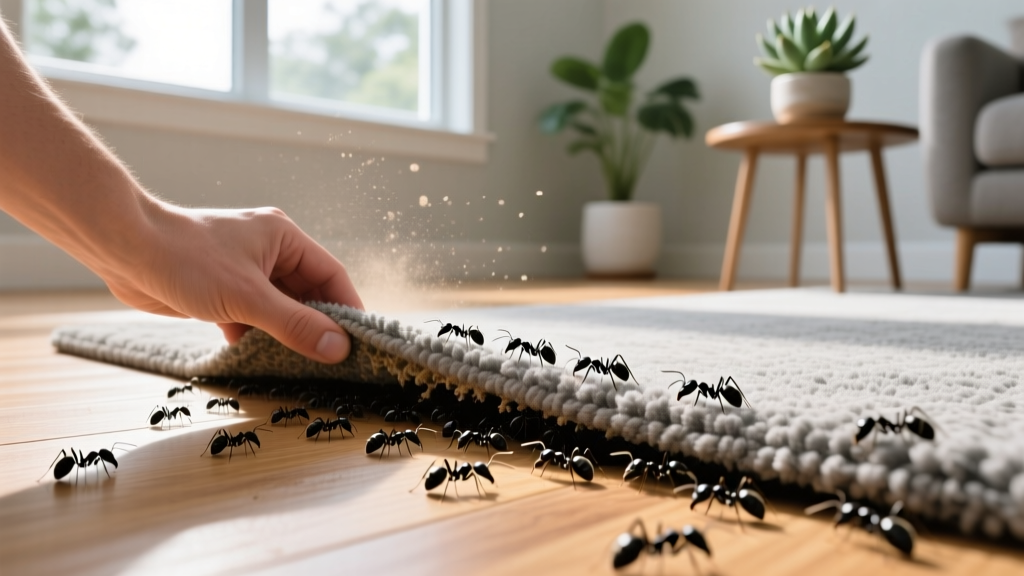
How to Get Rid of Ants in Carpet: Indoor Eradication & Yard Defense
The Biological Reality: Why Ants Target Your Carpet
Finding a trail of ants marching across your living room carpet is a frustrating experience, but it is critical to understand the biological reality of the infestation before reaching for a spray bottle. Ants do not nest or breed inside your carpet fibers. The insects you see are foraging workers—scouts dispatched from an outdoor colony to harvest carbohydrates, proteins, or moisture from inside your home. According to the UC Davis Statewide IPM Program, attempting to eradicate the colony by only treating the indoor trails is a mathematical impossibility; the outdoor queen will simply replace the lost workers within 48 hours.
To permanently solve the problem, you must execute a two-pronged strategy: deploy slow-acting, non-repellent transfer baits on the carpet to infect the foragers, and simultaneously establish a chemical and physical yard defense perimeter to collapse the source colony. This guide details the exact protocols, chemical formulations, and measurements required to eliminate carpet ants and fortify your property.
Phase 1: Indoor Carpet Eradication Protocol (Days 1-5)
The most common mistake homeowners make is applying over-the-counter contact killers (like bifenthrin or permethrin aerosol sprays) directly onto carpet trails. These repellents kill the visible ants instantly but trigger a survival mechanism called "budding," where the stressed colony splits into multiple satellite nests, worsening the infestation. Instead, use non-repellent transfer baits.
Step 1: Map and Preserve the Foraging Trails
Do not vacuum or sweep the ants away immediately. Observe the trail to identify their entry point (usually a gap under the baseboard, a weep hole in the brick, or a crack in the foundation). The ants are following a pheromone highway; you will use this exact highway to deliver poison back to the nest.
Step 2: Deploy Non-Repellent Transfer Baits
Use a gel bait formulated with Indoxacarb 0.66% (such as Syngenta Advion Ant Gel, typically priced around $30 for a 4-tube pack) or Dinotefuran (like Alpine WSG). These active ingredients are non-repellent, meaning the ants cannot detect them, and they possess a delayed transfer effect (trophallaxis).
- Application Technique: Apply 1/8-inch diameter dots of gel bait every 6 inches directly adjacent to the carpet trail, resting on the baseboard or hard flooring. Do not inject gel deep into the carpet pile, as it will stain the fibers and dry out too quickly.
- Alternative for Carpet Edges: If the trail is strictly in the center of the rug, place small squares of wax paper on the carpet and apply the gel dots to the paper to prevent staining.
WARNING: Carpet Staining Risks
Never apply liquid concentrate pesticides (like Termidor SC or Bifen IT) directly to indoor carpets. These formulations contain petroleum distillates and emulsifiers that will permanently stain synthetic and wool carpet fibers and leave hazardous residues in your living space. Reserve liquid concentrates strictly for outdoor perimeter use.
Step 3: The 72-Hour Observation Window
Leave the bait undisturbed for 3 to 5 days. You will likely see an increase in ant activity on the carpet during the first 48 hours as more foragers are recruited to the newly discovered food source. This is the desired outcome. The foragers will ingest the bait, return to the outdoor nest, and regurgitate it to feed the larvae and the queen, ultimately collapsing the colony.
Phase 2: Establishing the Yard-to-Home Defense Perimeter (Days 6-10)
Once the indoor foragers have been eliminated, you must secure your yard to prevent new colonies from establishing near your foundation. The EPA recommends integrated pest management strategies that combine habitat modification with targeted outdoor chemical barriers.
Habitat Modification: The 12-Inch Rule
Ants thrive in the moist, protected microclimates created by overgrown landscaping. Trim all shrubs, tree branches, and groundcover so there is a minimum 12-inch gap between any vegetation and your home's exterior walls. Remove mulch that is piled directly against the siding, as this retains moisture and provides ideal nesting conditions for carpenter ants and odorous house ants.
Foundation Trenching and Liquid Barrier Application
To create an impenetrable yard defense barrier, apply a non-repellent liquid termiticide/insecticide like Termidor SC (Fipronil 9.1%) or Alpine WSG (Dinotefuran 40%) to the soil immediately adjacent to your foundation.
- Dig a Trench: Use a hand trowel to dig a trench 6 inches wide and 6 inches deep around the entire perimeter of your home's foundation.
- Mix the Solution: For Termidor SC, mix 0.8 fluid ounces of concentrate per gallon of water. For a standard 200-linear-foot perimeter, you will need approximately 20 gallons of finished solution.
- Apply and Backfill: Pour 1 gallon of the mixed solution into every 10 linear feet of the trench. Backfill the trench with the excavated soil to lock the chemical into the ground, creating a continuous, undetectable barrier that ants will cross and carry back to their subterranean nests.
Active Ingredient Comparison Matrix
Selecting the right chemistry is vital for success. Below is a comparison of the industry-standard active ingredients used for carpet ant eradication and yard defense.
| Active Ingredient | Product Example | Primary Use Case | Transfer Effect | Est. Cost (2026) |
|---|---|---|---|---|
| Indoxacarb (0.66%) | Advion Ant Gel | Indoor carpet trails, baseboards | High (Trophallaxis) | $30 / 4 tubes |
| Fipronil (9.1%) | Termidor SC | Outdoor foundation trenching | Very High (Domino Effect) | $85 / 20 oz bottle |
| Dinotefuran (40%) | Alpine WSG | Indoor/outdoor broadcast spray | Moderate | $45 / 10 packets |
| Indoxacarb + Thiamethoxam | Optigard Ant Gel | Sweet-feeding ants on carpets | High | $35 / 4 tubes |
Phase 3: Carpet Decontamination and Pheromone Erasure
After the colony has been eradicated and the 5-day waiting period has passed, you must clean the carpet to remove dead ants and, more importantly, erase the invisible pheromone trails. If the chemical trail remains, future scout ants from neighboring yards may follow the exact same path into your home.
- Vacuuming: Use a HEPA-filter vacuum to remove all dead ants, shed exoskeletons, and dried bait residue from the carpet fibers. Dispose of the vacuum bag or empty the canister into an outdoor trash receptacle immediately.
- Enzyme Cleaning: Standard carpet shampoos do not break down insect pheromones. Apply a bio-enzymatic cleaner (such as Nature's Miracle or Rocco & Roxie Stain & Odor Eliminator, typically $20-$25 per gallon) directly to the areas where the trails were heaviest. The enzymes will biologically degrade the hydrocarbon pheromone markers, effectively blinding future scouts.
Troubleshooting: Why the Ants Keep Coming Back
If you have executed the indoor baiting and outdoor trenching protocols but still see ants on your carpet after 14 days, you are likely dealing with one of two edge cases:
1. Moisture Trapped Under the Carpet Pad
Ants require high moisture levels to survive. If you have a slow plumbing leak, a condensation issue from an HVAC duct, or poor exterior grading causing water to pool under your foundation, the subfloor beneath your carpet may be damp. Ants will exploit this moisture. Use a non-invasive moisture meter on the carpet surface. If readings exceed 15%, you must pull back the carpet, replace the wet padding, and fix the water intrusion source before pest control can be fully effective.
2. Wall Void Satellite Colonies
As noted by University of Kentucky Entomology, certain species like the Pharaoh ant (Monomorium pharaonis) routinely establish satellite colonies inside wall voids, insulation, and under subflooring. If the ants are emerging from under the baseboard rather than entering from outside, the colony is inside the structure. In this scenario, outdoor yard defense will not solve the issue. You must drill 1/8-inch holes into the wall studs and inject an aerosol non-repellent dust (like Alpine Dust or Cimarron) directly into the voids.
Pro Tip: The Blacklight Test
If you cannot locate the entry point during the day, turn off all interior lights at night and use a UV blacklight to scan the carpet edges. Many ant species leave trace amounts of fluorescent biological material and pheromones that glow faintly under UV light, revealing hidden trails that lead directly to structural cracks.
Frequently Asked Questions
Will vinegar kill ants on my carpet?
White vinegar (acetic acid) will kill individual ants on contact and temporarily disrupt their pheromone trails, but it has zero residual effect and will not reach the outdoor colony. It is a temporary deterrent, not an eradication tool.
Can I use diatomaceous earth (DE) on my carpet?
While food-grade diatomaceous earth is a popular organic pest control method, applying it to carpets is highly discouraged. DE is a fine, abrasive silica dust that will embed deeply into the carpet pile, potentially degrading the fibers over time. Furthermore, it acts as a severe respiratory irritant when kicked up into the air by foot traffic, posing a health risk to humans and pets.
How long does the outdoor Termidor barrier last?
When applied correctly via the 6-inch trenching method into undisturbed soil, a Fipronil-based barrier like Termidor SC remains active in the soil for 6 to 12 months, depending on your local rainfall and soil porosity. Reapplication should be scheduled annually in early spring before the primary swarming season.

