
Pest Control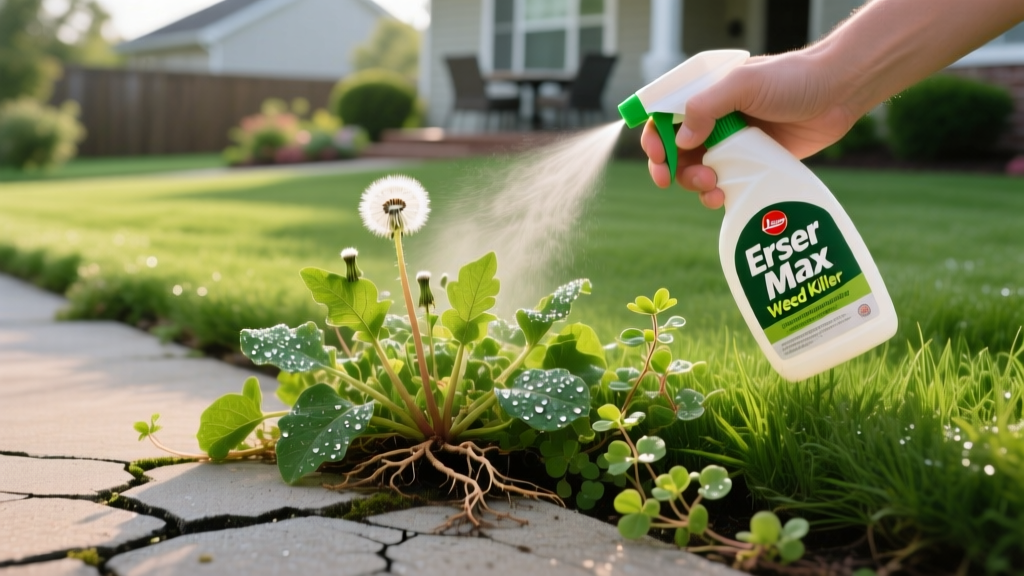
Eraser Max Weed Killer: Spot-Treatment Guide for Stubborn Weeds
Eraser Max weed killer is a high-concentration, non-selective systemic herbicide primarily utilized for post-emergent control of stubborn perennial weeds, invasive grasses, and woody brush. When executing spot treatments in established lawns, the margin for error is zero. A single misdirected spray droplet can necrotize desirable turfgrass, leaving bare patches vulnerable to secondary infestations. This guide details the precise chemical mechanics, mix rates, and application protocols required to use Eraser Max effectively without compromising your surrounding landscape.
Formulation Dynamics and Soil Residual Risks
Standard Eraser formulations typically contain 41% glyphosate, an EPSP synthase inhibitor that halts the production of essential amino acids in plants. However, 'Max' or 'Extended Control' variants often blend glyphosate with imazapyr or imazapic to provide long-term vegetation control. Before mixing any solution, verify the active ingredients on your specific product label.
⚠️ CRITICAL WARNING: Imazapyr Soil Activity
If your Eraser Max product contains imazapyr, do not use it near the drip line of desirable trees or shrubs. Imazapyr is highly water-soluble and remains active in the soil for 6 to 12 months. It can be absorbed by the roots of non-target plants, causing severe systemic damage or death. For spot treatments in lawn settings, restrict imazapyr blends to hardscape cracks, fence lines, and isolated gravel beds. Use pure glyphosate formulations for spot-treating weeds directly within turfgrass canopies.
According to the Environmental Protection Agency (EPA), glyphosate binds tightly to soil particles and is rapidly deactivated by soil microbes, making it safe for targeted lawn use when applied correctly. For a deeper understanding of its environmental fate, the University of California IPM program provides extensive data on glyphosate's soil half-life and degradation pathways.
Target Weed Species and Precision Mix Rates
Broad-spectrum herbicides require calibrated mix rates based on the target species' cuticle thickness and root mass density. Over-mixing wastes product and increases soil loading, while under-mixing results in 'top-kill' where the foliage dies but the perennial root crown survives and regenerates. As of 2026, Eraser Max concentrates typically retail between $55 and $75 per quart, making accurate dilution economically essential.
| Target Weed Species | Mix Rate (oz per gallon) | Optimal Growth Stage | Expected Control Timeline |
|---|---|---|---|
| Dallisgrass / Nutsedge | 2.5 to 3.0 oz | Early seedhead emergence | 10–14 days |
| Field Bindweed | 4.0 to 5.0 oz | Early flowering stage | 14–21 days |
| Common Bermudagrass (in Fescue) | 2.0 to 2.5 oz | Active vegetative growth | 7–10 days |
| Poison Ivy / Woody Brush | 5.0 to 6.0 oz | Late summer (pre-senescence) | 21–30 days |
Precision Application Techniques for Lawn Safety
When spot-treating weeds intermingled with desirable turf, standard broadcast nozzles are unacceptable. You must isolate the herbicide to the target foliage using one of two mechanical methods.
1. Shielded Cone Spraying
For low-growing weeds like crabgrass or young dallisgrass, attach a plastic shielded cone to your sprayer wand. This physical barrier prevents wind drift and overspray from contacting adjacent turf blades. Keep the nozzle within 2 to 4 inches of the weed canopy and apply a fine mist until the leaves are uniformly wet, but not dripping. Dripping indicates product waste and increases the risk of soil saturation.
2. The Wick Wiping Method
Wick wiping is the gold standard for treating tall, invasive weeds (like bindweed or wild lettuce) that have grown above the canopy of a cool-season lawn. A rope wick or sponge applicator draws the herbicide solution via capillary action. By physically wiping the saturated wick only over the top third of the target weed, you achieve direct translocation into the plant's phloem without risking any contact with the shorter turfgrass below.
Water Chemistry and Surfactant Integration
The efficacy of Eraser Max is heavily dependent on water quality. Glyphosate is a weak acid and readily binds to calcium, magnesium, and iron cations found in hard water. This 'cation tie-up' renders the active ingredient biologically inactive before it even reaches the plant tissue.
- Hard Water Antagonism: If your water source exceeds 150 ppm in hardness, add Ammonium Sulfate (AMS) to the spray tank at a rate of 1 to 2% by volume (1.3 to 2.6 oz per gallon) before adding the Eraser Max. The AMS satisfies the cation binding sites, leaving the glyphosate free to penetrate the weed.
- Surfactant Requirements: While some Max formulations include built-in surfactants, adding a high-quality Non-Ionic Surfactant (NIS) at 0.25% to 0.5% v/v drastically reduces the surface tension of the spray droplet. As noted by Penn State Extension, surfactants increase the spray contact area on waxy, hydrophobic leaves (like those of plantain or mature poison ivy) by up to 40%, ensuring maximum cuticular absorption.
Common Failure Modes and Troubleshooting
When a spot treatment fails to kill the root system, it is rarely a product defect. It is almost always an environmental or procedural error. Avoid these critical failure modes:
- Premature Mowing: Systemic herbicides require time to translocate from the leaf tissue down to the root crown. Mowing the treated area within 3 to 5 days of application physically removes the herbicide-loaded foliage, halting the kill process. Wait until the weed shows severe chlorosis (yellowing) before mowing.
- Drought Stress Application: Plants close their stomata and halt phloem transport during severe drought to conserve water. If you apply Eraser Max to a wilted, drought-stressed weed, the chemical will sit in the leaf and degrade in the UV light without moving to the roots. Irrigate the area 24 hours before treatment to ensure the weed is actively translocating nutrients.
- Inadequate Rainfastness: While the label may state a 2-hour rainfast window, heavy cuticle weeds require up to 6 hours for full absorption. Check hyper-local weather forecasts and avoid application if precipitation is expected within half a day.
Post-Treatment Lawn Recovery and Overseeding
Once the targeted weed has completely necrotized and the root system is dead, you must repair the bare spot to prevent new weed seeds from germinating in the exposed soil. Because pure glyphosate is deactivated upon contact with soil organic matter, it leaves no residual herbicidal barrier.
You can safely rake out the dead weed debris, amend the soil with a thin layer of compost, and overseed with your desired turfgrass seed just 7 to 14 days after the initial Eraser Max application. Ensure you use a starter fertilizer that does not contain pre-emergent herbicides, as these will inhibit the germination of your new grass seed. By combining precise chemical selection, mechanical isolation, and proper water conditioning, you can eradicate the most stubborn perennial weeds while preserving the integrity of your surrounding lawn.

