
Pest Control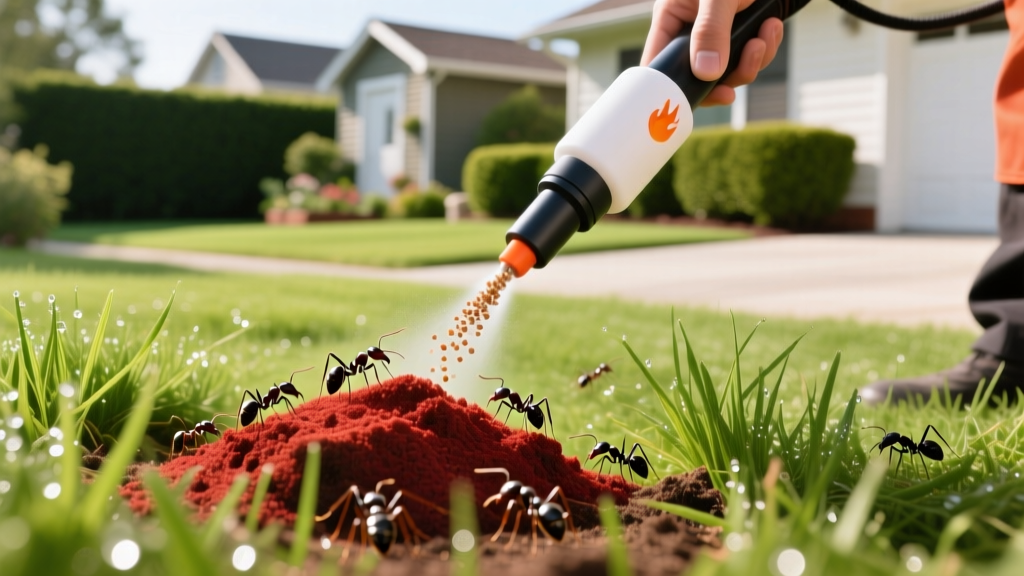
How to Exterminate Fire Ants in Your Yard: The Two-Step Method
The Reality of Red Imported Fire Ants (RIFA)
Attempting to eliminate fire ants by pouring boiling water, club soda, or gasoline into a mound is a dangerous myth that rarely reaches the queen. The Red Imported Fire Ant (RIFA) builds complex, deep subterranean colonies that can house up to 500,000 workers and multiple queens. When disturbed, they swarm aggressively, delivering painful, venom-filled stings that can cause severe allergic reactions. Furthermore, RIFA colonies are notorious for damaging electrical equipment, chewing through irrigation wire insulation, and undermining patio foundations. To successfully reclaim your yard, you must abandon reactive spot treatments and adopt a strategic, colony-level eradication protocol known in the entomology community as the Two-Step Method.
Identifying the Threat: RIFA vs. Native Ants
Before purchasing chemicals, confirm you are dealing with RIFA rather than native, less aggressive species. Native fire ants are generally beneficial to the ecosystem, while RIFA is a highly destructive invasive species. According to the Texas A&M AgriLife Extension Fire Ant Project, accurate identification is the first step in effective yard defense.
| Characteristic | Red Imported Fire Ant (RIFA) | Native Fire Ant |
|---|---|---|
| Mound Structure | Dome-shaped, no visible entrance holes on top, spongy texture | Flatter, often has visible entrance holes on the surface |
| Aggression Level | Extreme; swarms and stings repeatedly upon slight vibration | Moderate; retreats or shows mild defensive behavior |
| Colony Size | 100,000 to 500,000+ workers | Typically under 50,000 workers |
| Coloration | Reddish-brown head/thorax, darker brown/black abdomen | Uniformly lighter red or orange |
Step 1: Broadcast Baiting for Colony Eradication
The foundation of how to exterminate fire ants on a macro level is broadcast baiting. Worker ants forage up to 100 feet from the mound. When they find a lipid-based bait laced with a slow-acting insecticide, they carry it deep into the colony and feed it to the larvae and queens via trophallaxis (regurgitation). The slow-acting nature of the chemical is critical; if the workers die too quickly, the colony will recognize the threat and reject the food.
Recommended Products and Active Ingredients
- Indoxacarb (0.04%): Found in Advion Fire Ant Bait. This is the industry gold standard. It requires metabolic activation inside the ant's gut to become lethal, ensuring it reaches the queen. Expect to pay $45 to $55 for a 7.5 lb jug in 2026.
- Spinosad + Methoprene: Found in Extinguish Plus. An excellent organic-compatible alternative (Spinosad) combined with an insect growth regulator (Methoprene) that sterilizes the queen.
Pro-Tip: The Potato Chip Foraging Test
Never apply bait blindly. Place a single potato chip or hot dog slice 3 feet from an active mound. Wait 15 minutes. If 3 or more fire ants are actively feeding on it, the colony is foraging, and soil temperatures are optimal (between 65°F and 90°F). If they ignore it, wait for a different time of day or a warmer evening.
Never apply bait blindly. Place a single potato chip or hot dog slice 3 feet from an active mound. Wait 15 minutes. If 3 or more fire ants are actively feeding on it, the colony is foraging, and soil temperatures are optimal (between 65°F and 90°F). If they ignore it, wait for a different time of day or a warmer evening.
Exact Application Rates
Apply Advion Fire Ant Bait at a rate of 1.5 pounds per acre. For a standard 10,000 square foot suburban lawn, this equates to roughly 5.5 ounces of bait. Use a handheld rotary spreader (like the Scotts Whirl Hand-Powered Spreader) with the setting adjusted to the lowest opening that allows the granules to flow. Broadcast evenly across the entire yard, not just around visible mounds, to intercept foraging trails from hidden satellite colonies.
Warning: Moisture Ruins Bait
Fire ants will not consume wet or moldy bait. Check the local forecast and ensure no rain or heavy dew is expected for at least 4 to 6 hours post-application. Apply bait in the late afternoon or early evening when RIFA foraging peaks and UV degradation is minimal.
Fire ants will not consume wet or moldy bait. Check the local forecast and ensure no rain or heavy dew is expected for at least 4 to 6 hours post-application. Apply bait in the late afternoon or early evening when RIFA foraging peaks and UV degradation is minimal.
Step 2: Targeted Mound Drenching for Immediate Relief
While broadcast baiting takes 2 to 4 weeks to collapse the colony, high-traffic areas (near patios, mailboxes, or playsets) require immediate neutralization. This is where Step 2—mound drenching—comes in. Drenching involves flooding the mound with a liquid contact insecticide to kill the workers and queen on contact.
Chemical Selection and Mixing
Use a liquid concentrate containing Bifenthrin (7.9%), such as Bifen IT or Talstar P. Bifenthrin provides an immediate kill and leaves a residual barrier in the soil for up to 90 days.
Mixing Ratio: Mix 1 fluid ounce of Bifenthrin concentrate per 1 gallon of water in a pressurized pump sprayer.
The Drenching Protocol
- Do not disturb the mound first. Kicking or poking the mound causes the queen to immediately retreat into deep subterranean escape tunnels.
- Create a chemical barrier. Spray a 2-foot radius around the outside of the mound to catch fleeing workers.
- Drench the center. Using a watering can or a sprayer with the nozzle adjusted to a gentle shower (to avoid digging a hole in the crust), pour 1 to 2 gallons of the mixed solution directly over the mound. The goal is to saturate the entire gallery system.
- Wait and observe. The mound should be completely inactive within 15 to 30 minutes.
Perimeter Defense: Keeping Fire Ants Out of the House
Exterminating fire ants in the yard is only half the battle; preventing them from migrating indoors is the other. As outdoor food sources dry up in late summer, RIFA colonies frequently invade homes seeking moisture and protein. According to the Environmental Protection Agency (EPA), creating a continuous chemical barrier around the foundation is the most effective structural defense.
Using your Bifenthrin mixture, apply a "1-foot up, 1-foot out" barrier. Spray the foundation wall 12 inches up from the soil line, and the soil 12 inches out from the foundation. Pay special attention to weep holes, utility penetrations, and HVAC drip lines, which act as superhighways for foraging ants. Reapply this perimeter barrier every 90 days during the active season.
Cost Breakdown & ROI: DIY vs. Professional Extermination
Understanding the financial commitment helps homeowners decide whether to manage the infestation independently or hire a licensed pest control operator (PCO). Below is a comparative analysis based on average 2026 market rates for a standard 1/4 acre (10,890 sq ft) residential lot.
| Treatment Strategy | Materials / Service Cost | Time Investment | Longevity of Control |
|---|---|---|---|
| DIY Two-Step Method (Annual) | $65 - $90 (Bait + Concentrate) | 2-3 hours per application (3x/year) | 85-95% reduction if timed correctly |
| Professional Quarterly Service | $350 - $550 per year | Zero (Technician managed) | 90-98% reduction, includes warranties |
| DIY Spot Treatment Only (Sprays) | $15 - $30 per season | 1 hour per week (Reactive) | 10-20% reduction (Colonies simply relocate) |
Common Extermination Failures & How to Avoid Them
Even with the right chemicals, homeowners frequently make tactical errors that allow colonies to rebound. Review these common failure modes to ensure your yard defense holds.
- Failure Mode 1: Stale Bait. The lipid carriers in fire ant bait go rancid once opened. If you buy a 7.5 lb jug but only use 5 oz per application, store the remainder in an airtight container in a cool, dark place. Discard any bait older than 12 months.
- Failure Mode 2: Ignoring Satellite Mounds. When a large central mound is stressed by drenching, the colony will often bud, sending mated queens and a subset of workers to form smaller satellite mounds 10 to 20 feet away. This is why Step 1 (broadcast baiting) is non-negotiable; it targets the satellites before they mature.
- Failure Mode 3: Over-application. Applying more bait than the recommended 1.5 lbs/acre does not kill ants faster. It creates a chemical repellency effect, causing foragers to avoid the granules entirely. Stick strictly to the label rates.
Mastering how to exterminate fire ants requires patience and precise timing. By combining a slow-acting broadcast bait to destroy the reproductive core of the colony with a targeted liquid drench for immediate surface relief, you can reclaim your lawn and establish a robust perimeter defense that keeps RIFA out of your living spaces.

