
Pest Control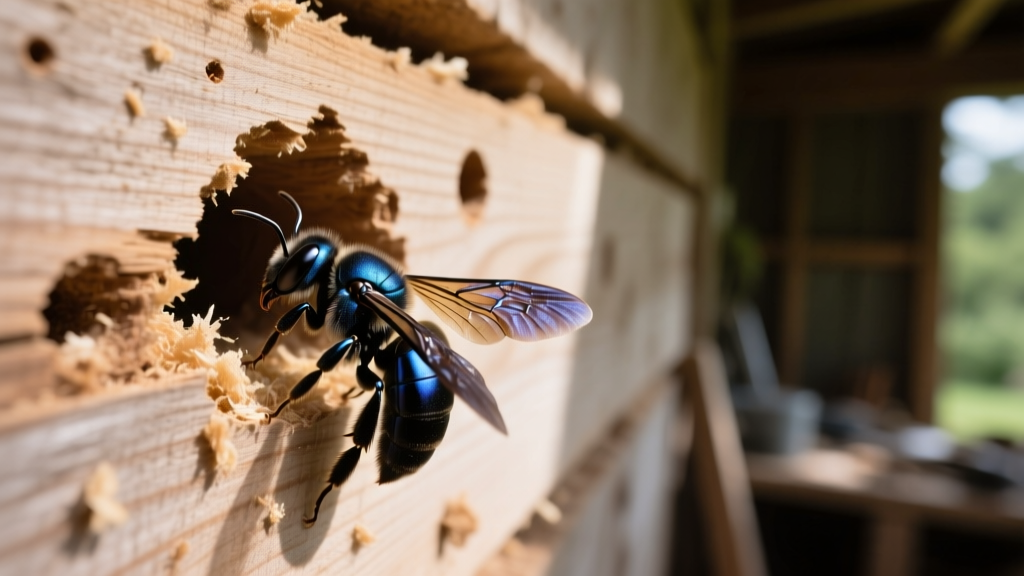
How to Exterminate Wood Boring Bees and Protect Your Home's Woodwork
The Anatomy of a Carpenter Bee Invasion
Carpenter bees (Xylocopa species) are large, solitary insects that excavate galleries in untreated wood to rear their young. Often mistaken for bumblebees due to their similar size (1/2 to 1 inch long), carpenter bees can be identified by their shiny, hairless, metallic black or blue-black abdomens. While bumblebees nest in the ground, carpenter bees target structural and cosmetic woodwork, including deck railings, fascia boards, eaves, and window sills.
The damage begins when a mated female drills a perfectly round entrance hole, typically 1/2 inch in diameter. Inside, she tunnels parallel to the wood grain, creating a main gallery that can extend 6 to 10 inches deep, often branching into multiple sub-tunnels. According to Penn State Extension, while a single season's damage is mostly cosmetic, successive generations reusing and expanding the same galleries can cause severe structural weakening and moisture rot over time.
Early Warning Signs
- Fresh Frass: Coarse, sawdust-like material accumulating directly beneath circular holes.
- Fecal Staining: Yellowish-brown streaks on the wood surface below the entrance.
- Hovering Males: Aggressive but stingless male bees patrolling specific areas of your deck or eaves.
- Buzzing Inside Wood: Faint vibrating sounds emanating from fascia boards, indicating active larvae or adult movement.
Why Liquid Sprays Fail: The Gallery Problem
A common mistake homeowners make when trying to exterminate wood boring bees is spraying liquid insecticide directly into the entrance hole. This approach almost always fails. The main gallery runs horizontally or at an upward angle, and liquid sprays simply pool at the entrance or absorb into the superficial wood fibers without reaching the deep nesting chambers where the larvae and pollen provisions are stored.
To effectively eliminate the colony, you must use an insecticidal dust. Dust formulations (such as those containing deltamethrin or cyfluthrin) cling to the bee's body as they enter and exit the tunnel, carrying the lethal dose deep into the gallery and transferring it to other bees and larvae. Liquid sprays should be reserved exclusively for exterior surface barriers, not internal gallery treatment.
Step-by-Step Protocol to Exterminate Wood Boring Bees
Follow this precise treatment sequence to ensure complete eradication while minimizing harm to beneficial pollinators foraging elsewhere in your yard.
- Time the Application: Treat active holes at dusk or after dark. Carpenter bees are largely inactive at night, reducing the risk of aggressive encounters and ensuring the bee is inside the gallery when the dust is applied.
- Apply Insecticidal Dust: Use a hand-held bulb duster or a specialized tube duster (like the JT Eaton Duster). Insert the nozzle into the 1/2-inch hole and puff 2 to 3 bursts of dust (e.g., Delta Dust or Tempo 1% Dust). Do not pack the hole with dust; the goal is to coat the inner walls lightly.
- Leave Holes Open: Resist the urge to plug the holes immediately. The bees must be allowed to enter and exit over the next 48 to 72 hours to track the dust throughout the entire tunnel network and expose the hidden larvae.
- Apply a Surface Barrier: The morning after dusting, spray the surrounding wood surface (within a 2-foot radius of the holes) with a microencapsulated liquid residual spray like Cyzmic CS or Onslaught FastCap. This kills any emerging adults and deters new females from starting adjacent tunnels.
- Seal the Galleries: After 3 to 4 days, plug the entrance holes tightly. Use a wooden dowel coated in carpenter's glue, a cork, or a high-quality exterior wood filler. This prevents future generations from reusing the old tunnels and stops moisture intrusion.
⚠️ Warning: The Woodpecker Secondary Damage Effect
Do not delay sealing the holes after treatment. Woodpeckers and flickers can hear the movement of carpenter bee larvae inside the wood. They will peck through fascia boards and deck railings to extract the grubs, causing significantly more destruction than the bees themselves. If you see woodpecker damage near round holes, immediate extermination and sealing are critical.
Treatment Matrix: Dusts, Liquids, and Natural Deterrents
Selecting the right product depends on whether you are treating an active infestation, establishing a preventive barrier, or managing a low-level nuisance organically.
| Method | Active Ingredient / Type | Best Use Case | Pros | Cons |
|---|---|---|---|---|
| Insecticidal Dust | Deltamethrin (Delta Dust) or Cyfluthrin (Tempo 1%) | Active gallery extermination | Reaches deep tunnels; long residual life; waterproof formulations available | Requires specific duster tool; messy application |
| Residual Liquid Spray | Lambda-cyhalothrin (Cyzmic CS) or Bifenthrin | Surface barrier / Prevention | Covers large areas quickly; microencapsulation resists UV degradation | Useless inside deep tunnels; can harm foraging bees if sprayed on flowers |
| Essential Oil Repellents | Citrus oil (d-Limonene) or Almond oil | Organic deterrence on small projects | Safe for pets and humans; pleasant scent | Does not kill bees; requires frequent reapplication; washes away in rain |
| Physical Traps | Untreated pine boxes with collection bottles | Population reduction in high-traffic areas | Zero chemicals; reusable year after year | Only catches foraging adults; does not treat existing wood galleries |
DIY Carpenter Bee Trap Specifications
If you prefer a chemical-free approach to reduce local populations, building a targeted wooden trap is highly effective. According to research cited by the University of Kentucky Entomology Department, carpenter bees are drawn to pre-existing holes in soft, untreated woods like pine or cedar, provided the dimensions and angles mimic their natural nesting preferences.
Exact Trap Measurements
- The Box: Construct a simple house-like structure using untreated 1x6 pine boards. The base should be roughly 5x5 inches, with a height of 8 inches.
- The Roof: Cap the top with a slanted roof to prevent rain from washing out the trap or ruining the collection bottle.
- The Entrance Holes: Drill 3/4-inch diameter holes into the side panels. Critical detail: Drill the holes at a 45-degree upward angle. This specific angle mimics the entrance of a natural gallery and prevents rain from entering.
- The Collection Chamber: Remove the bottom panel of the box and attach a clear plastic soda bottle (neck pointing up into the box). Bees enter the angled side holes, drop down into the light at the bottom, and funnel into the bottle where they become trapped.
Hang these traps from the corners of your eaves or the edges of your deck in early spring (March to April) when female bees are actively scouting for nesting sites. Empty the bottle weekly and add a few drops of soapy water to ensure trapped bees expire quickly.
Post-Extermination: Long-Term Wood Defense
Carpenter bees strongly prefer bare, weathered, and unpainted softwoods. The single most effective long-term defense is altering the wood's surface profile so it is no longer attractive to scouting females.
- Paint Over Stain: While exterior stains offer some protection, a high-quality acrylic latex paint completely masks the wood grain and texture, making it virtually impossible for the bee to grip and drill. Oil-based polyurethane is a strong alternative if you must preserve the natural wood look.
- Replace Vulnerable Trim: If your fascia boards are repeatedly targeted and structurally compromised, replace them with PVC trim boards (like Azek) or fiber cement siding. Carpenter bees cannot bore into synthetic or cementitious materials.
- Fill Cracks and Checks: Large weather-checks (cracks in timber beams) provide sheltered starting points for drilling. Fill these with exterior-grade silicone or polyurethane caulk before the spring emergence.
Frequently Asked Questions
Do carpenter bees sting?
Only female carpenter bees possess stingers, and they are highly docile. They will only sting if physically handled or trapped against the skin. The males, which are often seen aggressively darting at people near decks, do not have stingers and are entirely harmless.
Will WD-40 kill carpenter bees?
While spraying WD-40 into a hole may suffocate a bee currently inside, it is not a residual insecticide. It will not kill larvae deep in the gallery, nor will it deter new bees from using the hole once the petroleum scent dissipates. Stick to formulated insecticidal dusts for reliable extermination.
When is the best time of year to treat for carpenter bees?
The primary treatment window is late spring (May to June) when females are actively excavating new galleries and provisioning them with pollen. A secondary, smaller treatment window occurs in late summer (August to September) when the new generation of adults emerges and mates before overwintering in old tunnels.

