
Pest Control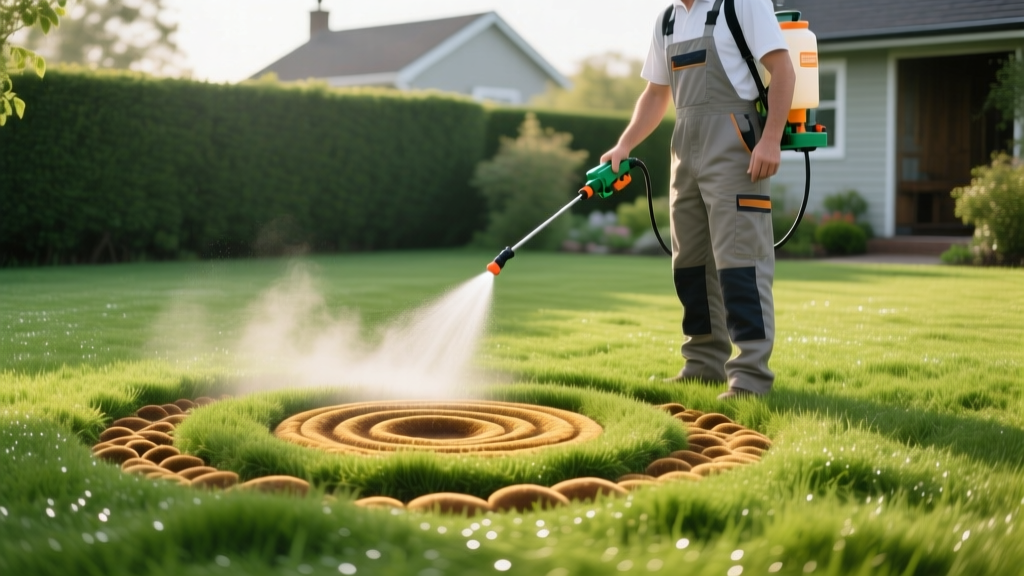
Fairy Ring Fungicide Application: A Step-by-Step Lawn Guide
The Biology of Fairy Rings: Why Fungicides Often Fail
Fairy rings are caused by over 50 species of soil-inhabiting Basidiomycete fungi that feed on decaying organic matter in the thatch and root zone. Homeowners frequently report that fairy ring fungicide applications fail to resolve the issue. This failure rarely stems from the chemical itself; rather, it results from misdiagnosing the fairy ring type, applying insufficient water volumes to reach the mycelium, or ignoring the hydrophobic soil conditions the fungus creates.
According to NC State TurfFiles, the mycelial mat of a fairy ring can extend 6 to 12 inches deep into the soil profile. If your spray solution remains trapped in the thatch layer due to low application volumes or hydrophobic soil, the active ingredient never contacts the target pathogen.
Diagnosing Your Fairy Ring Type
Before mixing any chemical, you must classify the fairy ring. Fungicides target the mycelium, but symptom management requires type-specific cultural interventions alongside chemical control.
- Type I (Hydrophobic/Dead Turf): The mycelial mat becomes so dense that it repels water, causing the turf inside and along the ring to die from drought stress, not direct fungal infection. Treatment requires a fungicide paired with a penetrating wetting agent.
- Type II (Dark Green Ring): The fungus decomposes organic matter, releasing excess nitrogen (ammonia) into the soil. The turf grows rapidly and turns dark green. Treatment requires a fungicide to halt mycelial spread, paired with nitrogen fertilization on the rest of the lawn to mask the contrast.
- Type III (Mushrooms/Basidiocarps): The fruiting bodies (mushrooms) appear, usually after heavy rainfall. Fungicides do not kill existing mushrooms. Physical removal (mowing or raking) combined with a preventative fungicide program is required.
Selecting the Right Fairy Ring Fungicide
Not all fungicides are equally effective against Basidiomycetes. Strobilurins and carboxamides are the industry standards for fairy ring suppression. Below is a comparison of the most effective professional-grade active ingredients available to homeowners and commercial applicators in 2026.
| Active Ingredient | Brand Example | Target Type | Approx. Cost (2026) | Curative Rate (per 1,000 sq ft) |
|---|---|---|---|---|
| Azoxystrobin (2.08 SC) | Heritage SC | I, II, III | $185 / pint | 0.8 fl oz |
| Flutolanil (70 WP) | ProStar 70 WP | I, II | $260 / 2.5 lb bag | 4.5 oz (by weight) |
| Polyoxin D Zinc Salt | Endorse | I, II, III | $130 / 8 oz bottle | 1.0 oz (by weight) |
| Propiconazole + Azoxystrobin | Headway G (Granular) | II, III (Preventative) | $85 / 30 lb bag | 2.3 lbs (granular) |
Note: Granular formulations like Headway G are excellent for preventative maintenance but lack the immediate soil penetration required for curative Type I treatments. Liquid formulations are mandatory for active, severe infestations.
The Missing Link: Penetrating Wetting Agents
If you are treating a Type I fairy ring, applying a fairy ring fungicide without a soil surfactant is a waste of money. The mycelium coats soil particles with a waxy, hydrophobic substance. Standard irrigation or rainfall will bead up and run off the affected zone.
Expert Recommendation: Tank-mix your liquid fungicide with a dedicated penetrating wetting agent like Aqueduct or Cascade. These products break the surface tension of the water, pulling the fungicide solution deep into the root zone where the mycelium resides. Apply the wetting agent at 3 to 4 oz per 1,000 sq ft simultaneously with your fungicide application.
Step-by-Step Fairy Ring Fungicide Application Protocol
Follow this precise calibration and application sequence to ensure the active ingredient reaches the target depth.
Step 1: Core Aeration and Soil Puncturing
Before spraying, use a core aerator or a solid-tine pitchfork to puncture the fairy ring and the soil 2 feet beyond its visible edge. This physically disrupts the dense mycelial mat and creates channels for the chemical solution to penetrate. For severe Type I rings, use a spading fork to poke holes 6 inches deep every 2 inches across the dead zone.
Step 2: Sprayer Calibration for High Water Volume
Fairy rings require a minimum carrier volume of 4 gallons of water per 1,000 square feet. Standard lawn sprayers often deliver only 1.5 to 2 gallons. To calibrate your backpack sprayer:
- Measure a 20 ft x 50 ft area (1,000 sq ft) on your driveway.
- Fill your sprayer with a known volume of water (e.g., 2 gallons).
- Spray the area at your normal walking pace and pump pressure.
- If you run out of water before covering the area, you must walk slower, increase pressure, or change to a higher-flow nozzle (such as an AI11004 air-induction nozzle).
Step 3: Tank Mixing Order
Proper mixing prevents chemical binding and nozzle clogging. Follow the W-A-L-E-S protocol:
- Wettable powders (e.g., ProStar 70 WP) - Mix in water first.
- Agitate thoroughly.
- Liquid flowables (e.g., Heritage SC).
- Emulsifiable concentrates (if using a liquid wetting agent).
- Surfactants (Non-ionic surfactants or adjuvants added last).
Step 4: Application and Watering-In
Spray the affected area plus a 3-foot buffer zone in all directions. Immediately after application, water the lawn with exactly 0.25 inches of irrigation. This washes the fungicide off the grass blades and into the soil profile without diluting it so deeply that it passes below the active root zone. Use a tuna can placed on the lawn to measure when 0.25 inches has been applied.
Post-Application Recovery and Cultural Controls
Chemical control halts the expansion of the fungus, but it does not instantly repair the lawn. According to Penn State Extension, recovery relies heavily on post-treatment cultural practices.
- For Type I (Dead Zones): Once the fungicide and wetting agent have restored soil moisture, overseed the bare patches with a matching turfgrass cultivar. Keep the seed moist; the newly introduced wetting agent will help retain water in the previously hydrophobic soil.
- For Type II (Dark Green Rings): Apply a fast-release nitrogen fertilizer (like 46-0-0 Urea) at a rate of 0.5 lbs of actual nitrogen per 1,000 sq ft to the surrounding healthy turf. This darkens the rest of the lawn, visually blending the dark green fairy ring into the overall canopy.
- For Type III (Mushrooms): Mow frequently with a bagging attachment to remove fruiting bodies before they drop spores. Note that spore removal does not eradicate the underground mycelium, which is why the fungicide protocol remains necessary.
Troubleshooting Common Application Mistakes
Warning: Avoid These Critical Errors
- Applying during heat stress: Strobilurins (Azoxystrobin) can cause phytotoxicity (leaf burn) if applied when daytime temperatures exceed 85°F. Apply in the early morning when temperatures are below 80°F.
- Using too little water: Applying 0.8 fl oz of Heritage SC in only 1 gallon of water per 1,000 sq ft will leave the chemical trapped in the thatch. The mycelium is in the soil; the chemical must be in the soil.
- Ignoring soil temperature triggers: For preventative control, apply your first fungicide treatment when soil temperatures at a 2-inch depth consistently reach 55°F to 60°F for five consecutive days (typically mid-to-late spring). Curative applications in late summer are significantly less effective and require higher rates.
Frequently Asked Questions
Will a fairy ring fungicide kill the mushrooms immediately?
No. Fungicides target the microscopic mycelium network in the soil, not the macroscopic fruiting bodies (mushrooms). Existing mushrooms will naturally wither in a few days or can be knocked down with a mower.
How many applications are required to cure a fairy ring?
Curative treatment typically requires two to three applications spaced 21 to 28 days apart, depending on the active ingredient's residual efficacy. Azoxystrobin provides roughly 28 days of systemic protection.
Are fairy ring mushrooms toxic to pets?
Many Basidiomycete species that cause fairy rings are highly toxic to dogs and cats if ingested. Always rake and dispose of mushrooms immediately upon appearance, and keep pets off the treated lawn until the liquid fungicide has completely dried (usually 2 to 4 hours).

