
Pest Control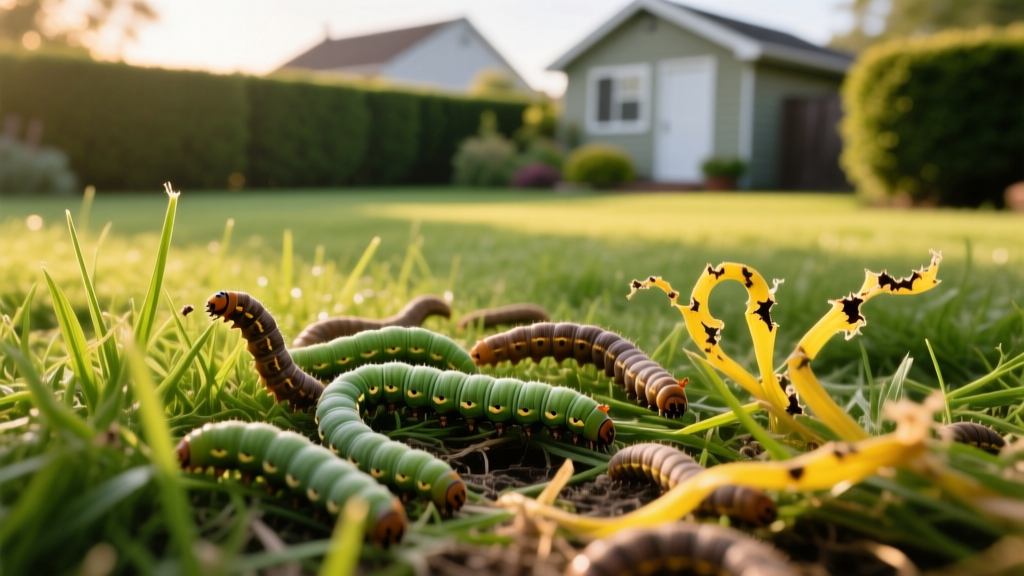
Stop Army Worms Fast: Identification and Lawn Treatment Guide
The 48-Hour Threat: Understanding the Fall Armyworm
The fall armyworm (Spodoptera frugiperda) is not a slow-moving pest; it is a turfgrass emergency. Unlike grubs that damage roots over months, armyworms are foliar feeders that can skeletonize an entire lawn in 48 to 72 hours. This rapid destruction occurs because the caterpillar goes through six developmental stages (instars). During the first three instars, they consume only 10% of their total lifetime food intake. The remaining 90% is devoured during the final 2 to 3 days of their larval stage. By the time you notice the browning tips of your Bermuda, Zoysia, or Fescue, the largest, most destructive caterpillars are already actively feeding.
According to entomologists at the University of Florida IFAS Extension, armyworm moths can migrate hundreds of miles in a single night, laying clusters of 100 to 200 eggs on the tips of grass blades. These eggs hatch in just 2 to 3 days during warm summer and early fall weather, meaning an infestation can materialize seemingly overnight.
The Soap Flush Test: Confirming an Active Invasion
Do not guess based on brown patches alone. Fungal diseases like brown patch or drought stress can mimic armyworm damage. To confirm an active infestation, perform a soap flush test. This forces the caterpillars, which hide in the thatch layer during the heat of the day, to the surface.
The 60-Second Soap Flush Protocol:
- Mix 1 to 2 tablespoons of lemon-scented liquid dish detergent into 1 gallon of water.
- Mark off a 1-square-yard area (3 ft x 3 ft) at the border of the damaged and healthy grass.
- Pour the solution evenly over the marked area.
- Wait 3 to 5 minutes. If 3 or more caterpillars emerge, your lawn requires immediate treatment.
Field Identification Matrix: Armyworms vs. Lookalikes
Correct identification dictates your chemical selection. The fall armyworm has distinct morphological markers that separate it from cutworms and sod webworms. Use this matrix to confirm your target.
| Pest Species | Head Capsule Marking | Body Markings | Frass (Droppings) | Feeding Time |
|---|---|---|---|---|
| Fall Armyworm | Distinct light-colored inverted 'Y' | 3 yellow stripes down the back; dark side stripes | Green/brown sawdust-like pellets on grass blades | Nocturnal / Overcast days |
| Black Cutworm | No 'Y' marking; solid dark | Greasy, dark brown/black, lacks prominent stripes | Scattered pellets near soil surface | Strictly nocturnal |
| Sod Webworm | Dark brown, no 'Y' | Double row of dark spots down the back | Fine, sand-like green pellets | Nocturnal |
The Treatment Protocol: Organic and Conventional Options
Once confirmed, you must act within 24 hours. Your choice of insecticide depends on the size of the caterpillars, your environmental preferences, and your budget. The Environmental Protection Agency (EPA) notes that biological controls are highly effective when timed correctly, but synthetic pyrethroids are necessary for late-stage rescue treatments.
Option 1: Biological Control (Bt Kurstaki) - Best for Early Instars
Bacillus thuringiensis var. kurstaki (Bt) is a naturally occurring soil bacterium that produces proteins toxic to caterpillars. It is highly specific and will not harm beneficial insects, earthworms, or pets.
- Target: Small caterpillars (instars 1-3, less than 1/2 inch long).
- Product Example: Monterey Bt or Thuricide.
- Application Rate: 2 oz per 1,000 sq ft mixed in 1 gallon of water.
- Cost: ~$15 for a 16 oz bottle.
- Limitation: Ineffective against large, mature armyworms. Requires 4 hours of rainfastness.
Option 2: Synthetic Pyrethroids (Bifenthrin) - Best for Heavy Infestations
When the lawn is actively being destroyed and caterpillars are large (1 inch+), you need a fast-acting contact and stomach poison. Bifenthrin provides rapid knockdown.
- Target: All life stages, particularly mature larvae.
- Product Example: Talstar P Professional Insecticide.
- Application Rate: 0.5 to 1.0 oz per 1,000 sq ft.
- Cost: ~$25 for a 32 oz bottle (covers up to 10,000 sq ft).
- Advantage: Rainfast in 2 hours; leaves a 30-day residual barrier.
Option 3: Anthranilic Diamides (Chlorantraniliprole) - The Preventative Standard
For long-term defense, Chlorantraniliprole stops caterpillars from feeding within hours of ingestion and provides months of residual control.
- Target: Preventative applications and early-stage knockdown.
- Product Example: Syngenta Acelepryn.
- Application Rate: 0.1 to 0.2 oz per 1,000 sq ft.
- Cost: ~$140 for 8 oz (highly concentrated, covers massive acreage).
- Advantage: Exceptional safety profile for pollinators; lasts up to 6 months in the soil profile.
Application Timing and Technique
The most expensive insecticide will fail if applied incorrectly. Armyworms are primarily nocturnal feeders, hiding deep in the thatch during peak sunlight hours. To maximize contact, follow these strict application parameters:
Expert Application Rules:
1. Time of Day: Apply liquid treatments at dusk or early evening (between 6:00 PM and 8:00 PM) when caterpillars are moving up the grass blades to feed.
2. Mowing: Do not mow for 48 hours before application (longer grass provides more surface area for the chemical to adhere to) and wait 48 hours after application.
3. Irrigation: Lightly water the lawn 1 hour before spraying to force the worms out of the soil. Do not irrigate for at least 24 hours after a liquid application to prevent washing the active ingredient off the foliage.
4. Nozzle Selection: Use a flat-fan nozzle on your pump sprayer calibrated to 40 PSI. This ensures the spray penetrates the canopy rather than bouncing off the leaf tips.
The Perimeter Buffer Strategy
Armyworms march. If your neighbor has an untreated infestation, or if your property borders an unmanaged agricultural field or ditch, treating only your visible lawn damage is a mistake. Always apply a 10-to-15-foot perimeter buffer zone of Bifenthrin or Chlorantraniliprole into adjacent unmanaged areas to create a chemical tripwire, killing the larvae before they migrate into your turf.
Post-Treatment Lawn Recovery
Once the caterpillars are eradicated, the lawn will look scorched. Do not panic; the roots and crown of the grass are usually unharmed by foliar-feeding armyworms. Recovery relies on stimulating lateral growth without promoting fungal diseases.
Avoid applying high-nitrogen synthetic fertilizers immediately after an outbreak, as the sudden flush of tender, rapid growth can attract a secondary wave of moths looking for egg-laying sites. Instead, apply a slow-release, organic fertilizer with a balanced N-P-K ratio (such as a 10-10-10 or a specialized lawn recovery blend containing kelp extract) at half the standard rate. Water deeply but infrequently (1 inch per week, applied in 1 or 2 sessions) to encourage the surviving grass crowns to push new tillers. Within 14 to 21 days, with proper hydration, the turf canopy will fill back in, erasing the visual damage of the invasion.

