
Pest Control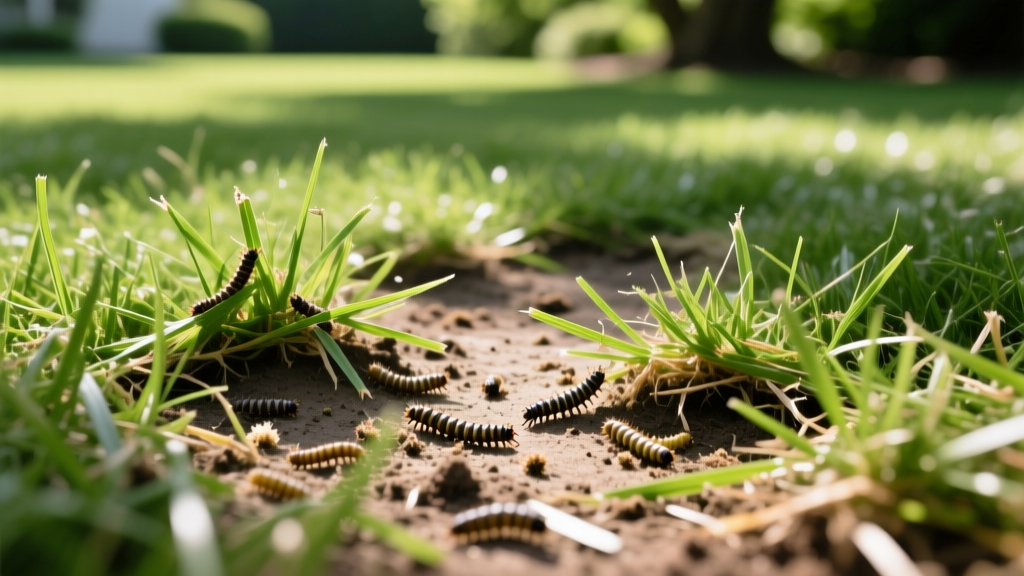
Identifying Army Worm Damage: Rapid Rescue Fixes for Lawns
Fall armyworms (Spodoptera frugiperda) are notorious for their explosive population growth and ravenous appetite for warm-season turfgrasses like Bermuda, Zoysia, and St. Augustine. A pristine lawn can transition from lush green to scalped brown in under 48 hours. Because roughly 80% of the total foliage consumption occurs during the final two larval stages (instars 5 and 6), early symptom diagnosis is the difference between a minor cosmetic setback and total turf loss. This guide outlines the precise visual indicators of army worm damage and provides a 72-hour rescue protocol utilizing both synthetic and organic active ingredients.
The 3-Stage Visual Progression of Army Worm Damage
Armyworms do not eat uniformly. Their feeding patterns evolve as they grow through six distinct larval stages (instars). Recognizing the exact stage of damage dictates the aggressiveness of your chemical intervention.
Stage 1: Early Instars (Days 1–7) - Windowpane Feeding
Young larvae lack the mandible strength to chew through entire grass blades. Instead, they scrape away the green chlorophyll layer on one side of the leaf, leaving a translucent, skeletal membrane. This is known as 'windowpaning.' At this stage, the lawn may just look slightly frosted or off-color from a distance. Early instars are highly susceptible to organic controls like Bacillus thuringiensis (Bt).
Stage 2: Mid Instars (Days 8–12) - Edge Notching
As the caterpillars reach 3/4 inch in length, they begin consuming the entire leaf blade, starting from the edges and working inward. You will notice distinct, ragged notches on the tips and margins of the grass blades. The lawn will begin to show localized thinning and a grayish-brown cast.
Stage 3: Late Instars (Days 13–16) - Total Scalping
The 6th instar is the most destructive. These 1.5-inch caterpillars eat voraciously, severing grass blades completely at the crown. The damage appears as circular, brown, scalped patches that expand rapidly, often merging into massive dead zones overnight. At this stage, organic options are too slow; fast-acting synthetic pyrethroids are mandatory.
⚠️ The Soapy Water Flush Test
Visual damage is often a lagging indicator. To confirm an active infestation before severe scalping occurs, perform a flush test:
- Mix 2 tablespoons of lemon-scented liquid dish soap into 1 gallon of water.
- Mark off a 1-square-yard section at the border of the damaged and healthy grass.
- Pour the mixture evenly over the area and wait 3 to 5 minutes.
- Action Threshold: If 3 to 4 or more armyworms surface, immediate treatment is required. According to Texas A&M AgriLife Extension, treating at threshold prevents exponential late-stage damage.
Differential Diagnosis Matrix: Army Worms vs. Environmental Stress
Homeowners frequently misdiagnose early army worm damage as drought stress or fungal disease. Applying fungicides or increasing irrigation will not stop a caterpillar infestation and will only accelerate turf loss. Use this matrix to isolate the root cause.
| Symptom / Indicator | Army Worm Damage | Drought Stress | Brown Patch (Fungus) |
|---|---|---|---|
| Leaf Blade Appearance | Notched edges, windowpaning, or severed at crown | Folded or rolled blades, bluish-gray tint | Distinct dark brown lesions/bands across the blade |
| Damage Pattern | Irregular, expanding scalped patches; moves directionally | Uniform browning, worst in full sun/sandy areas | Circular rings with a 'smoke ring' border in morning |
| Presence of Frass | Green/brown sawdust-like droppings in thatch | None | None |
| Soapy Flush Result | Caterpillars surface within 3 minutes | None | None |
The 72-Hour Rapid Rescue Treatment Protocol
Once an infestation breaches the action threshold, you must execute a phased chemical attack. This protocol combines an immediate synthetic knockdown with a biological residual to catch any late-hatching eggs.
Phase 1: Immediate Knockdown (Hours 1–24)
For late-stage instars, you need a fast-acting contact insecticide. Synthetic pyrethroids are the industry standard for rapid knockdown.
- Active Ingredient: Bifenthrin (7.9%) or Lambda-cyhalothrin.
- Recommended Product: Talstar P Professional Insecticide or Spectracide Triazicide.
- Application Rate: 0.5 to 1.0 fluid ounces of Talstar P per 1,000 square feet.
- Execution: Apply in the late afternoon or early evening when armyworms are actively feeding on the surface. Use a hose-end sprayer calibrated to deliver 2 gallons of water per 1,000 sq ft to ensure thorough foliage coverage.
- Critical Rule: Do NOT water the lawn immediately after application. The chemical must remain on the grass blades where the caterpillars ingest it. Wait at least 24 hours before irrigating.
Phase 2: Biological Residual (Hours 24–48)
Armyworm moths lay eggs in staggered cycles. A single synthetic application may miss newly hatched larvae emerging from thatch-protected egg masses 48 hours later.
- Active Ingredient: Bacillus thuringiensis var. kurstaki (Btk) or Spinosad.
- Recommended Product: Monterey B.t. or Bonide Captain Jack's Deadbug Brew.
- Application Rate: 2 fluid ounces of Monterey B.t. per 1,000 square feet.
- Execution: Apply 24 hours after the pyrethroid treatment. Btk is a stomach poison that specifically targets caterpillars and is harmless to beneficial insects, pets, and humans. It provides a 5-to-7-day residual shield against new hatchlings.
Phase 3: Post-Attack Turf Recovery (Days 3–14)
Army worm damage rarely kills the crown of warm-season grasses; it only removes the photosynthetic tissue. The turf will recover if supported correctly.
Expert Insight: Avoid high-nitrogen synthetic fertilizers immediately after an attack. Pushing rapid, weak top-growth stresses the compromised root system. Instead, apply a carbon-based organic fertilizer like Milorganite (5-2-0) at 32 lbs per 2,500 sq ft to gently stimulate root regeneration and soil microbe activity.
- Mowing: Do not mow for at least 7 days post-treatment. Allow the remaining stubble to generate new tillers.
- Irrigation: Provide 1 inch of water per week, split into two deep waterings to encourage root depth without keeping the surface canopy wet (which invites secondary fungal infections).
Cost Analysis: DIY Chemical Rescue vs. Professional Service
Understanding the financial commitment helps homeowners decide whether to tackle the infestation independently or hire a licensed lawn care operator (LCO).
| Treatment Variable | DIY Homeowner Approach (Per 5,000 sq ft) | Professional LCO Service (Per 5,000 sq ft) |
|---|---|---|
| Synthetic Knockdown | $25 - $35 (Talstar P concentrate) | $65 - $90 (Includes commercial-grade surfactant) |
| Biological Residual | $15 - $22 (Monterey B.t.) | $40 - $60 (Often bundled in a multi-visit contract) |
| Equipment Cost | $15 (Hose-end sprayer) | $0 (Included in service fee) |
| Total Estimated Cost | $55 - $72 | $105 - $150 |
| Time Investment | 2 hours (Mixing, application, cleanup) | 15 minutes (Scheduling and gate access) |
Long-Term Monitoring with Pheromone Traps
As noted by NC State Extension, relying solely on visual damage means you are already reacting to an advanced infestation. Proactive homeowners utilize green plastic unitrap bucket traps baited with fall armyworm pheromone lures.
Place the trap near outdoor lighting or along the prevailing wind edge of your property in late July. Check the trap twice weekly. When you capture 10 or more moths in a single night, you can accurately predict that egg-laying has peaked, and a preventative application of a growth regulator like Diflubenzuron (Dimilin) or an early Btk spray should be scheduled 5 to 7 days later to target the hatching 1st instars before they cause visible damage.
For comprehensive regional data on moth flight patterns and degree-day tracking, consult the Purdue University Field Crops IPM database. Tracking local agricultural reports allows you to apply rescue treatments precisely when the local larval populations are most vulnerable, saving both money and turf health.

