
Pest Control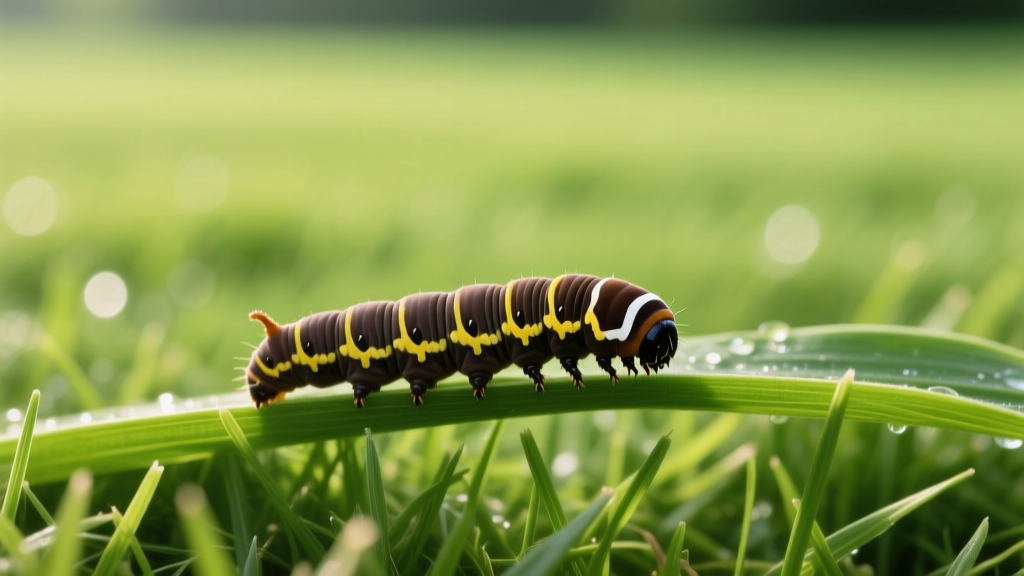
When to Apply Insecticide for Fall Armyworms: Regional Timing Guide
The Biology of Timing: Why Instar Stages Dictate Treatment
Fall armyworms (Spodoptera frugiperda) do not damage lawns uniformly. The larval stage consists of six distinct instars, and the efficacy of any insecticide for fall armyworms drops precipitously after the third instar. During the first three instars (lasting roughly 10 to 14 days), the larvae are under 0.5 inches long, pale green to brown, and feed by skeletonizing the leaf tissue. This is your critical treatment window.
By the time the larvae reach the 4th through 6th instars, they grow up to 1.5 inches long, develop their characteristic dark coloring with prominent lateral stripes, and consume nearly 90% of the total biomass they will eat in their lifetime. Applying chemical controls at this stage is largely ineffective; the larvae have stopped feeding, are highly resistant to active ingredients, and are actively burrowing into the soil to pupate.
Warning: Do not wait for visible brown patches to treat. By the time turfgrass shows severe defoliation, the armyworms are likely in their 5th or 6th instar and will pupate within days, rendering your insecticide application a waste of resources.
Regional Treatment Calendars for 2026
Fall armyworms do not overwinter in the northern United States. They survive the winter in South Florida and South Texas, migrating northward via weather fronts throughout the spring and summer. Because of this migratory pattern, the timing for applying an insecticide for fall armyworms varies drastically by region. Below is the regional peak pressure calendar for the 2026 treatment season.
| Region | States Included | Peak Outbreak Window | Generations per Year |
|---|---|---|---|
| Southeast | FL, GA, AL, MS, LA | August 15 – October 30 | 3 to 4 overlapping |
| Mid-Atlantic | VA, NC, SC, MD, DE | August 1 – October 15 | 2 to 3 |
| Midwest | OH, IN, IL, MO, KY | July 25 – September 20 | 1 to 2 |
| Northeast | PA, NY, NJ, CT, MA | August 20 – September 30 | 1 major generation |
According to turfgrass entomologists at NC State University's TurfFiles, monitoring should begin exactly two weeks prior to your region's peak window, especially following heavy summer rainfall events which trigger moth egg-laying.
Active Ingredient Comparison: Choosing the Right Insecticide
Selecting the correct insecticide for fall armyworms depends on whether you are executing a preventative strategy or a curative rescue treatment. Below is a breakdown of the most effective professional-grade active ingredients, their costs, and application rates.
- Chlorantraniliprole (e.g., Acelepryn G / SC): The premier preventative option. Applied at 0.08 to 0.11 lbs of active ingredient per 1,000 sq ft, it provides 60 to 90 days of residual control. Cost is high (approx. $180–$220 per 30-lb bag of granular), but it is highly targeted and safe for pollinators. Apply 30 days before your regional peak window.
- Bifenthrin (e.g., Talstar P): A fast-acting pyrethroid for curative control. Mix rate is 0.5 to 1.0 fl oz per 1,000 sq ft. Cost is roughly $45 per pint, treating up to 1 acre. It provides immediate knockdown of 1st through 3rd instars but has a short residual life of 14 to 21 days.
- Lambda-cyhalothrin (e.g., Demand CS): A microencapsulated pyrethroid that offers superior UV resistance and rainfastness compared to standard bifenthrin. Mix rate is 0.4 fl oz per 1,000 sq ft. Priced around $65 per 8-oz bottle. Ideal for southern regions with intense afternoon sun and frequent late-summer thunderstorms.
- Spinosad (e.g., Conserve SC): A biological, OMRI-listed option derived from soil bacteria. Highly effective on early instars. Mix rate is 0.25 to 1.25 fl oz per 1,000 sq ft. Cost is approximately $90 per quart. Best for organic lawn care programs, though it requires more frequent reapplication (every 7-10 days during peak pressure).
The "Soap Flush" Monitoring Protocol
Before mixing any insecticide for fall armyworms, you must confirm their presence and instar stage. The industry standard for detection is the soap flush technique.
- Mix 2 tablespoons of liquid dish soap (lemon-scented varieties work exceptionally well due to the specific surfactant profile) into 2 gallons of water in a watering can.
- Identify a 3-foot by 3-foot (1 square yard) area at the border of damaged and healthy turfgrass.
- Pour the soapy solution evenly over the area. The soap irritates the larvae's cuticle, forcing them to the surface within 2 to 4 minutes.
- Count the larvae and measure them. If you find more than 3 to 5 larvae per square yard, and they are under 0.5 inches long, immediate curative treatment is required.
Step-by-Step Application for Maximum Efficacy
Even the best active ingredient will fail if application mechanics are flawed. Fall armyworms reside in the thatch layer and lower canopy. Follow this protocol to ensure the chemical reaches the target zone:
1. Mow and Remove Clippings
Mow the lawn to its standard height, but bag the clippings. Leaving clippings on the lawn creates a physical barrier that intercepts the spray, preventing the active ingredient from reaching the thatch where the early instars feed.
2. Optimize Water Volume and Surfactants
Apply liquid formulations using a minimum carrier volume of 2.5 to 3.0 gallons of water per 1,000 sq ft. This high volume acts as a mechanical driver, pushing the chemical down through the grass blades into the thatch. Always add a non-ionic surfactant at a rate of 0.25% v/v (roughly 1 teaspoon per gallon of water) to break the surface tension of the waxy turfgrass cuticle.
3. Time the Application for Nocturnal Feeding
Fall armyworms are primarily nocturnal feeders, retreating deep into the thatch and soil during the heat of the day. Apply your insecticide in the late afternoon or early evening (between 5:00 PM and 7:00 PM). This ensures the chemical residue is fresh and highly toxic when the larvae emerge to feed at dusk. Research published by Purdue University Extension confirms that evening applications significantly increase mortality rates compared to morning applications.
4. Enforce a 48-Hour Irrigation and Mowing Ban
Do not water the lawn, and do not allow rainfall to wash the treatment area for at least 48 hours. Pyrethroids like bifenthrin require a minimum of 2 hours to become rainfast, but allowing the chemical to sit undisturbed on the foliage and thatch for two days maximizes ingestion by the larvae. Delay mowing for at least 3 days post-application.
Troubleshooting: Edge Cases and Failure Modes
Common Failure Mode: Thatch Accumulation
If your lawn has a thatch layer thicker than 0.5 inches, liquid insecticides will bind to the organic matter and never reach the soil surface. If a soap flush reveals heavy thatch, you must core aerate or use a dethatching rake before applying the insecticide for fall armyworms. Alternatively, switch to a granular formulation (like Acelepryn G) and water it in immediately with 0.25 inches of irrigation to drive the granules through the thatch barrier.
If your lawn has a thatch layer thicker than 0.5 inches, liquid insecticides will bind to the organic matter and never reach the soil surface. If a soap flush reveals heavy thatch, you must core aerate or use a dethatching rake before applying the insecticide for fall armyworms. Alternatively, switch to a granular formulation (like Acelepryn G) and water it in immediately with 0.25 inches of irrigation to drive the granules through the thatch barrier.
Another frequent edge case involves treating during peak summer drought. When turfgrass is drought-stressed, it stops growing and the thatch layer becomes hydrophobic. In these conditions, liquid sprays will bead up and run off. You must lightly irrigate the lawn 24 hours prior to application to rehydrate the thatch and ensure proper chemical absorption.

