
Pest Control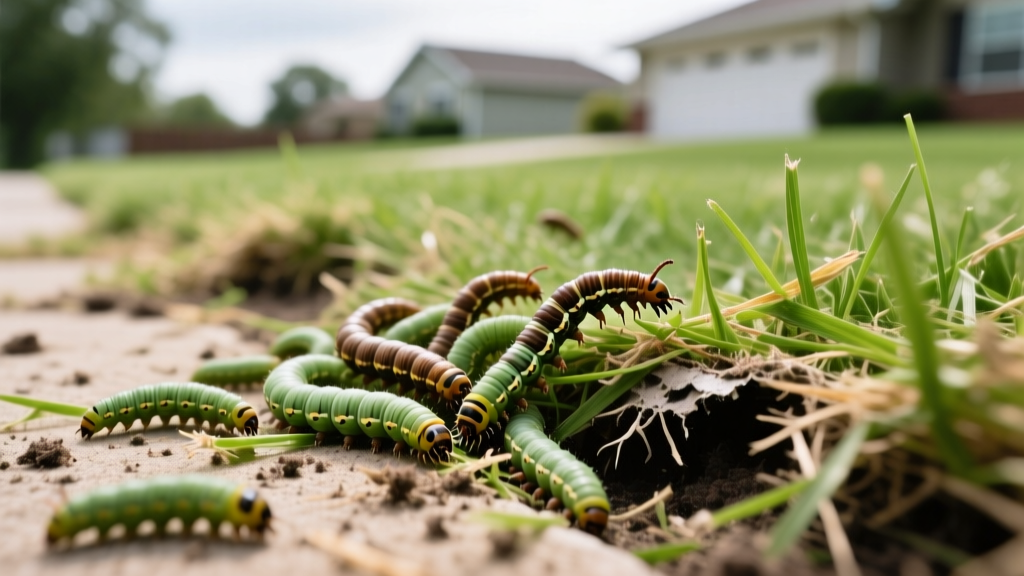
Army Worms Treatment Guide: Identify, Kill, and Restore Your Lawn
The 48-Hour Threat: Identifying Fall Armyworms
Fall armyworms (Spodoptera frugiperda) are not a slow-moving nuisance; they are a rapid-onset agricultural emergency for turfgrass. A severe infestation can strip a 5,000-square-foot lawn of its foliage in under 48 hours. Unlike soil-dwelling grubs that attack roots silently, armyworms are surface feeders that march in massive numbers, consuming grass blades down to the dirt. Effective army worms treatment requires immediate identification and precise chemical timing.
The first visual indicator of an infestation is rarely the caterpillar itself, but rather the damage: irregular brown patches that expand outward daily, accompanied by a dusting of greenish-brown frass (caterpillar droppings) on the soil surface. To confirm their presence, execute a soap flush test. Mix 1 ounce of liquid lemon-scented dish soap into 1 gallon of water and pour it over a 1-square-yard section of the damaged lawn's perimeter. Within three minutes, the irritating soap will force the caterpillars to the surface.
Critical Identification Marker: Inspect the caterpillars for a distinct, pale inverted 'Y' suture line on the front of their dark head capsules. This is the definitive field marker separating fall armyworms from look-alike cutworms and sod webworms, dictating which active ingredients will yield a successful kill.
According to entomologists at the University of Florida IFAS, fall armyworms undergo six larval instars. The first three instars consume only 2% of their total diet, while the fifth and sixth instars consume 80%. If your soap flush reveals caterpillars larger than 1 inch (late-stage instars), you must bypass organic slow-kill options and deploy fast-acting synthetic pyrethroids immediately to save the remaining turf.
Curative vs. Preventative Army Worms Treatment Matrix
Selecting the correct active ingredient depends entirely on your current infestation status. Curative treatments are designed to knock down active, visible caterpillars within 24 to 48 hours. Preventative treatments create a toxic barrier in the thatch and soil that kills early-instar larvae before they cause visible damage.
| Active Ingredient | Product Example | Type | Kill Time | Cost (per 1k sq ft) |
|---|---|---|---|---|
| Bifenthrin (7.9%) | Bifen I/T | Curative | 24-48 Hours | $4.50 - $5.50 |
| Cyfluthrin | Tempo SC Ultra | Curative | 12-24 Hours | $6.00 - $7.50 |
| Bt kurstaki | Monterey B.t. | Curative (Organic) | 48-72 Hours | $8.00 - $10.00 |
| Chlorantraniliprole | Acelepryn G | Preventative | N/A (Systemic) | $16.00 - $19.00 |
For organic lawn care protocols, Bacillus thuringiensis kurstaki (Btk) is highly effective, but it carries a strict limitation: it only works on early-instar caterpillars (less than 0.5 inches long). Once the armyworms reach their destructive late stages, Btk will fail, necessitating a pyrethroid intervention. As noted by Texas A&M AgriLife Extension, rotating chemical classes is also vital if your region experiences multiple overlapping generations from late summer through early fall.
Step-by-Step Liquid Application Protocol
When dealing with an active outbreak, abandon granular treatments. Granules require heavy irrigation to activate, which can take hours and delays the kill. Liquid applications provide immediate contact and residual control. Follow this exact protocol to maximize mortality rates:
- Mow and Bag: Mow the lawn slightly lower than your normal height and strictly bag the clippings. This removes the upper canopy where caterpillars hide and strips away a significant portion of the population and their frass.
- Calculate and Mix: For Bifenthrin 7.9%, mix 1 fluid ounce of concentrate per 1 gallon of water to cover 1,000 square feet. Use a pump sprayer with a fan-nozzle tip to ensure a wide, even broadcast pattern rather than a concentrated stream.
- Time the Application: Spray strictly at dusk or dawn. Armyworms are nocturnal feeders that emerge from the thatch as the sun sets. Spraying at dusk ensures they crawl directly across the freshly treated foliage. Furthermore, UV radiation rapidly degrades pyrethroids; evening application preserves the chemical's residual lifespan.
- Hold the Water: Do not irrigate the lawn for at least 24 hours after a curative liquid spray. You need the chemical to dry on the leaf blade to act as a contact and stomach poison when the caterpillars resume feeding.
Common Treatment Failure Modes
Many homeowners report that their army worms treatment 'didn't work,' but failure is almost always tied to one of three environmental or mechanical errors:
- Thatch Barrier: If your lawn has more than 0.5 inches of thatch, the liquid spray gets trapped in the dead organic matter before reaching the soil line where smaller larvae hide. Dethatching or using a surfactant (like a non-ionic wetting agent) is mandatory for thick lawns.
- Heat of Day Spraying: Applying Bifenthrin or Cyfluthrin at 2:00 PM in 90°F heat causes rapid solvent evaporation, leading to uneven distribution and potential phytotoxicity (chemical burn) on stressed grass blades.
- Ignoring the Perimeter: Armyworms 'march' inward from adjacent fields, gardens, or untreated neighbor lawns. Failing to spray a 10-foot buffer zone beyond your property line guarantees a secondary invasion within five days.
Post-Treatment Lawn Recovery Framework
Once the caterpillars are eradicated, the lawn will look scorched. The crown and root systems, however, are usually still alive. Recovery requires patience and precise nutrient timing. Applying a high-nitrogen synthetic fertilizer immediately after an armyworm attack will shock the compromised root system and promote fungal pathogens like Pythium blight in the open wounds of the grass.
Instead, wait 14 days post-treatment before applying nitrogen. For the first week, apply a liquid kelp or seaweed extract. The natural cytokinins and auxins in kelp stimulate root regeneration and cellular repair without forcing rapid, unsustainable top-growth. After 14 days, apply a slow-release nitrogen fertilizer (such as methylene urea) at a rate of 0.5 lbs of nitrogen per 1,000 square feet, paired with deep, infrequent irrigation to push the grass blades back through the thatch layer.
Proactive Defense Note: If your region suffered an outbreak this year, the USDA APHIS recommends applying a preventative systemic like Chlorantraniliprole (Acelepryn) in early June of the following year. This single application provides 60 to 90 days of residual control, neutralizing the first generation of hatching larvae before they ever reach the surface.
Frequently Asked Questions
Will armyworms kill my grass down to the roots?
No. Fall armyworms are strictly defoliators; they eat the leaf blades but leave the crown and root system intact. As long as the crown is not desiccated by extreme drought following the attack, the turf will regenerate within 21 to 30 days with proper recovery care.
Do birds and natural predators control armyworms?
While flocks of starlings and grackles will descend on an infested lawn to eat caterpillars, they cannot consume a severe outbreak fast enough to prevent total defoliation. Furthermore, heavy bird foraging can cause secondary mechanical damage to the turf crown due to aggressive pecking. Rely on chemical or biological treatments for primary control.
How often do I need to spray during peak season?
During peak late-summer pressure, a single Bifenthrin application provides roughly 14 to 21 days of residual control. If moth flights are continuous in your area, plan a follow-up curative application 21 days after the initial spray, or switch to a longer-residual product like Cyfluthrin.

