
Pest Control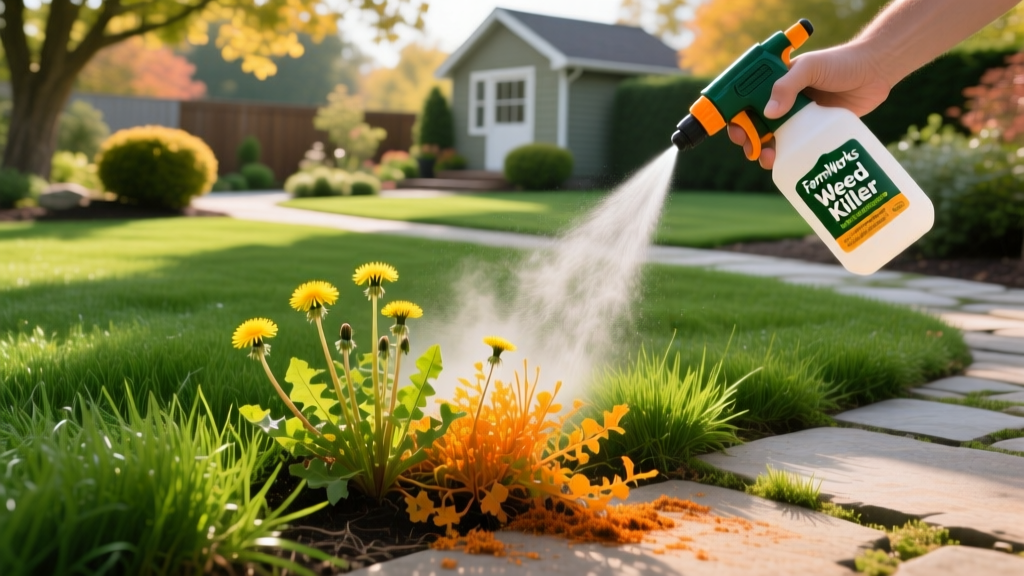
How to Spot-Treat Tough Weeds With FarmWorks Weed Killer
The Economics and Ecology of Spot-Treatment
Broadcast spraying an entire lawn or pasture is a blunt instrument that wastes chemical, damages desirable turf, and accelerates herbicide resistance. Spot-treating specific weed species with concentrated agricultural-grade products like the FarmWorks weed killer line offers a precise, cost-effective alternative. A single 2.5-gallon jug of FarmWorks 41% Glyphosate Plus typically retails between $45 and $60 in 2026, yielding over 300 gallons of finished spray solution when mixed at standard spot-treatment rates. This translates to pennies per gallon compared to $15 ready-to-use consumer bottles.
However, agricultural concentrates require exact calibration, proper surfactant pairing, and species-specific timing. Misidentifying a weed or mixing the wrong concentration will result in top-kill without eradicating the root system, leading to rapid regrowth. This guide details the exact protocols for using FarmWorks formulations against the most stubborn perennial and broadleaf weeds.
Decoding FarmWorks Active Ingredients
FarmWorks produces several herbicide formulations. For spot-treatment, you will primarily rely on two active ingredients, each with a distinct mode of action:
- FarmWorks 41% Glyphosate Plus: A non-selective, systemic herbicide. It translocates from the foliage down to the root crown. It will kill any green plant it touches, making it ideal for spot-treating weeds in hardscape cracks, fence lines, or using shielded nozzles in turf.
- FarmWorks Amine 2,4-D: A selective, systemic broadleaf herbicide. It mimics plant growth hormones, causing broadleaf weeds to grow themselves to death while leaving monocot grasses (like Kentucky Bluegrass and Bermuda) unharmed.
⚠️ Critical Drift Warning: Never use a hose-end sprayer for spot-treating with agricultural concentrates. The droplet size is too small, leading to aerosolized drift that can decimate neighboring ornamental shrubs and vegetable gardens. Always use a dedicated, calibrated 1-to-2-gallon pump sprayer with a flat-fan nozzle.
Weed Species Identification & Treatment Matrix
Timing and concentration dictate success. Applying systemic herbicides when a plant is actively pushing nutrients to its roots (usually late summer or early fall) ensures the chemical reaches the rhizomes. Use the matrix below to calibrate your FarmWorks mixtures.
| Target Weed Species | FarmWorks Formulation | Mix Rate (per 1 Gallon Water) | Optimal Application Window |
|---|---|---|---|
| Field Bindweed | 41% Glyphosate Plus | 3.0 fl oz + 0.5 oz Surfactant | Late Summer (full bloom stage) |
| Canada Thistle | Amine 2,4-D | 2.0 fl oz | Fall Rosette Stage |
| Dandelion | Amine 2,4-D | 1.5 fl oz | Spring (pre-bloom) or Fall |
| Johnsongrass | 41% Glyphosate Plus | 2.5 fl oz | Boot to heading stage |
Deep Dive: Eradicating Field Bindweed
Field bindweed (Convolvulus arvensis) possesses a root system that can extend up to 20 feet deep. Spraying it in the spring when it is actively growing upward only burns off the top growth; the roots simply push out new shoots weeks later. According to University of Minnesota Extension, the most effective chemical control occurs when the plant begins flowering in late summer, as carbohydrate transport shifts downward to store energy for winter.
For bindweed, mix 3.0 fluid ounces of FarmWorks 41% Glyphosate Plus per gallon of water. You must add a non-ionic surfactant (like methylated seed oil) at a rate of 0.5 ounces per gallon. Bindweed leaves have a heavy waxy cuticle; without a surfactant, the water-based herbicide will bead up and roll off the leaf surface, resulting in total treatment failure.
Precision Application Equipment
When spot-treating weeds in a desirable lawn or near sensitive ornamentals, the physical delivery of the FarmWorks mixture is just as important as the chemistry. Standard cone nozzles create fine mist particles prone to wind drift.
- TeeJet XR8002VS Flat Fan Nozzle: Produces larger, uniform droplets that penetrate the weed canopy without drifting. Ideal for 2,4-D applications over turf.
- Shielded Sprayer Hoods: If using non-selective FarmWorks Glyphosate near desirable plants, attach a plastic spray shield to your wand. This allows you to treat weeds within inches of hostas or vegetable crops safely.
- Wick Applicators: For tall weeds like Johnsongrass growing above a short lawn, a wick wiper applies the glyphosate directly to the weed stem via capillary action, eliminating soil contact and drift entirely.
The Hard Water Antagonism Problem
One of the most common reasons homeowners report that 'FarmWorks glyphosate didn't work' is hard water antagonism. Water with high levels of calcium, magnesium, or iron ions binds to the glyphosate molecule, rendering it inactive before it even enters the plant tissue.
If your well water leaves white scale on your faucets, it will neutralize your herbicide. Always add Ammonium Sulfate (AMS) to your spray tank before adding the FarmWorks concentrate.
The AMS Protocol: Add 2.7 ounces (by weight) of spray-grade Ammonium Sulfate per gallon of water to your empty tank. Fill the tank halfway with water and agitate. The AMS binds to the hard water minerals, leaving the glyphosate free to act on the weed. Only after the AMS is dissolved should you add your FarmWorks herbicide and surfactant.
Common Failure Modes to Avoid
- Spraying During Drought Stress: When weeds are wilting from heat or lack of rain, they close their leaf stomata to conserve moisture. Herbicides cannot penetrate closed stomata. Wait for a soaking rain, then apply the FarmWorks solution 48 hours later when the weed is actively photosynthesizing.
- Mowing Too Soon: Systemic herbicides require leaf surface area to absorb the chemical. Do not mow for at least 48 hours before application, and wait a full 7 days after application before mowing to allow full translocation to the roots.
- Over-Mixing: Mixing a higher concentration than recommended does not kill weeds faster. It causes rapid necrosis (browning) of the leaf tissue, which severs the vascular system and prevents the chemical from reaching the roots. Stick strictly to the matrix rates above.
Environmental Safety and Re-entry
The Environmental Protection Agency (EPA) mandates strict adherence to label re-entry intervals (REI). For FarmWorks Amine 2,4-D, keep pets and children off the treated turf until the spray has completely dried—typically 2 to 4 hours depending on humidity. For glyphosate applications in garden beds, avoid disturbing the soil for 72 hours to allow the chemical to bind to soil microbes and begin breaking down.
Frequently Asked Questions
Can I mix FarmWorks 2,4-D and Glyphosate together?
Yes, a tank mix of 1.5 oz 2,4-D and 1.5 oz Glyphosate per gallon is highly effective for mixed weed populations in non-turf areas like gravel driveways. However, never use this mix on your lawn, as the glyphosate will kill your grass.
How long does FarmWorks weed killer take to show results?
Amine 2,4-D typically shows twisting and curling of broadleaf weeds within 24 to 48 hours, with complete death in 10-14 days. Glyphosate takes longer; you will see yellowing in 3-5 days, with total root death taking up to 21 days for deep-rooted perennials.

