
Pest Control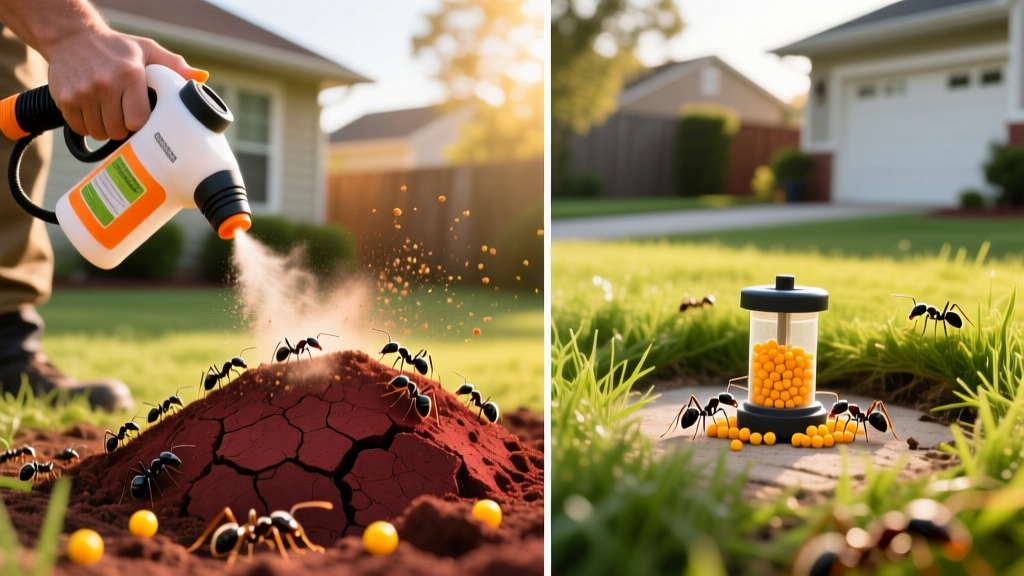
The Best Fire Ants Cure: Two-Step Mound and Bait Strategy
Why a Single 'Fire Ants Cure' Doesn't Exist
Homeowners battling the Red Imported Fire Ant (Solenopsis invicta) often search for a singular, overnight fire ants cure. The reality of colony biology makes this impossible. A mature fire ant mound contains 100,000 to 500,000 sterile female workers, thousands of winged reproductives, and multiple egg-laying queens in polygyne (multi-queen) colonies. When you pour a contact killer down the center of a visible mound, the queens and a significant portion of the colony often escape through subterranean satellite tunnels, relocating just a few feet away to rebuild.
According to the Texas A&M AgriLife Extension Fire Ant Project, treating individual mounds as they appear is a reactive game you will lose. The only scientifically validated approach that mimics a permanent cure is the 'Two-Step Method,' combining broadcast baiting with targeted mound treatments.
⚠️ Warning: The Boiling Water Myth
Pouring boiling water, gasoline, or bleach on a mound is not a viable fire ants cure. Boiling water only kills ants it physically touches and will destroy the surrounding turfgrass roots, leaving dead patches in your lawn. Gasoline is an illegal and highly dangerous environmental hazard that contaminates groundwater. Stick to EPA-registered active ingredients.
The Two-Step Method: Your Blueprint for Eradication
The closest thing to a true fire ants cure relies on exploiting the colony's foraging behavior and social structure. This method requires treating your entire yard, not just the visible mounds.
Step 1: Broadcast Baiting (The Foundation)
Broadcast baits are slow-acting, insecticide-laced corn grits coated in soybean oil. Worker ants carry the bait back to the mound, regurgitate it, and feed it to the larvae and queens. Because the active ingredients are slow-acting, the workers do not associate the food source with the resulting deaths, allowing the poison to penetrate the deepest chambers of the nest.
- Top Product: Advion Fire Ant Bait (0.04% Indoxacarb). Indoxacarb is a pro-insecticide that only becomes lethal after the ants' internal enzymes metabolize it, ensuring it reaches the queen.
- IGR Alternative: Extinguish (0.5% Methoprene). This is an Insect Growth Regulator that doesn't kill adults but sterilizes the queens and prevents larvae from molting, causing the colony to collapse over 6 to 8 weeks.
- Application Rate: 1.5 lbs per acre. For a standard 1/4-acre suburban lawn, you need roughly 0.37 lbs (about 6 ounces) of bait.
- Cost: Expect to pay $40 to $50 for a 7.9 lb bag of Advion, which is enough to treat over 5 acres, making it highly cost-effective at roughly $10 per 1/4-acre application.
Step 2: Individual Mound Drenching (The Targeted Strike)
Seven to ten days after broadcasting the bait, inspect your yard for any remaining active mounds. These are typically nuisance mounds located near high-traffic areas (driveways, patios, mailboxes) where immediate elimination is required. You will use a fast-acting contact insecticide to drench these specific mounds.
- Top Product: Bifen I/T (7.9% Bifenthrin) or Cyonara 9.7 (Lambda-cyhalothrin).
- Mixing Ratio: Mix 1 fluid ounce of Bifen I/T per gallon of water.
- Application Technique: Slowly pour 1 to 2 gallons of the mixed solution over the mound, starting from the outer perimeter and working inward. This creates a chemical barrier that prevents escape. Use a watering can or a pump sprayer with the nozzle removed to deliver a gentle flood rather than a high-pressure spray that disturbs the mound structure.
Product Comparison Matrix: Baits vs. Contact Killers
Choosing the right chemistry is critical. Using a fast-acting contact killer as a broadcast treatment will fail, as it kills foragers before they can transport the chemical to the queen.
| Product Name | Active Ingredient | Action Speed | Best Use Case | Est. Cost (1/4 Acre) |
|---|---|---|---|---|
| Advion Fire Ant Bait | Indoxacarb (0.04%) | Slow (3-14 days) | Step 1: Broadcast | $10 - $12 |
| Extinguish | Methoprene (0.5%) | Very Slow (6-8 weeks) | Step 1: Broadcast (IGR) | $15 - $18 |
| Bifen I/T | Bifenthrin (7.9%) | Fast (Hours) | Step 2: Mound Drench | $2 - $4 |
| Ortho Orthene | Acephate (50%) | Fast (Minutes-Hours) | Step 2: Mound Dust/Drench | $5 - $7 |
Critical Application Edge Cases & Mistakes
Even the best fire ants cure will fail if environmental variables are ignored. Avoid these common application errors:
- Ignoring the Foraging Test: Fire ants do not forage when soil temperatures are below 65°F or above 90°F, or during drought conditions. Before broadcasting bait, place a greasy potato chip next to an active mound. If 5 to 10 ants do not cover the chip within 15 minutes, they are not foraging. Delay your bait application.
- Baiting Before Rain: The soybean oil carrier in baits becomes rancid and unappealing to ants once wet. Check the forecast and ensure no rain is expected for at least 12 to 24 hours post-application.
- Disturbing the Mound Before Drenching: When preparing to drench a mound with Bifen I/T, do not kick or poke the mound with a stick. Disturbing the mound triggers a defensive response, causing the queens to immediately retreat deep into the soil profile or flee to satellite chambers before the drench can reach them.
- Over-applying Bait: More is not better. If you apply bait too thickly, the ants will treat it as a physical barrier rather than a food source. Calibrate your spreader to the exact manufacturer specifications (usually 1.5 lbs/acre).
Biological Controls: The Future of Long-Term Defense
While chemical baits provide the most immediate relief, long-term yard defense is shifting toward biological controls. The USDA and various university extensions have introduced Phorid flies (Pseudacteon species) in several southern states. These parasitic flies decapitate fire ant workers, causing the colony to restrict foraging and reducing their competitive advantage against native ant species. Additionally, fungal pathogens like Beauveria bassiana are being formulated into commercial organic baits. While these biological agents will not eradicate fire ants entirely, they suppress populations to manageable levels, reducing the need for frequent chemical interventions. For current regulatory and safety guidelines on pesticide use, always consult the EPA's official guidance on controlling fire ants.
Frequently Asked Questions
Can I use beneficial nematodes as a fire ants cure?
Beneficial nematodes (specifically Steinernema and Heterorhabditis species) can infect and kill fire ant larvae, but their efficacy in the field is highly inconsistent. They require precise soil moisture levels and specific temperatures to survive. They are best used as a supplementary organic treatment rather than a primary cure.
How often should I repeat the Two-Step Method?
For severe infestations in the Deep South, apply broadcast bait twice a year: once in mid-April to May, and again in September to October. Spot-treat individual mounds with drenches as they appear during the summer months.
Will treating my yard for fire ants harm native pollinators?
Broadcast fire ant baits like Advion and Extinguish are highly specific to ants and pose minimal risk to bees and butterflies because the granules are too large for most pollinators to collect, and the active ingredients are not systemic in plants. However, liquid drenches containing Bifenthrin are highly toxic to bees if applied directly to blooming weeds. Keep liquid drenches strictly confined to the bare soil of the ant mound.

