
Pest Control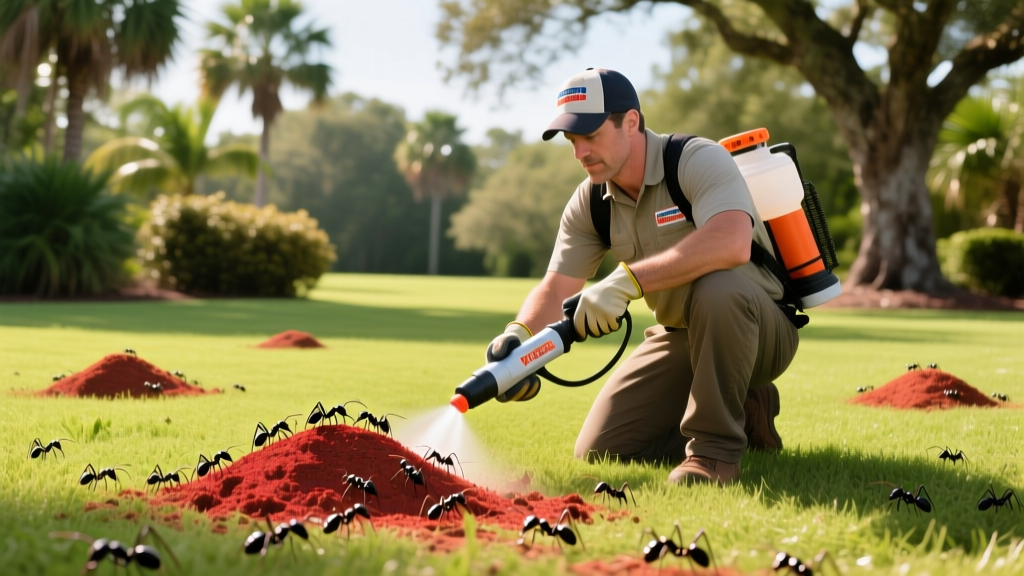
Fire Ants in Florida: A Seasonal Treatment Calendar
Florida’s subtropical climate creates a near-ideal environment for the red imported fire ant (Solenopsis invicta). Unlike northern states where deep winter freezes naturally suppress populations, fire ants in Florida remain active, foraging, and reproducing for up to ten months of the year. Because they do not experience true winter dormancy in zones 8b through 11, managing them requires a continuous, seasonally adjusted strategy rather than a single annual application.
Treating fire ants at the wrong time of year wastes money and leaves your lawn vulnerable to rapid rebound. This guide breaks down the exact seasonal timing, soil temperature triggers, and product selection required to control fire ants in Florida's unique sandy soils.
The Master Switch: Soil Temperature and Foraging
Fire ant activity is entirely dictated by soil temperature at a 2-inch depth. In Florida, the soil rarely drops below the 60°F threshold where foraging ceases, meaning colonies are almost always hungry. However, their metabolism peaks when soil temperatures sit between 70°F and 90°F.
When soil temperatures exceed 95°F during the peak of a Florida summer, colonies retreat deeper underground to escape the heat, making surface-applied baits largely ineffective. Conversely, during the brief winter cool-downs, foraging slows drastically. Understanding this thermal biology is the key to timing your interventions perfectly.
The Florida Fire Ant Seasonal Calendar
Use this regional framework to schedule your pest control applications. Timing your treatments to align with the colony's natural biological imperatives yields drastically higher mortality rates.
Spring (March – May): The Growth Phase
As soil temperatures climb past 70°F, colonies rapidly expand their worker populations and begin producing alates (winged reproductive ants) for mating flights. Strategy: Apply an Insect Growth Regulator (IGR) bait. IGRs like methoprene or pyriproxyfen sterilize the queen and prevent new workers from maturing, effectively capping the population explosion before summer.
Summer (June – August): The Heat Retreat
Florida’s intense summer heat and daily afternoon thunderstorms make summer the most difficult time to control fire ants. Bait applied in the morning is often washed away by 3 PM rains, and extreme heat drives ants deep into the soil profile. Strategy: Rely on targeted individual mound treatments using granular dusts or injectable aerosols rather than broadcast baits. Treat mounds late in the evening when ants move closer to the surface as the soil cools.
Fall (September – November): The Peak Foraging Window
This is the most critical window for fire ant control in Florida. Colonies are aggressively foraging to store lipids and proteins for the winter, and soil temperatures are back in the optimal 75°F–85°F range. Strategy: Execute a broadcast application of a slow-acting metabolic bait. Because the ants are hoarding food deep in the nest, the toxicant is reliably distributed to the queen and the brood.
Winter (December – February): The Maintenance Phase
While foraging slows, Florida fire ants do not die off. They remain clustered tightly around the queen in the central mound chamber. Strategy: Avoid broadcast baits. Instead, use a fast-acting contact insecticide dust (like carbaryl or deltamethrin) applied directly onto the surface of visible, active mounds on warm winter afternoons.
| Season | Colony Behavior | Primary Strategy | Recommended Product Type |
|---|---|---|---|
| Spring | Rapid growth, mating flights | Population suppression | IGR Baits (Methoprene) |
| Summer | Deep retreat, heat stress | Targeted elimination | Mound Dusts / Aerosol Injections |
| Fall | Aggressive foraging, hoarding | Broad-scale colony kill | Slow-acting Metabolic Baits |
| Winter | Dormant clustering, slow metabolism | Direct mound contact | Fast-acting Contact Dusts |
The Two-Step Method: Calculating Exact Florida Application Rates
The Two-Step Method, developed by university entomologists, remains the gold standard for fire ant management. It involves broadcasting bait across the entire yard (Step 1) followed by treating individual nuisance mounds with a fast-acting contact product (Step 2). However, most Florida homeowners drastically over-apply bait, wasting money and increasing environmental runoff.
The Application Math: Most commercial fire ant baits recommend a broadcast rate of 1.0 to 1.5 lbs per acre. One acre is 43,560 square feet. If you have a standard 5,000 sq. ft. Florida lawn, you are treating roughly 0.11 acres. Therefore, you only need 1.7 to 2.6 ounces of bait for your entire yard. Use a small handheld rotary spreader and weigh your bait on a kitchen scale before application.
Product Comparison: Top Baits for Subtropical Climates
Not all baits perform equally in Florida's high-humidity environment. The carrier (usually ground corncob) must remain intact long enough for the ants to find it before it molds or degrades. Below is a comparison of the top-performing baits available to consumers in 2026.
| Product Name | Active Ingredient | Speed of Kill | Approx. Cost (2026) | Best Season to Use |
|---|---|---|---|---|
| Advion Fire Ant Bait | Indoxacarb (0.04%) | 2–4 Weeks | $28 / lb | Fall (Peak Foraging) |
| Extinguish Plus | Hydramethylnon + Methoprene | 3–6 Weeks | $19 / lb | Spring (Growth Phase) |
| Amdro Fire Ant Bait | Hydramethylnon (0.73%) | 1–2 Weeks | $14 / lb | Fall / Early Winter |
According to research from the UF/IFAS Pest Ant Management program, baits containing Indoxacarb (like Advion) are highly effective because the active ingredient is only converted into its lethal form by the specific enzymes found in the insect's gut, making it exceptionally safe for non-target organisms while devastating to the colony.
The Sandy Soil Factor: Why Liquid Drenches Fail in Florida
One of the most common mistakes homeowners make is applying a liquid insecticide drench (e.g., mixing liquid bifenthrin with water and pouring it over a mound). While this works in dense clay soils, it is highly ineffective in Florida’s entisols and spodosols.
Florida's sandy soils have infiltration rates that frequently exceed 2 inches per hour. When you pour two gallons of liquid drench onto a mound, the fluid bypasses the queen’s deep central chamber and drains straight down into the water table. The workers on the surface die, but the queen survives and simply relocates the colony a few feet away.
The Fix: In sandy soils, use granular baits (which the ants carry down to the queen) or specialized aerosol mound injectors equipped with a 12-inch soil probe. The probe allows you to inject the insecticide directly into the queen's gallery network, bypassing the rapid surface percolation of the sand.
Warning: The Afternoon Thunderstorm Rule
Never broadcast fire ant bait in Florida if rain is forecast within the next 12 hours. Once the corncob carrier absorbs moisture, the bait becomes unpalatable to the ants and will mold within 48 hours. Check your local radar and apply bait early in the morning or late in the evening, ensuring a dry window of at least 24 hours.
Biological Controls on the Horizon
For those seeking organic or long-term ecological solutions, the USDA and University of Florida have been introducing Pseudacteon phorid flies (decapitating flies) across the state. These flies lay their eggs inside the heads of fire ant workers, eventually decapitating them. While you cannot purchase these flies for residential application, preserving naturalized, untreated buffer zones around your property can help establish local phorid fly populations, which naturally suppress fire ant foraging behavior by up to 30% simply through their presence.
By aligning your product selection with the biological rhythms of the colony and adapting your application methods to Florida's unique sandy soils, you can achieve a 90%+ reduction in fire ant mounds without wasting chemicals or money on ineffective treatments.

