
Pest Control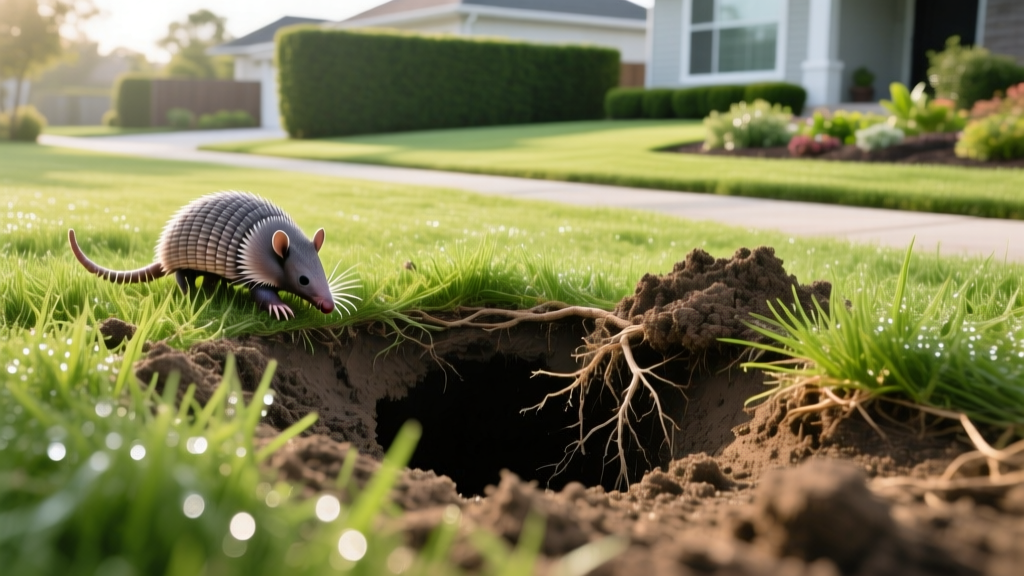
How to Fix Armadillo Holes in Yard and Deter Future Digging
Diagnosing the Damage: Are These Actually Armadillo Holes?
Before purchasing deterrents or repairing your turf, you must confirm the culprit. The nine-banded armadillo (Dasypus novemcinctus) is a prolific digger, but its foraging signatures are distinctly different from other common lawn pests. Armadillos possess poor eyesight but an exceptional sense of smell, allowing them to detect insect larvae buried up to eight inches beneath the soil surface. When they dig, they create shallow, conical pits rather than complex tunnel systems.
Key Identification Metrics: Armadillo foraging holes are typically 1 to 3 inches wide and 3 to 5 inches deep. Their primary burrow entrances are larger (7 to 8 inches wide) and often feature a small mound of excavated dirt at the entrance, usually located near foundations, stumps, or brush piles.
Pest Hole Comparison Matrix
| Pest | Hole Diameter | Depth & Shape | Dirt Mound? |
|---|---|---|---|
| Armadillo | 1 - 3 inches | 3-5 inches, conical pit | No (foraging), Yes (burrows) |
| Skunk | 3 - 4 inches | 4-6 inches, clean edges | Rarely |
| Raccoon | 3 - 5 inches | Shallow, torn sod chunks | No |
| Groundhog | 10 - 12 inches | Deep, complex tunnel | Large crescent mound |
| Vole | 1 - 1.5 inches | Shallow surface runways | No |
According to the Texas A&M Agrilife Extension, armadillos can cause severe structural damage if their primary burrows undermine concrete slabs, driveway edges, or retaining walls. Identifying the difference between a superficial foraging pit and a structural burrow is the first step in your remediation plan.
The Root Cause: Grub Populations and Soil Moisture
Armadillos do not dig for sport; they dig for calories. An adult nine-banded armadillo consumes up to 40,000 insects and larvae annually. Their diet consists primarily of white grubs (scarab beetle larvae), earthworms, and ants. If your yard is heavily irrigated or suffers from poor drainage, it creates an ideal habitat for grub proliferation, effectively rolling out a red carpet for foraging armadillos.
The 'Sod Peel' Test: To determine if grubs are attracting armadillos, cut a 1-square-foot section of your lawn with a spade and peel back the turf. Count the white, C-shaped grubs. If you find more than 5 to 7 grubs per square foot, your lawn has an infestation severe enough to attract mammalian foragers.
Step-by-Step Remediation: Filling and Repairing the Turf
Simply kicking loose dirt back into an armadillo hole will result in settling, creating a depression that traps water and kills surrounding grass. Proper remediation requires structural soil compaction and turf integration.
- Clear the Debris: Remove loose clods, rocks, and torn thatch from the hole. If the hole is a primary burrow, probe it with a long stick to ensure it is vacant before filling.
- Mix a Structural Fill: Do not use pure topsoil, which retains too much moisture and invites re-digging. Create a mix of 70% sandy loam topsoil and 30% coarse masonry sand. This ensures rapid drainage and deters future foraging in that exact spot.
- Tamp in Layers: Fill the hole in 2-inch increments, tamping each layer firmly with the end of a 4x4 post or a manual hand tamper. Overfill the final layer by half an inch to account for natural settling.
- Apply Turf Repair: For cool-season lawns, use a product like Scotts PatchMaster Sun and Shade Mix (approx. $22 for a 4.75 lb bag). For warm-season lawns (Bermuda, Zoysia), plug the area with matching sod cut slightly larger than the hole, and stomp it flush with the surrounding grade.
Advanced Deterrence Strategies (Keeping Them Out)
Filling holes is reactive; deterrence is proactive. To permanently stop armadillo holes in your yard, you must attack the problem on three fronts: food source elimination, physical exclusion, and sensory disruption.
1. Chemical & Organic Grub Control
Eliminating the food source is the single most effective deterrent. You have two primary routes for grub control:
- Conventional (Preventative): Products containing Chlorantraniliprole (e.g., Acelepryn) are highly effective and safe for pollinators. Apply in early spring (April/May) at a rate of 1.5 to 2.0 fl oz per 1,000 sq ft. Cost: ~$150 for a 1.67-gallon jug, which treats over 10,000 sq ft.
- Organic (Biological): Milky Spore (Paenibacillus popilliae) specifically targets Japanese beetle grubs. It requires a one-time application using a grid pattern (1 teaspoon per 4x4 foot grid). Cost: ~$45 for 20 oz. Note: It takes 1 to 3 years to establish full soil colonization, making it a long-term strategy rather than an immediate fix.
2. Physical Barriers: The 45-Degree Exclusion Trench
Armadillos are poor climbers but excellent diggers. Standard vertical fencing will not stop them; they will simply dig underneath. The Internet Center for Wildlife Damage Management recommends a specific trenching technique for exclusion.
- Material: 19-gauge, 1/2-inch x 1/2-inch galvanized hardware cloth.
- Installation: Dig a trench 12 to 18 inches deep along the perimeter of your property or garden bed.
- The Angle: Bury the bottom edge of the mesh and angle the entire barrier outward (away from your yard) at a 45-degree degree angle. When the armadillo digs down and hits the mesh, its natural instinct is to dig deeper, not to back up and climb over.
3. Sensory Deterrents: Castor Oil Applications
Armadillos rely heavily on their sense of smell and tactile sensitivity in their snouts. Castor oil-based repellents coat the soil and the insects within it, making the foraging experience highly unpleasant for the mammal. Products like Nature's Mole & Armadillo Repellent utilize a concentrated castor oil and garlic base. Apply via a hose-end sprayer at a rate of 1 oz per 1,000 sq ft immediately after watering the lawn. Reapply every 30 days or after heavy rainfall exceeding 1 inch.
Trapping and Legal Considerations
If deterrents fail, live trapping may be necessary. However, armadillos do not respond well to standard bait traps because their diet consists of live soil insects, not standard commercial baits like peanut butter or cat food. Instead, trap placement must intercept their established travel corridors.
Legal Warning: Before setting a trap, consult your state wildlife regulations. In many states, such as Texas, armadillos are classified as non-game animals and can be trapped year-round on private property, but relocation is often strictly prohibited due to the risk of spreading leprosy (Hansen's disease), which nine-banded armadillos can carry. Euthanasia or release on the exact capture site is usually the legal requirement.
Use a 10x12x32 inch galvanized steel live trap (e.g., Havahart Model #1045, approx. $75). Place the trap directly over a fresh burrow entrance or wedge it into a narrow pathway between brush and a fence line. Remove the trap's trip pan and run a taut wire across the entrance to act as a trigger wire, ensuring the armadillo trips the mechanism as it forces its way into the enclosure.
Quick Reference FAQ
Do ultrasonic pest repellers work on armadillos?
No. Armadillos have relatively poor hearing and their foraging behavior is driven by olfactory and tactile feedback. Ultrasonic stakes marketed for moles and gophers have zero documented efficacy against armadillos in controlled university extension studies.
Will mothballs keep armadillos out of my yard?
Mothballs (naphthalene) are entirely ineffective for outdoor armadillo deterrence. The gas dissipates rapidly in open-air environments, and using them outdoors violates federal EPA pesticide regulations, posing severe toxicity risks to pets, children, and local groundwater.
How deep can an armadillo burrow go?
While foraging pits are shallow (3-5 inches), primary nesting burrows can extend up to 15 feet in length and reach depths of 15 feet, often following the root systems of large trees or the footings of residential foundations.

