
Pest Control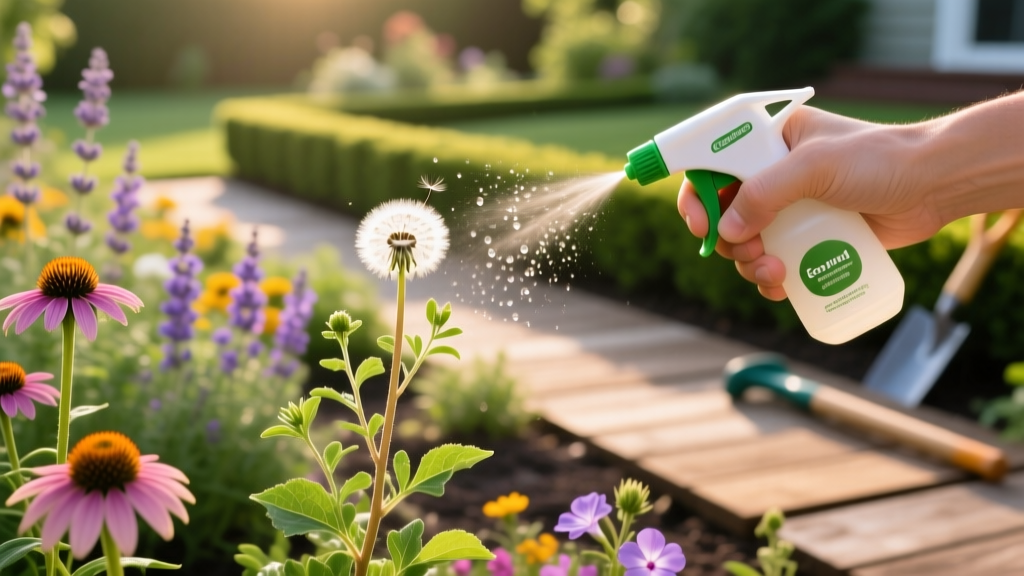
Safe Weed Killer for Flower Beds: Species Spot-Treatment
The Biological Challenge of Ornamental Weed Control
Applying a broadcast weed killer for flower beds is a high-risk endeavor. Unlike turfgrass, which is a uniform monoculture, ornamental beds contain diverse plant families (dicots, monocots, and woody perennials) growing in tight proximity to invasive weeds. A non-selective herbicide drift of just 2% can cause severe phytotoxicity, leaf cupping, or death to sensitive ornamentals like roses, hydrangeas, and tomatoes. Furthermore, the microclimate of a flower bed—characterized by frequent irrigation, rich organic soil, and disturbed mulch layers—creates an ideal germination zone for both summer annuals and deep-rooted perennials.
According to the UC Statewide IPM Program, successful weed management in ornamental landscapes relies on precise identification and targeted, species-specific spot treatments rather than blanket chemical applications. This guide provides exact chemical protocols, active ingredients, and application techniques to eradicate specific weed species without harming your prized ornamentals.
⚠️ Critical Drift Warning: Never use hose-end sprayers for flower bed weed control. The droplet size generated by hose-end nozzles is highly susceptible to wind drift and vapor drift. Always use a dedicated, pressurized 1-to-2-gallon pump sprayer with a flat-fan nozzle (such as a TeeJet 8002VS) calibrated to 20-30 PSI for large droplet delivery.
Species-Specific Spot-Treatment Matrix
Selecting the correct weed killer for flower beds requires matching the herbicide's mode of action to the weed's botanical classification. The matrix below outlines the primary invaders and their corresponding selective treatments.
| Weed Species | Active Ingredient | Brand Example | Ornamental Safety Profile |
|---|---|---|---|
| Crabgrass / Annual Bluegrass | Fluazifop-p-butyl | Ortho Grass B Gon | Safe for most broadleaf dicots; toxic to ornamental grasses. |
| Yellow / Purple Nutsedge | Halosulfuron-methyl | SedgeHammer+ | Safe for established woody and broadleaf ornamentals when directed. |
| Creeping Charlie / Bindweed | Glyphosate (Wick applied) | Roundup Precision Weed | Non-selective; 100% lethal on contact. Requires physical shielding. |
| Spurge / Purslane (Pre-emergent) | Dithiopyr / Trifluralin | Preen Garden Weed Preventer | Safe for established plants; do not use on ungerminated flower seeds. |
Protocol 1: Grassy Weeds (Monocots) in Broadleaf Beds
Crabgrass, Foxtail, and Annual Bluegrass
Grassy weeds are notoriously difficult to remove by hand from flower beds because their fibrous root systems intertwine with the shallow roots of annual flowers. The most effective weed killer for flower beds infested with grassy weeds is Fluazifop-p-butyl (an aryloxyphenoxypropionate herbicide).
This chemical works by inhibiting acetyl-CoA carboxylase (ACCase), an enzyme critical for lipid synthesis in monocots. Because broadleaf ornamentals (dicots) possess a structurally different ACCase isoform, they are biologically immune to this chemical. You can spray a 0.48% ready-to-use fluazifop solution directly over the top of broadleaf flowers like petunias, marigolds, and daylilies without causing phytotoxicity. Exception: Do not use near ornamental grasses (e.g., fountain grass, liriope) or bulb crops like iris and gladiolus.
Yellow and Purple Nutsedge
Nutsedge is not a grass; it is a sedge characterized by a triangular stem ('sedges have edges') and underground tubers (nutlets). Pulling nutsedge often leaves the nutlets behind, triggering the growth of multiple new shoots. To eradicate nutsedge in ornamental beds, use Halosulfuron-methyl.
Halosulfuron is an ALS (acetolactate synthase) inhibitor. For spot treatment, mix 0.9 grams of the 75% dry flowable formulation per 1 gallon of water. Crucially, you must add a non-ionic surfactant (at 0.25% v/v) to the mixture. Nutsedge leaves have a thick, waxy cuticle that repels water-based sprays; the surfactant breaks this surface tension, allowing the herbicide to penetrate and translocate down to the tubers. Apply when the nutsedge is in the 3-to-5 leaf stage for maximum systemic absorption.
Protocol 2: Deep-Rooted Perennial Vines and Broadleaves
Field Bindweed and Creeping Charlie (Ground Ivy)
Perennial vines like field bindweed (Convolvulus arvensis) and creeping charlie (Glechoma hederacea) weave tightly through ornamental shrubs and groundcovers. Because there are no selective post-emergent herbicides that will kill these broadleaf weeds without also killing broadleaf flowers, you must use a non-selective herbicide like Glyphosate via localized transfer techniques.
According to research published by Penn State Extension, localized transfer prevents vapor drift and root uptake by desirable plants. Prepare a 15% glyphosate solution (roughly 1 part 41% glyphosate concentrate to 2 parts water). Do not spray. Instead, use one of the following methods:
- Rope-Wick Applicator: A specialized tool that holds the herbicide in a reservoir and dispenses it through a cotton rope. Wipe the rope directly onto the apical meristem (growing tips) of the weed.
- Sponge Painting: Wear a heavy-duty nitrile glove, place a cheap foam paintbrush over it, dip the brush in the solution, and dab the weed's leaves.
- The 'Glove of Death': For severe infestations, wear a cotton glove over a nitrile glove, saturate the cotton fingers with the 15% solution, and run your hand up the weed's stem. The plant absorbs the chemical through its stomata and translocates it to the rhizomes.
Protocol 3: Pre-Emergent Defense for Annual Weeds
Post-emergent spot treatments are reactive. To stop spurge, purslane, and lambsquarters from germinating in the mulch, apply a granular pre-emergent herbicide in early spring when soil temperatures consistently reach 55°F at a 2-inch depth. Trifluralin (Preen) or Dithiopyr (Dimension) create a chemical barrier in the top 1 inch of soil that inhibits root development in germinating weed seeds. Apply at a rate of 2.5 lbs per 1,000 square feet, and water in with 0.5 inches of irrigation immediately to activate the barrier without washing it away.
Organic and Non-Chemical Spot Alternatives
For gardeners managing edible flower beds (like nasturtiums or calendula) or those avoiding synthetic chemicals, organic spot treatments require strict adherence to concentration and timing.
"Kitchen vinegar (5% acetic acid) is largely ineffective on mature weeds. For true burndown capability in ornamental beds, you must use horticultural vinegar containing 20% to 30% acetic acid, applied with a shielded nozzle on a hot, sunny day to maximize cellular desiccation." — EPA Safe Pest Control Guidelines
Thermal Weeding: For weeds growing in the gaps between patio stones adjacent to flower beds, or deep in thick woodchip mulch, a 150,000 BTU propane flame weeder is highly effective. You do not need to incinerate the weed; passing the flame over the foliage for 1-2 seconds boils the water inside the plant's cells, causing the leaves to wilt and the plant to die back to the root within 48 hours.
Frequently Asked Questions
Can I use 2,4-D amine in my flower beds?
While 2,4-D is a selective broadleaf herbicide that spares turfgrass, it is highly dangerous in flower beds. 2,4-D is notorious for volatilizing (turning into a gas) at temperatures above 80°F and drifting onto sensitive ornamentals, causing severe epinasty (twisted, cupped growth). It is strongly advised to avoid 2,4-D in mixed ornamental landscapes.
How long should I wait to plant new flowers after applying a pre-emergent?
Pre-emergent herbicides like trifluralin do not distinguish between weed seeds and flower seeds. If you apply a pre-emergent, you must wait at least 8 to 12 weeks before sowing new flower seeds. Transplanting established plugs or potted plants with intact root balls, however, is generally safe immediately after application, as the chemical barrier only affects seeds germinating at the soil surface.
What is the best mulch to suppress weeds naturally?
Arborist wood chips applied at a depth of 3 to 4 inches provide the best physical weed suppression. The chips deplete nitrogen at the soil surface as they decompose, which starves germinating weed seeds, while the physical thickness blocks photosynthesis. Avoid using dyed mulches near edible flowers, as the carbon black dyes can leach into the soil profile over time.

