
Pest Control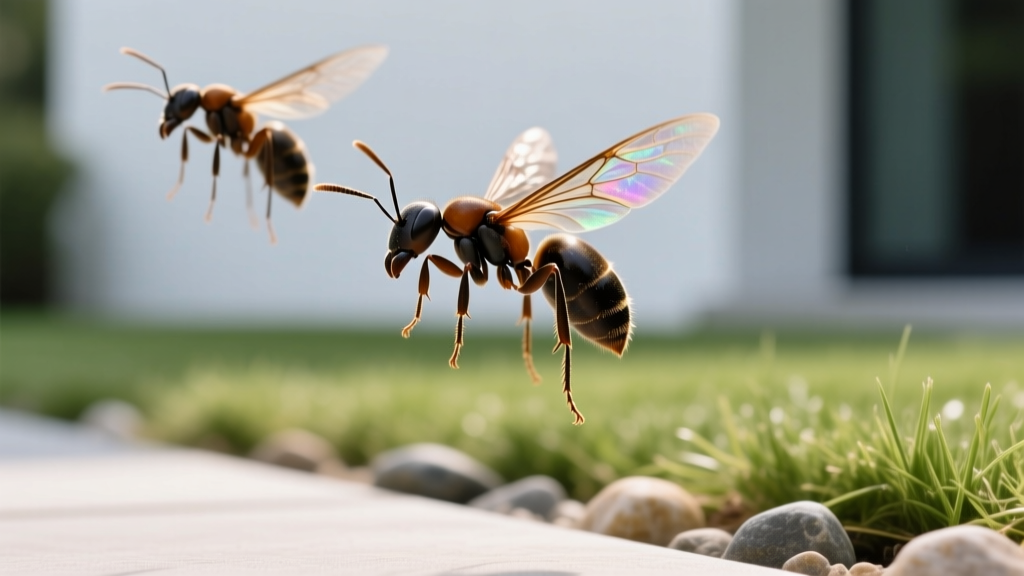
Flying Insects That Look Like Ants: ID Guide and Treatment Steps
Spotting a swarm of flying insects in your yard or near your foundation triggers an immediate question: are these harmless nuisance bugs, or are they actively destroying your home's structural integrity? While several species fit the description of flying insects that look like ants, the two most critical to distinguish are termite swarmers and flying carpenter ants. Misidentifying them can lead to either unnecessary panic or catastrophic, unchecked structural damage.
This guide provides a precise, field-tested framework for identifying these insects, differentiating them from harmless mimics, and executing the correct treatment protocols based on exact species confirmation.
The Big Two: Termite Swarmers vs. Flying Carpenter Ants
Both subterranean termites (Reticulitermes spp.) and carpenter ants (Camponotus spp.) produce winged reproductive swarmers (alates) in the spring and early summer. Their biological purpose is identical—leave the nest, mate, and establish a new colony. However, their physical morphology and the damage they cause are vastly different.
Damage Reality Check: Termites consume cellulose and will eat the structural framing of your home, causing an estimated $5 billion in U.S. property damage annually. Carpenter ants do not eat wood; they excavate it to build galleries. While carpenter ants cause damage, it is generally slower and secondary to pre-existing moisture rot.
Morphological Comparison Matrix
When you capture a specimen, use a macro lens or magnifying glass to inspect these three critical anatomical features:
| Feature | Termite Swarmers | Flying Carpenter Ants |
|---|---|---|
| Wings | Four wings of equal length, typically twice the length of the body. Veins are faint. | Front wings are noticeably longer than hind wings. Veins are distinct and dark. |
| Waist | Broad, uniform, and straight. The thorax and abdomen are wide and connected. | Narrow, pinched, and distinctly segmented (a distinct hourglass shape). |
| Antennae | Straight and beaded, resembling a string of tiny pearls. | Elbowed (bent at a sharp 90-degree angle near the base). |
| Body Color | Dark brown to black body, but wings are translucent, milky, or slightly smoky. | Body is usually black, red, or a combination. Wings are tinted brown or reddish. |
5 Harmless Flying Insects That Look Like Ants
Not every winged insect marching across your patio is a structural threat. Entomologists frequently field calls about these harmless mimics:
- Velvet Ants (Dasymutilla occidentalis): Despite the name, these are actually flightless female wasps (the males have wings but are rarely seen). They are covered in dense, bright orange or red fuzz. They possess a notoriously painful sting, earning them the nickname 'cow killer,' but they are solitary, non-aggressive, and pose zero threat to structures.
- Adult Antlions (Myrmeleontidae): The larvae dig the famous sand pits to trap ants, but the adults emerge as flying insects with long, clubbed antennae and mottled, lacewing-like wings. They are clumsy fliers, strictly nocturnal, and entirely harmless.
- Winged Aphids: During population booms, aphids develop wings to migrate. They are tiny (1/16 to 1/8 inch), soft-bodied, and usually green, black, or yellow. They damage garden plants by sucking sap but do not harm wood or humans.
- Ichneumon Wasps: Many species have elongated bodies, narrow waists, and long ovipositors that make them look like large, mutated flying ants. They are parasitoid wasps that target wood-boring beetle larvae and are highly beneficial for garden pest control.
- Thrips: Extremely tiny (under 1/20 inch), slender, and dark with fringed wings. They swarm in late summer and may land on you, occasionally delivering a harmless, superficial prick, but they are strictly agricultural/garden pests.
Field Identification: The 'Capture and Inspect' Protocol
Swarmers are fragile. Termite wings, in particular, are deciduous—meaning they snap off easily when the insect is disturbed, leaving you with a wingless insect that is much harder to identify. Follow this protocol to secure a pristine specimen:
- Isolate the Specimen: Do not swat or squash the insect. Place a clear glass or plastic cup over it while it is resting on a flat surface.
- Secure the Capture: Slide a stiff piece of cardstock under the cup. Invert it and screw on a lid with small air holes.
- Chill for Inspection: Place the jar in the refrigerator for 10 minutes. This slows the insect's metabolism, preventing it from beating its wings against the glass and shedding them.
- Macro Photography: Use a clip-on smartphone macro lens (such as the Xenvo Pro or Moment Macro) to capture high-resolution images of the waist, antennae, and wing venation.
- Measure: Subterranean termite swarmers are typically 3/8 to 1/2 inch long. Carpenter ant swarmers are larger, ranging from 1/2 to 5/8 inch. Drywood termite swarmers are slightly larger and darker than subterranean species.
Treatment Frameworks: What to Do When You Find Them
Your treatment strategy must be dictated entirely by the identification results. According to the U.S. Environmental Protection Agency (EPA), improper application of termiticides can lead to groundwater contamination and ineffective colony elimination.
Scenario A: Confirmed Subterranean Termite Swarmers
If you have termites, DIY surface sprays are useless. Subterranean termites live deep underground, and the swarmers you see represent a colony that is likely 3 to 5 years old and contains hundreds of thousands of workers.
- Liquid Trenching (Termidor SC): The industry standard is Fipronil 9.1% (Termidor SC). You must dig a trench 6 inches wide and 6 inches deep around the entire foundation. Mix 0.8 fluid ounces of Termidor SC per gallon of water. Apply 4 gallons of the finished solution per 10 linear feet of trench. Cost: $65-$85 per 20oz bottle; a standard 200-foot perimeter requires roughly 3 bottles.
- Bait Stations (Sentricon Always Active): If trenching is impossible due to concrete slabs or landscaping, install bait stations every 10 feet around the perimeter. These utilize Noviflumuron, an insect growth regulator that prevents termites from molting. Cost: $15-$25 per station; professional installation for an average home runs $1,200 to $2,500.
Scenario B: Confirmed Drywood Termite Swarmers
Drywood termites do not need soil contact and infest dry structural timber, attic beams, and fascia boards. Liquid soil trenching will not work.
- Localized Treatment: For isolated spots, professionals inject foaming termiticides (like Altriset) directly into the wood galleries.
- Whole-Structure Fumigation: For widespread infestations, structural tenting with Vikane gas (sulfuryl fluoride) is required. Cost: $1,200 to $3,000+ depending on home cubic footage.
Scenario C: Confirmed Carpenter Ant Swarmers
The University of Florida IFAS notes that carpenter ants are moisture indicators. They excavate wood that has already been softened by fungal decay.
- Perimeter Barrier: Apply Alpine WSG (Dinotefuran) as a perimeter spray. It is a non-repellent that ants track back to the colony. Mix 0.45 oz per gallon of water and spray a 3-foot band up the foundation and 3 feet out on the soil.
- Targeted Baiting: Use Maxforce Fleet Ant Bait Gel near foraging trails. The slow-acting indoxacarb allows workers to share the bait via trophallaxis, eventually reaching the queen.
- Moisture Remediation: You must fix the underlying leak or ventilation issue, or the ants will simply return to the damp wood.
Expert Prevention Tactics for Long-Term Control
Regardless of the species, environmental modification is the most cost-effective long-term deterrent.
The 6-Inch Rule: Maintain a strict 6-inch gap between the top of your soil/mulch and the bottom of your siding or weep holes. Mulch piled against siding provides a hidden, moisture-rich highway for termites to bypass chemical soil treatments.
- Ventilation and Mesh: Cover all crawl space vents, soffit vents, and weep holes with 1/16-inch galvanized hardware cloth. Standard window screens (1/18 inch) are large enough for drywood termite swarmers and small ants to penetrate.
- Wood-to-Soil Contact: Remove any fence posts, deck stairs, or trellises that rest directly on the soil. Use galvanized post bases anchored into concrete footings to elevate wood at least 2 inches above grade.
- Exterior Lighting: Swarmers are highly phototactic (attracted to light). During swarming season (typically March through June), replace exterior white LED or halogen bulbs with yellow 'bug lights' (sodium vapor or specific LED wavelengths) near entryways to reduce the congregation of alates near your doors.
Frequently Asked Questions
Do flying ants bite or sting?
Carpenter ant swarmers can deliver a mild pinch with their mandibles and may spray formic acid, but they do not possess a stinger and are not aggressive toward humans. If an 'ant' stings you severely, you have likely encountered a velvet ant (which is a wasp).
Why do I see swarms only for one or two days a year?
Swarming is triggered by a highly specific combination of soil temperature, ambient air temperature, and recent rainfall. Once the reproductive alates leave the nest, the remaining workers seal the exit holes. The absence of swarmers does not mean the colony has left; it means the workers are silently foraging 365 days a year.
For localized identification assistance, consult your state's university cooperative extension office or a licensed structural pest control operator. Always read and follow the exact label instructions on any EPA-registered pesticide product before application.

