
Pest Control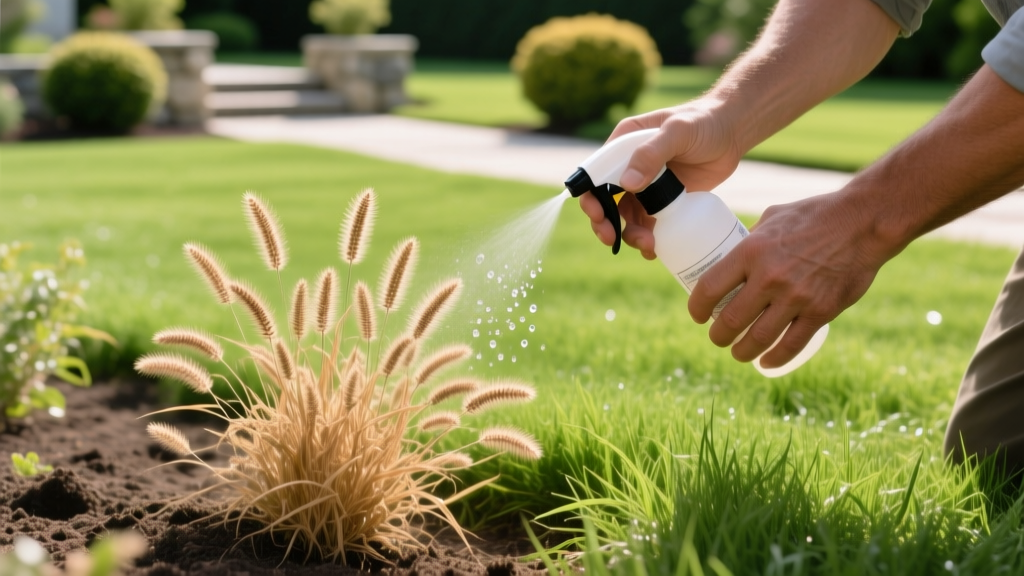
Effective Foxtail Weed Killer & Spot Treatment Guide
Foxtail weeds (Setaria species) are aggressive, annual grassy weeds that can quickly overtake a thinning lawn, competing for water, nutrients, and sunlight. Unlike broadleaf weeds, foxtail shares the same monocot structure as your desirable turfgrass, making selective eradication highly complex. Choosing the wrong foxtail weed killer will not only fail to eliminate the weed but can also cause severe phytotoxicity to your lawn. This guide provides a precise, chemistry-backed spot-treatment protocol tailored to your specific turf type, complete with exact mixing ratios and real-world failure modes.
The Foxtail Identification Matrix
Before mixing any herbicide, you must confirm the specific foxtail species. While the post-emergent chemistry remains largely the same across species, the growth habits dictate your application timing. According to the University of California IPM, the three most common invaders are:
- Yellow Foxtail (Setaria pumila): Identified by yellowish, bristly seedheads and sparse, long hairs on the upper leaf blades near the collar. Thrives in compacted, poorly drained soils.
- Green Foxtail (Setaria viridis): Features dense, green, bottle-brush seedheads and completely hairless leaves. It is the most widespread and germinates slightly earlier in the spring than yellow foxtail.
- Giant Foxtail (Setaria faberi): Can grow up to 3 feet tall with a distinctly drooping, nodding seedhead. Leaves have dense short hairs on the upper surface.
Pro Tip: The optimal window for post-emergent spot treatment is the 1-leaf to 3-leaf stage. Once the foxtail develops a mature seedhead (panicle), the plant's vascular system shifts resources upward for seed production, severely reducing the downward translocation of systemic herbicides to the roots.
Selecting the Right Foxtail Weed Killer by Turf Type
The single biggest mistake homeowners make is purchasing a generic "grass and weed killer" without checking the active ingredient against their specific turfgrass species. Quinclorac is the undisputed gold standard for foxtail control in cool-season lawns, but it is highly toxic to certain warm-season grasses.
Turf Safety and Product Matrix (2026 Pricing)
| Turfgrass Type | Active Ingredient | Commercial Product Example | Approx. Cost |
|---|---|---|---|
| Tall Fescue / Kentucky Bluegrass | Quinclorac | Quinclorac 75 DF / Drive XLR8 | $45 - $55 / lb (DF) |
| Bermudagrass / Zoysia | Quinclorac or Fluazifop | Drive XLR8 / Ornamec 170 | $85 / 2.5 gal (XLR8) |
| St. Augustine / Centipede | Sethoxydim (with caution) | Vantage / Hi-Yield Grass Killer | $35 - $45 / 16 oz |
Critical Warning for St. Augustine & Centipede: Never apply Quinclorac to St. Augustine or Centipede grass. It will cause severe chlorosis, necrosis, and potentially kill the turf. For these warm-season grasses, spot-treating mature foxtail post-emergence is notoriously difficult. Sethoxydim is safer but often requires multiple applications and can still cause temporary stunting. In many cases, careful wick-application of glyphosate directly to the foxtail seedheads is the only viable rescue option.
The Precision Spot-Treatment Protocol
For cool-season lawns and Bermudagrass, Quinclorac (specifically the 75% Dry Flowable formulation) offers the most economical and effective control. Because foxtail has a waxy leaf cuticle, the herbicide will bead up and roll off without a high-quality surfactant.
Step 1: Calculate the Exact Mix Rate
For Quinclorac 75 DF, the standard label rate for foxtail is 0.367 oz to 0.735 oz per 1,000 square feet. For spot treatments, we mix by the gallon to cover smaller areas. A standard 1-gallon pump sprayer covers approximately 1,000 sq ft when walking at a normal pace. Therefore, add 0.5 oz of Quinclorac 75 DF to 1 gallon of water.
Step 2: Add the Surfactant (Non-Negotiable)
Do not use dish soap. You must use a Methylated Seed Oil (MSO) or a high-quality Non-Ionic Surfactant (NIS). MSO is superior for penetrating the waxy cuticle of mature grassy weeds. Add 0.5 oz (1 tablespoon) of MSO per gallon of water. This represents a 0.5% v/v concentration, which is the optimal threshold for efficacy without causing excessive turf burn.
Step 3: Application Technique
- Agitate: Shake the sprayer vigorously. Quinclorac DF is a suspension; if left sitting, it will settle at the bottom and clog your nozzle.
- Spray to Wet: Apply the mixture evenly over the foxtail clumps until the leaves are visibly wet but not dripping. Avoid spraying the surrounding healthy turf unnecessarily to prevent cumulative chemical stress.
- Wait: Do not mow for 48 hours before or 48 hours after application. This maximizes the leaf surface area available for herbicide absorption.
Why Your Foxtail Weed Killer Failed (Troubleshooting)
Even with the right chemistry, environmental and biological factors can cause a spot treatment to fail. The NC State Extension TurfFiles database highlights several common edge cases that homeowners overlook.
- Temperature Phytotoxicity: Quinclorac becomes highly volatile and toxic to desirable cool-season turf when daytime temperatures exceed 85°F (29°C). If you spray in July heat, you will burn your Tall Fescue or Kentucky Bluegrass. Restrict applications to early morning when temperatures are below 80°F.
- The Maturity Wall: If the foxtail has already dropped seed, the plant is naturally senescing (dying off) to complete its lifecycle. Herbicides rely on active photosynthesis and translocation to work. Spraying a dying, mature plant is a waste of chemical. Focus on the younger, actively growing offshoots nearby.
- Surfactant Omission: Without MSO or NIS, the surface tension of the water droplets prevents the active ingredient from crossing the leaf epidermis. The weed will show minor yellowing but will recover within 10 days.
- Single-Application Expectation: For foxtail that has reached the 4-leaf stage or beyond, a single application will only stunt the plant. The label explicitly requires a second application 14 to 21 days later to achieve complete control of mature specimens.
Closing the Lifecycle: The Pre-Emergent Mandate
Post-emergent spot treatment is a reactive rescue measure. Foxtail produces thousands of seeds per plant, which can remain viable in the soil seedbank for up to 5 years. If you are actively spraying foxtail in the summer, you have already lost the primary battle.
To break the lifecycle, you must apply a pre-emergent herbicide in early spring when soil temperatures at a 2-inch depth consistently reach 60°F to 62°F. Prodiamine (e.g., Barricade) and Dithiopyr (e.g., Dimension) are the industry standards. Dithiopyr offers a distinct advantage: it provides both pre-emergent control and early post-emergent control of foxtail seedlings up to the 1-leaf stage, giving you a wider application window in the spring. Apply at a rate of 0.38 lbs of active ingredient per acre, and water in with 0.5 inches of irrigation immediately to move the chemical into the weed germination zone.
"Successful foxtail management is 80% pre-emergent timing and 20% post-emergent spot treatment. Relying solely on summer spraying guarantees a heavier infestation the following spring due to the inevitable seed drop from mature plants."

