
Pest Control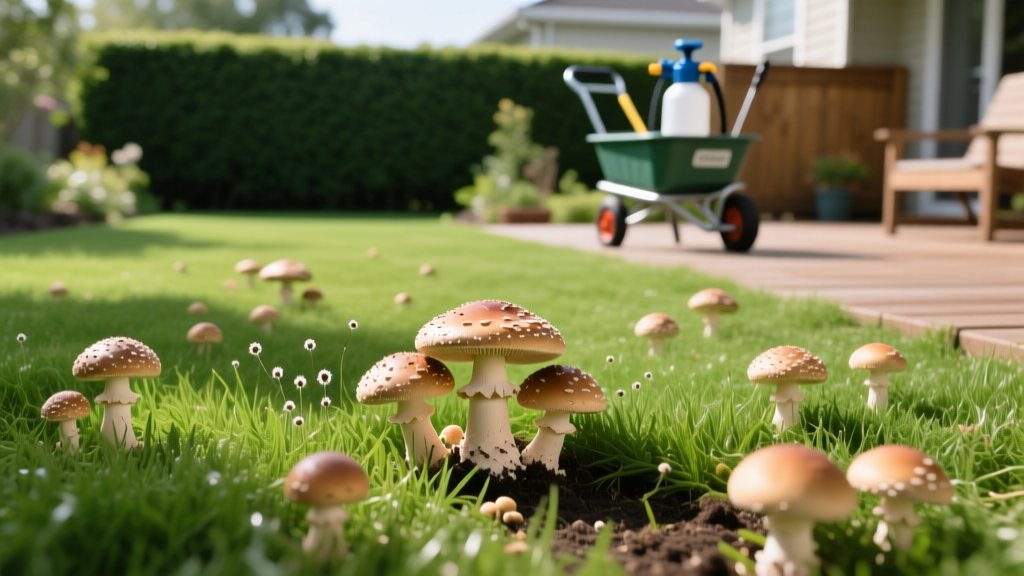
Using Fungicide for Mushrooms: Why Sprays Fail and What Works
The Hard Truth About Fungicide for Mushrooms
When a cluster of mushrooms erupts in your lawn after a heavy rain, the immediate instinct is to reach for a bottle of over-the-counter fungicide. However, applying a standard contact fungicide for mushrooms is one of the most common and costly mistakes homeowners make. To understand why sprays fail, you must understand the biology of the organism you are fighting.
Mushrooms are not the actual fungus; they are merely the temporary reproductive structures (fruiting bodies) of a massive, subterranean mycelial network. These networks, primarily belonging to the Basidiomycota phylum, live 2 to 6 inches below the soil surface, feeding on decaying organic matter like buried tree roots, construction debris, and thick thatch layers. The mushroom itself has a lifespan of only 3 to 7 days. By the time you see it and spray it, it is already dying. The chemical never reaches the true organism—the mycelium—leaving the network completely unharmed and ready to produce more mushrooms the next time it rains.
⚠️ The 'Quick Fix' Myth: Spraying copper sulfate, chlorothalonil, or neem oil directly onto mushroom caps will not kill the underground network. Furthermore, harsh home remedies like pouring vinegar or baking soda over the mushrooms will severely alter your soil pH, burning grass roots and causing long-term turf damage without solving the fungal issue.
Chemical Intervention: Targeting the Mycelium
While contact sprays are useless, there are specific scenarios where professional-grade, systemic fungicides are warranted. This is primarily true when dealing with Fairy Ring—a destructive basidiomycete infection that creates hydrophobic (water-repelling) rings of dead grass surrounded by dark green, rapid-growth zones.
To treat fairy ring or severe mycelial overgrowth, you must use systemic active ingredients that can be watered deep into the soil profile. According to turfgrass research from the University of Minnesota, these chemicals must be combined with a professional wetting agent (surfactant) to penetrate the hydrophobic mycelium mat.
| Active Ingredient | Common Brand | Application Rate | Est. Cost (2026) | Efficacy on Basidiomycetes |
|---|---|---|---|---|
| Azoxystrobin (23%) | Heritage SC | 0.4 - 0.8 oz / 1,000 sq ft | $180 / 2.5 gal | High (Curative & Preventative) |
| Flutolanil (70%) | Prostar 70WP | 1.5 - 3.0 oz / 1,000 sq ft | $130 / 1.5 lb | Moderate to High |
| Copper Octanoate | Camelot O | 2.0 - 4.0 oz / 1,000 sq ft | $95 / 1 gal | Low (Contact only) |
Expert Application Tip: If using Azoxystrobin for fairy ring, you must water it in with at least 0.25 inches of irrigation immediately after application to move the chemical past the thatch layer and into the root zone where the mycelium lives. Always tank-mix with an alkylpolyglycoside surfactant (like Aquifer or Cascade Plus) to break the surface tension of the hydrophobic fungal mat.
The 4-Step Cultural Eradication Protocol
For 90% of lawn mushrooms (which are harmless saprophytic fungi simply doing their job decomposing organic matter), chemical fungicides are an unnecessary expense. The University of Minnesota Extension emphasizes that environmental modification is the only permanent cure. Follow this exact protocol to starve the mycelium.
Step 1: Aggressive Moisture Management
Mycelium requires constant moisture to fruit. Homeowners often water their lawns lightly every day, which keeps the top 2 inches of soil perpetually damp—the exact environment mushrooms thrive in.
- The Fix: Switch to deep, infrequent watering. Apply 0.5 to 0.75 inches of water twice a week, preferably between 4:00 AM and 6:00 AM. This allows the surface to dry out during the day while pushing moisture deep into the root zone.
Step 2: Thatch Reduction and Core Aeration
If your thatch layer exceeds 0.5 inches, it acts as a sponge, holding moisture and providing a buffet of decaying lignin for the fungi.
- The Fix: Rent a mechanical dethatcher (power rake) in the early fall or spring to rip out the dead organic layer. Follow this immediately with core aeration, pulling 3-inch deep plugs on 3-inch centers. This physically fractures the mycelium network and drastically improves soil drainage.
Step 3: Nitrogen Loading to Accelerate Decomposition
Mushrooms feed on carbon-rich, nitrogen-poor materials like buried stumps or construction wood. By adding nitrogen, you stimulate soil bacteria to decompose the wood faster, effectively starving the fungi.
- The Fix: Apply a high-nitrogen, quick-release fertilizer (such as a 32-0-0 or 46-0-0 urea blend) at a rate of 1 lb of actual nitrogen per 1,000 square feet. Repeat every 6 weeks during the growing season until the buried organic matter is fully broken down.
Step 4: Physical Removal of Food Sources
If mushrooms are concentrated in one specific 3-foot radius, there is almost certainly a buried stump, thick root, or pile of construction debris underneath.
- The Fix: Use a shovel to excavate the area 6 to 8 inches deep. Remove all woody debris, backfill with fresh, well-draining topsoil, and reseed with a turfgrass blend appropriate for your hardiness zone.
Cost-Benefit Analysis: Chemical vs. Cultural Control
Before purchasing expensive systemic chemicals, consider the financial reality of lawn fungus management. The table below outlines the real-world costs for an average 5,000 square foot lawn in 2026.
| Treatment Strategy | Material Costs | Labor/Equipment | Long-Term Efficacy |
|---|---|---|---|
| OTC Contact Fungicides | $25 - $40 | 2 hours spraying | 0% (Fails to kill mycelium) |
| Systemic Azoxystrobin + Surfactant | $110 - $150 | 3 hours (includes watering in) | 60-80% (Requires repeat apps) |
| Core Aeration + Dethatching + N-Fertilizer | $35 (Fertilizer) | $120 (Machine Rental) | 95%+ (Permanent environment fix) |
Expert FAQ: Lawn Mushrooms and Fungicides
Are the mushrooms in my lawn poisonous to my dog?
While the vast majority of saprophytic lawn mushrooms (like Agaricus campestris or common puffballs) are non-toxic, it is impossible to identify toxic species like Amanita variants without microscopic spore analysis. If you have pets or small children that roam the yard, physically knock the caps off with a rake or mower and dispose of them in a sealed yard waste bag immediately after they emerge. Do not rely on fungicides to protect pets.
Will applying lime or adjusting soil pH kill the mushrooms?
No. The EPA's guidelines on safe pest and fungus management warn against using unregistered household chemicals for turf diseases. While some fungi prefer acidic soil, altering your lawn's pH to extreme levels to discourage mushrooms will lock up essential nutrients like iron and phosphorus, causing severe chlorosis (yellowing) and death of your turfgrass. Stick to moisture and thatch management.
I just laid new sod, and mushrooms are everywhere. Why?
New sod is frequently grown on fields heavily amended with compost and organic matter. When you lay this sod over your existing soil, the shock of transplantation, combined with the heavy watering required to establish new roots, creates a temporary fungal bloom. This is normal and temporary. Continue your deep-watering schedule, and the mushrooms will naturally dissipate within 4 to 6 weeks as the soil ecosystem stabilizes.

