
Pest Control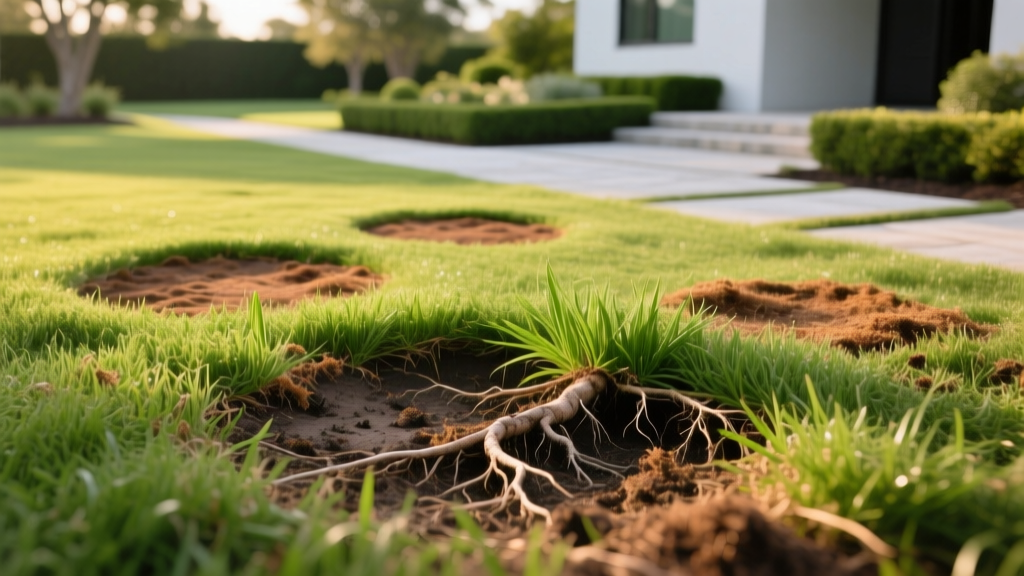
Best Fungicide for St Augustine Grass: Cure Brown Patch & Root Rot
The Big Three: Diagnosing St. Augustine Fungal Pathogens
St. Augustinegrass (Stenotaphrum secundatum) is the dominant warm-season turf in the Gulf Coast and Southeastern US, prized for its shade tolerance and dense carpet-like growth. However, its broad leaf blades and high moisture requirements make it exceptionally vulnerable to three specific fungal pathogens. Before selecting a fungicide for St Augustine grass, you must accurately identify the disease, as contact and systemic modes of action vary wildly by pathogen.
| Disease | Pathogen | Primary Symptoms | Peak Season |
|---|---|---|---|
| Brown Patch | Rhizoctonia solani | Circular patches (1-5 ft) of brown, blighted leaves; dark 'smoke rings' at margins in early morning. | Fall & Spring (70°F-85°F days, 60°F+ nights) |
| Take-All Root Rot (TARR) | Gaeumannomyces graminis | Yellowing/browning patches; roots are blackened, short, and rotted; stolons pull up easily. | Spring & Fall (soil temps 65°F-75°F) |
| Gray Leaf Spot | Pyricularia grisea | Oval, gray-brown spots on leaf blades; 'scorched' appearance; severe thinning in humid heat. | Late Summer (High humidity, 80°F-90°F) |
According to Texas A&M AgriLife Extension, Take-All Root Rot is frequently misdiagnosed as Brown Patch or chinch bug damage. The definitive test for TARR is examining the root mass: if the roots are black, brittle, and the stolons detach from the soil with zero resistance, you are dealing with TARR, which requires specific systemic fungicides that translocate downward to the root zone.
Top Systemic Fungicides for St. Augustine Grass
St. Augustine requires systemic fungicides—specifically those in the QoI (FRAC 11) and DMI (FRAC 3) chemical classes. Contact fungicides (like chlorothalonil) only protect the leaf surface and wash off during the heavy irrigation St. Augustine requires, making them ineffective for root-borne diseases like TARR.
1. Heritage SC (Azoxystrobin 22.9%) - The Pro Standard
Heritage SC is a liquid systemic fungicide (FRAC Group 11) that provides broad-spectrum control against Brown Patch, Gray Leaf Spot, and TARR. It is absorbed through the foliage and translocates acropetally (upward) through the xylem.
- Preventative Rate: 0.4 fl oz per 1,000 sq ft.
- Curative Rate: 0.8 fl oz per 1,000 sq ft.
- Cost: ~$135 for a 32 oz bottle (treats up to 80,000 sq ft at preventative rates).
- Reapplication Interval: 28 days.
⚠️ Critical Surfactant Requirement: St. Augustine grass has a highly waxy leaf cuticle. When applying liquid azoxystrobin, you must add a non-ionic surfactant (NIS) at 0.25% v/v (approx. 1/2 teaspoon per gallon of water). Without a surfactant, the liquid will bead up and roll off the broad blades, resulting in total application failure.
2. Armada 50 WDG (Trifloxystrobin + Triadimefon) - The TARR Killer
Armada combines a FRAC 11 (QoI) and a FRAC 3 (DMI) active ingredient. This dual-mode-of-action is the gold standard for Take-All Root Rot because the Triadimefon component translocates both upward and downward (systemic and locally systemic), reaching the infected root zone where TARR destroys the plant.
- Preventative Rate: 0.6 oz per 1,000 sq ft.
- Curative Rate: 1.2 oz per 1,000 sq ft.
- Cost: ~$125 for a 3 lb jug.
- Formulation Note: WDG (Water Dispersible Granule) requires constant agitation in your sprayer tank to prevent settling.
3. Scotts DiseaseEX (Azoxystrobin 0.31%) - The Consumer Granular
For homeowners without backpack sprayers, Scotts DiseaseEX offers the same active ingredient as Heritage SC in a granular form. It must be watered in immediately to activate the systemic uptake through the roots.
- Preventative Rate: 2 lbs per 1,000 sq ft.
- Curative Rate: 4 lbs per 1,000 sq ft.
- Cost: ~$32 for a 10 lb bag (treats 5,000 sq ft curatively).
- Activation: Requires exactly 0.25 inches of irrigation immediately after spreading to move the active ingredient into the soil profile.
Preventative vs. Curative Application Framework
The NC State Extension Turfgrass Pathology Lab emphasizes that fungicides are vastly more effective when applied preventatively. Once Brown Patch lesions sporulate or TARR destroys the root cortex, curative applications will only halt further spread; they will not instantly resurrect dead tissue.
The Warm-Season Transition Schedule
St. Augustine grass enters and exits dormancy in the Spring and Fall. These transition periods feature warm days, cool nights, and heavy dews—the exact microclimate required for Rhizoctonia solani (Brown Patch) to thrive.
- Early Fall (September 1 - October 15): Apply preventative systemic fungicide as night temperatures drop below 70°F but daytime highs remain above 80°F. This prevents Fall Brown Patch, which is the most destructive cycle for St. Augustine.
- Mid-Spring (April 1 - May 15): Apply a second preventative treatment as soil temperatures cross 65°F to protect emerging stolons from TARR and Spring Brown Patch.
- Peak Summer (July - August): Monitor for Gray Leaf Spot. If heavy afternoon thunderstorms are frequent, apply a preventative treatment, but avoid applying FRAC 11 fungicides during extreme heat stress (above 95°F) to prevent phytotoxicity.
Why Fungicides Fail: Cultural Edge Cases
Even the most expensive professional fungicide will fail if the underlying cultural practices are fueling the pathogen. Before spending $150 on chemicals, audit your lawn for these three failure points:
- Thatch Accumulation > 0.5 Inches: St. Augustine produces heavy thatch. If the thatch layer exceeds half an inch, it acts as a hydrophobic sponge. Granular fungicides will get trapped in the thatch and never reach the soil, while liquid sprays will be absorbed by dead organic matter rather than the living grass crown. Core aerate or verticut before application.
- Nocturnal Irrigation: Watering St. Augustine at 8:00 PM leaves the leaf blades wet for 12+ hours. Fungal spores require 10-12 hours of continuous leaf wetness to germinate. Shift your irrigation controller to water at 4:00 AM. The grass will absorb the moisture, and the rising sun will dry the canopy.
- Nitrogen Overload During Transition: Applying high-nitrogen quick-release fertilizers (like Urea 46-0-0) in September forces lush, succulent, thin-walled cell growth. These weak cells are highly susceptible to fungal penetration. Switch to a slow-release, low-nitrogen, high-potassium fertilizer (e.g., 5-10-15) in early fall to harden the grass for winter.
FAQ: St. Augustine Fungicide Nuances
Can I tank-mix fungicides with insecticides for St. Augustine?
Yes, but with strict chemical limitations. You can safely tank-mix a systemic fungicide like Heritage SC (Azoxystrobin) with a liquid insecticide like Bifen IT (Bifenthrin) to simultaneously treat Brown Patch and Chinch Bugs. However, never mix fungicides with liquid herbicides containing 2,4-D or Dicamba, as the surfactants and solvents in the herbicide can cause the fungicide to burn the sensitive St. Augustine canopy.
Do I need to rotate FRAC codes?
Absolutely. The Fungicide Resistance Action Committee (FRAC) mandates rotation to prevent pathogen mutation. If you use a FRAC 11 (Azoxystrobin) in September, you must use a FRAC 3 (Propiconazole or Triadimefon) or a FRAC 7 (Fluxapyroxad) for your Spring application. Repeated use of the same chemical class will result in resistant Rhizoctonia strains that no commercial product can kill.
How does soil pH affect Take-All Root Rot?
According to University of Florida IFAS, TARR thrives in alkaline soils (pH above 7.0). St. Augustine prefers a slightly acidic soil pH of 6.0 to 6.5. If your soil test shows a pH above 7.0, applying elemental sulfur to lower the pH will naturally suppress TARR severity and increase the efficacy of your systemic fungicide applications.

